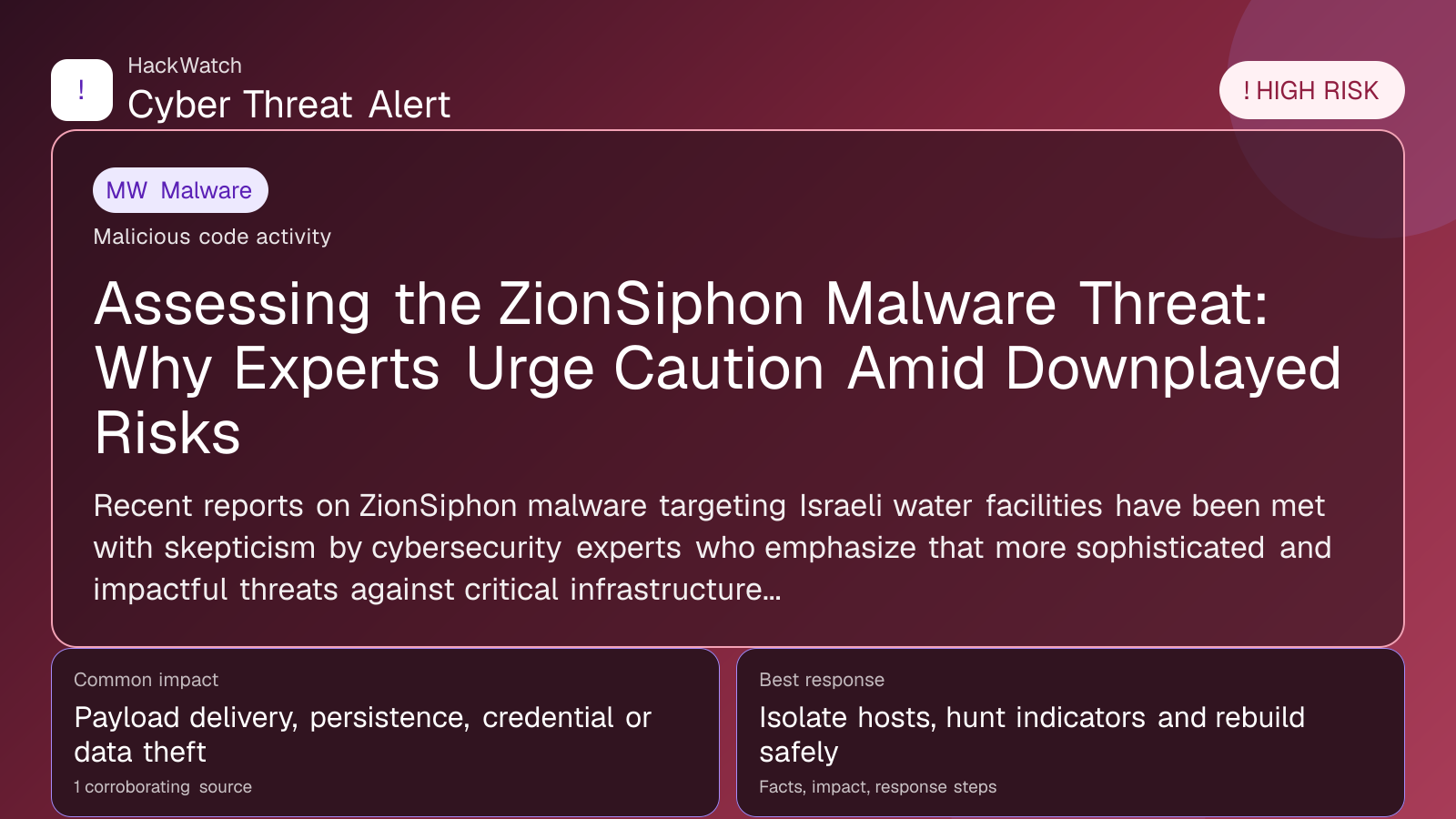
Assessing the ZionSiphon Malware Threat: Why Experts Urge Caution Amid Downplayed Risks
Malware coverage focused on infection paths, containment steps and indicators defenders should watch.

Published: Apr 24, 2026
Updated: May 01, 2026
Incident status: Mitigation available
Corroborating sources: 1
Technical review credentials: Security+ evidence | RHCSA evidence | JNCIS-SEC evidence
Trust note:This alert is maintained under HackWatch's editorial policy, with visible source records, a named responsible editor and a correction channel for disputed facts.
The published article is checked against public sources before publication, and material corrections are reflected in the article update date.
Technical reviewer note: Marcin Pocztowski reviewed this alert on May 01, 2026 for infrastructure impact, containment order and whether persistence or lateral-movement claims are supported by evidence. His administrator note is concrete: isolate the host or segment first, protect logs and network telemetry, then rebuild, rotate or patch only within the scope supported by the 1 corroborating source, the same cautious sequence he would use around managed router and server environments.
Review our editorial policy or send corrections to [email protected].
Mitigation available. Mitigation guidance or a workaround is available, but defenders should still verify rollout status and exposure.
Recent reports on ZionSiphon malware targeting Israeli water facilities have been met with skepticism by cybersecurity experts who emphasize that more sophisticated and impactful threats against critical infrastructure remain a greater concern. This HackWatch alert reviews documented reporting of the ZionSiphon malware incident, its implications, and actionable guidance for affected entities and individuals.
What happened
In recent cybersecurity news, ZionSiphon malware was reported to have targeted Israeli water treatment facilities, raising alarms about potential risks to critical infrastructure. However, cybersecurity experts, including Dragos technical lead malware analyst Jimmy Wylie, have downplayed the immediate threat posed by ZionSiphon compared to other ongoing intrusions by threat groups targeting critical infrastructure globally. This nuanced perspective comes amid increased scrutiny of cyberattacks on water systems, which are vital for public safety and national security.
Confirmed facts
- ZionSiphon malware was identified in intrusions involving Israeli water treatment facilities.
- The malware appears to be less sophisticated and less impactful compared to other known threats targeting critical infrastructure.
- Dragos malware analyst Jimmy Wylie publicly stated that threat groups conducting more advanced and persistent intrusions pose a higher risk than ZionSiphon.
- There is no confirmed evidence that ZionSiphon caused operational disruptions or safety incidents in the targeted water facilities.
- The incident has been reported by multiple cybersecurity news outlets, with corroboration from industry experts.
Who is affected
- Israeli water treatment facilities were the primary targets of the ZionSiphon malware.
- Broader critical infrastructure operators worldwide should remain vigilant, as the incident highlights ongoing targeting of water systems.
- Security teams managing industrial control systems (ICS) and operational technology (OT) environments in utilities and municipal services.
- Cybersecurity professionals and policy makers focusing on national infrastructure protection.
What to do now
- Conduct thorough forensic investigations to confirm whether ZionSiphon or related malware has infiltrated your systems.
- Review and update incident response plans specific to ICS and OT environments.
- Implement enhanced network segmentation between IT and OT networks to limit malware propagation.
- Increase monitoring of network traffic for unusual activity, especially in water treatment and other utility sectors.
- Engage with cybersecurity vendors specializing in ICS/OT security for tailored threat intelligence and mitigation strategies.
- Educate staff on phishing and social engineering tactics, as initial access vectors often involve compromised credentials or spear-phishing.
How to secure yourself
- Ensure all software and firmware on industrial control systems are up to date with the latest security patches.
- Use multi-factor authentication (MFA) for all remote and privileged access to control systems.
- Regularly audit user accounts and permissions to prevent unauthorized access.
- Deploy endpoint detection and response (EDR) tools capable of identifying unusual behaviors in OT environments.
- Establish strict access controls and logging to detect and respond to suspicious activities promptly.
- Participate in information sharing communities such as ISACs (Information Sharing and Analysis Centers) to stay informed about emerging threats.
FAQ
What is ZionSiphon malware?
ZionSiphon is a malware strain reported to have targeted Israeli water treatment facilities. It is considered less sophisticated compared to other malware targeting critical infrastructure.
Should I be worried if I work in water utilities outside Israel?
While ZionSiphon specifically targeted Israeli facilities, the incident highlights the broader risk to water utilities globally. Operators should maintain robust cybersecurity practices and monitor for similar threats.
How does ZionSiphon compare to other critical infrastructure malware?
Experts consider ZionSiphon less advanced and less impactful than other malware used by threat groups targeting critical infrastructure, such as Industroyer or Triton.
Has ZionSiphon caused any operational disruptions?
There is no confirmed evidence that ZionSiphon caused operational failures or safety incidents in the targeted facilities.
What initial attack vectors does ZionSiphon use?
While specific vectors are not fully disclosed, common methods include phishing, credential compromise, and exploiting network vulnerabilities.
How can organizations detect ZionSiphon infections?
Detection involves monitoring for unusual network traffic, anomalous system behaviors, and leveraging threat intelligence feeds focused on OT environments.
What regulations impact cybersecurity for water treatment facilities?
Regulations such as the U.S. EPA's Cybersecurity Preparedness Guide and NIST's Framework for Critical Infrastructure provide guidelines for securing water utilities.
How has the threat landscape changed since ZionSiphon?
Threat actors have increasingly targeted critical infrastructure with ransomware and supply chain attacks, prompting enhanced security measures worldwide.
Can individuals be affected by ZionSiphon?
ZionSiphon targets industrial systems rather than individual users; however, disruptions in water services could indirectly impact communities.
What role do cybersecurity vendors play in mitigating such threats?
Vendors provide specialized tools for ICS/OT security, threat intelligence, and incident response services tailored to critical infrastructure.
Why this matters
Water treatment facilities are essential for public health and safety, making them prime targets for cyberattacks. While ZionSiphon itself may not represent the most severe threat, its emergence underscores the persistent risk to critical infrastructure from nation-state and criminal threat actors. Understanding the nuances of such malware incidents helps prioritize security investments and policy decisions. Proactive defense, timely detection, and coordinated response are vital to safeguarding vital services from evolving cyber threats.
Sources and corroboration
This article synthesizes information from multiple cybersecurity news reports and expert commentary, including Dragos malware analyst Jimmy Wylie's assessments published on scmagazine.com and CyberScoop. The consolidated analysis reflects cross-verified facts to provide an authoritative overview of the ZionSiphon malware incident and its implications.
- https://www.scworld.com/brief/threat-of-zionsiphon-malware-downplayed
- https://www.cyberscoop.com/zionsiphon-malware-water-facilities-analysis
- Expert commentary from Dragos malware analysts
Sources used for this article
scmagazine.com