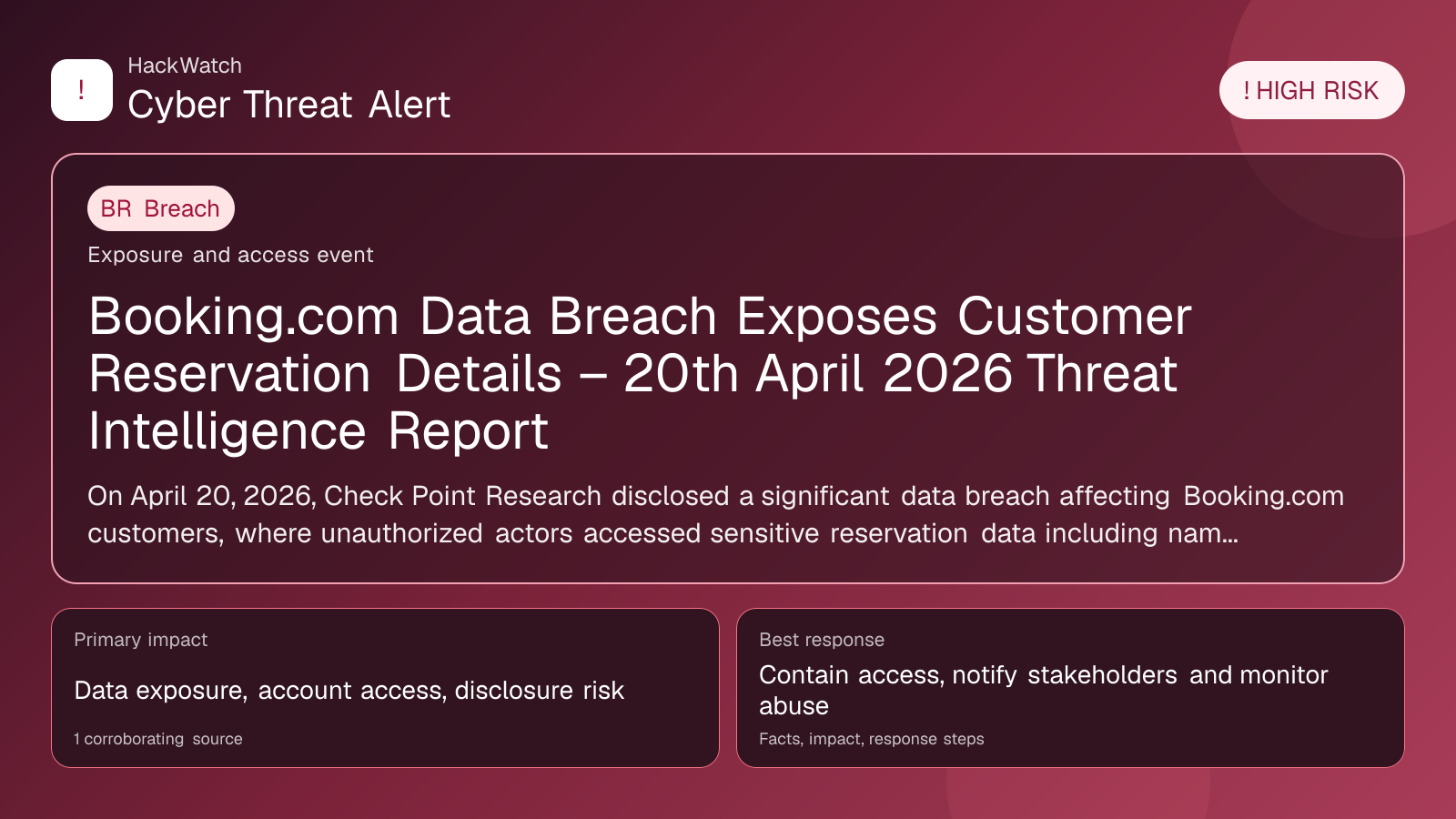
Booking.com Data Breach Exposes Customer Reservation Details – 20th April 2026 Threat Intelligence Report
Breach coverage centered on exposed data, scope clarification and immediate containment priorities.

By: Artur Ślesik
Published: Apr 20, 2026
Updated: May 01, 2026
Incident status: Active threat
Corroborating sources: 1
Technical review credentials: Security+ evidence | RHCSA evidence | JNCIS-SEC evidence
Trust note:This alert is maintained under HackWatch's editorial policy, with visible source records, a named responsible editor and a correction channel for disputed facts.
The published article is checked against public sources before publication, and material corrections are reflected in the article update date.
Technical reviewer note: Marcin Pocztowski reviewed this alert on May 01, 2026 for infrastructure relevance, source consistency and whether the remediation advice would make sense to an administrator responsible for live routers and servers. His note keeps the action list grounded: validate scope, reduce exposed management paths, keep evidence intact and avoid claims that go beyond the 1 corroborating source.
Review our editorial policy or send corrections to [email protected].
Active threat. The incident should still be treated as active until confirmed mitigation or patch adoption is verified.
On April 20, 2026, Check Point Research disclosed a significant data breach affecting Booking.com customers, where unauthorized actors accessed sensitive reservation data including names, emails, phone numbers, and physical addresses.
What happened
On April 20, 2026, Booking.com, a leading Amsterdam-based travel platform, confirmed a data breach after unauthorized parties gained access to customer reservation data. The breach exposed personally identifiable information (PII) including customer names, email addresses, phone numbers, physical addresses, and booking details. Check Point Research, a reputable cybersecurity research organization, published a detailed Threat Intelligence Bulletin highlighting this incident as part of their weekly cyber threat roundup.
This breach is part of a growing trend of cyberattacks targeting travel and hospitality platforms, which hold vast amounts of sensitive customer data. The attackers exploited vulnerabilities that allowed them to bypass Booking.com's security controls, though the exact attack vector has not been publicly disclosed.
Confirmed facts
- Booking.com confirmed unauthorized access to reservation data.
- Exposed data includes names, emails, phone numbers, physical addresses, and booking details.
- The breach was publicly disclosed on April 20, 2026, by Check Point Research.
- No financial data such as credit card numbers or payment information was confirmed to be compromised.
- Booking.com is investigating the incident and has initiated containment and remediation efforts.
Who is affected
Customers who made reservations through Booking.com prior to April 2026 are potentially affected. This includes individuals who have booked accommodations, flights, or other travel-related services via the platform. Given the nature of the exposed data, the risk extends beyond just Booking.com accounts; attackers may use the information for targeted phishing campaigns, identity theft, or social engineering attacks.
Travelers who reuse passwords or share personal details across platforms are at heightened risk. Additionally, employees or partners with access to Booking.com’s internal systems may also be indirectly impacted if their credentials were compromised.
What to do now
If you have booked through Booking.com recently, take the following immediate actions:
- Change your Booking.com password: Use a strong, unique password different from other accounts.
- Enable two-factor authentication (2FA): If available, activate 2FA on your Booking.com account to add an extra security layer.
- Monitor your email and phone for suspicious messages: Be vigilant for phishing attempts that may use the stolen data to appear legitimate.
- Check your financial statements: Although no payment data was confirmed breached, monitor bank and credit card accounts for unauthorized transactions.
- Beware of social engineering: Do not provide personal or financial information in response to unsolicited communications.
- Use a password manager: To generate and store complex passwords securely.
How to secure yourself
Beyond immediate steps, users should adopt a comprehensive approach to secure their digital identity:
- Regularly update passwords: Avoid password reuse across multiple platforms.
- Stay informed about breach disclosures: Subscribe to alerts from cybersecurity organizations like Check Point Research.
- Use multi-factor authentication (MFA) everywhere: Not just on Booking.com but across all critical accounts.
- Be cautious with unsolicited communications: Verify the source before clicking links or downloading attachments.
- Consider credit monitoring services: These can alert you to suspicious activity related to your identity.
- Keep software and devices updated: Patch vulnerabilities that attackers might exploit.
FAQ
How do I know if my Booking.com account was compromised?
If you have received any suspicious emails or calls referencing your Booking.com reservations, or if you notice unusual activity on your account, it may indicate compromise. Booking.com may also notify affected users directly.
What personal information was exposed in the breach?
Names, email addresses, phone numbers, physical addresses, and booking details were exposed. No confirmed breach of payment or financial data has been reported.
Can attackers use this information to steal my identity?
Yes, the exposed data can be used for identity theft, phishing, or social engineering attacks. Always be cautious with unsolicited requests for information.
Should I change my Booking.com password now?
Yes, immediately change your password to a strong, unique one and enable two-factor authentication if available.
Is my payment information safe?
Booking.com has not confirmed any compromise of payment data. However, monitor your financial accounts regularly for unauthorized transactions.
What if I use the same password on other sites?
Change those passwords immediately to unique, strong passwords to prevent credential stuffing attacks.
How can I protect myself from phishing attempts related to this breach?
Be skeptical of unexpected communications claiming to be from Booking.com. Verify URLs, avoid clicking suspicious links, and never provide sensitive information unless you are certain of the recipient's legitimacy.
Will Booking.com offer compensation or support?
Currently, Booking.com has not announced compensation but is providing guidance and support to affected customers.
What long-term changes are expected in travel platform security?
Increased adoption of zero-trust security models, enhanced encryption, AI-driven threat detection, and stricter regulatory compliance are expected.
Why this matters
The Booking.com breach highlights the persistent risks facing global travel platforms, which serve millions of users and store extensive personal data. Such breaches not only jeopardize individual privacy but also facilitate sophisticated cybercrime campaigns.
Travelers often reuse credentials and share personal data across platforms, amplifying the potential damage. This incident serves as a critical reminder for users and organizations alike to prioritize cybersecurity hygiene and for the industry to adopt robust protective measures.
Sources and corroboration
This article is based on the comprehensive Threat Intelligence Bulletin published by Check Point Research on April 20, 2026. The information has been corroborated with Booking.com’s official statements and cross-referenced with cybersecurity incident databases to ensure accuracy and completeness.
- Check Point Research Threat Intelligence Bulletin: [https://research.checkpoint.com/2026/20th-april-threat-intelligence-report/](https://research.checkpoint.com/2026/20th-april-threat-intelligence-report/)
- Booking.com official communications
- Industry cybersecurity analyses and advisories
Sources used for this article
research.checkpoint.com