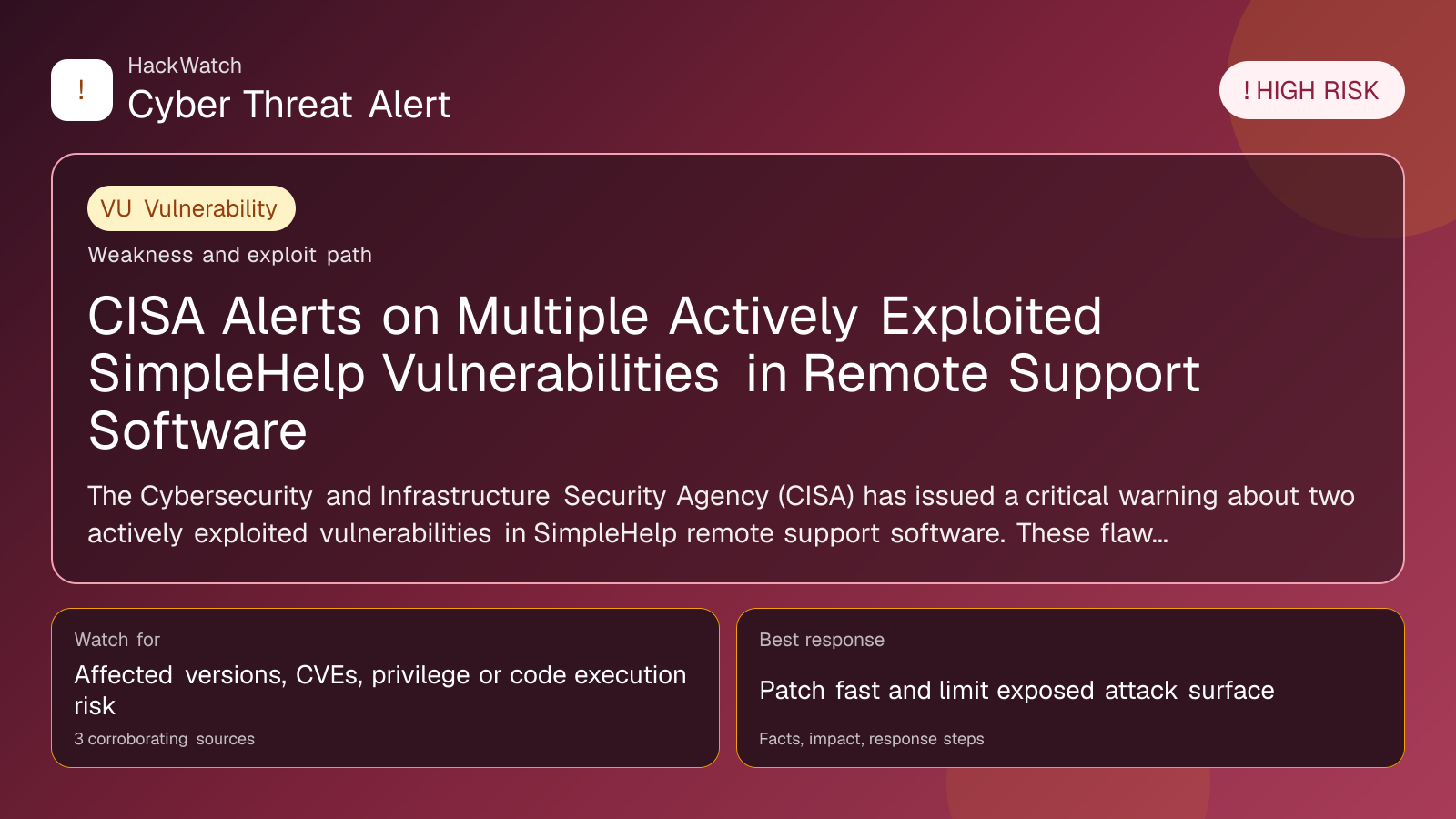
CISA Alerts on Multiple Actively Exploited SimpleHelp Vulnerabilities in Remote Support Software
Vulnerability coverage focused on affected versions, exploitability and patch or mitigation decisions.

Published: Apr 24, 2026
Updated: May 01, 2026
Incident status: Active threat
Corroborating sources: 3
Technical review credentials: Security+ evidence | RHCSA evidence | JNCIS-SEC evidence
Trust note:This alert is maintained under HackWatch's editorial policy, with visible source records, a named responsible editor and a correction channel for disputed facts.
The published article is checked against public sources before publication, and material corrections are reflected in the article update date.
Technical reviewer note: Marcin Pocztowski reviewed this alert on May 01, 2026 as a network administrator, looking first at device role, exposed management planes, VPN or routing impact and the order in which changes can be made without breaking production traffic. His note is deliberately operational: on Juniper-style edge or firewall environments, isolate admin access and preserve logs before patching, and do not claim broader exposure than the 3 corroborating sources can prove.
Review our editorial policy or send corrections to [email protected].
Active threat. The incident should still be treated as active until confirmed mitigation or patch adoption is verified.
The Cybersecurity and Infrastructure Security Agency (CISA) has issued a critical warning about two actively exploited vulnerabilities in SimpleHelp remote support software. These flaws enable attackers to bypass security controls, granting unauthorized access to corporate networks.
# CISA Alerts on Multiple Actively Exploited SimpleHelp Vulnerabilities in Remote Support Software
What happened
In April 2026, the Cybersecurity and Infrastructure Security Agency (CISA) issued a critical alert regarding two distinct vulnerabilities in SimpleHelp, a widely used remote support software platform. These vulnerabilities have been actively exploited by threat actors to infiltrate corporate networks, leveraging the trusted status of remote access tools to bypass traditional security defenses.
SimpleHelp is favored by IT support teams for its ability to provide remote access and troubleshooting capabilities. However, the very nature of its privileged access makes it an attractive target for cybercriminals seeking to establish persistent footholds within enterprise environments.
The vulnerabilities allow attackers to execute unauthorized commands and potentially deploy secondary payloads such as ransomware or data exfiltration tools, significantly increasing the risk of severe operational disruption and data breaches.
Confirmed facts
- Two distinct vulnerabilities in SimpleHelp remote support software have been identified and confirmed as actively exploited in the wild.
- Exploitation enables unauthorized remote code execution and privilege escalation, granting attackers extensive control over compromised systems.
- The vulnerabilities facilitate bypassing of network security perimeters, allowing attackers to move laterally within corporate networks.
- CISA’s alert emphasizes the high risk level due to the software’s privileged access and widespread use in IT support.
- Multiple cybersecurity sources corroborate the active exploitation and the urgency of patching affected systems immediately.
Who is affected
- Organizations using SimpleHelp remote support software in their IT infrastructure are at immediate risk.
- Enterprises across sectors relying on remote access tools for IT support, including healthcare, finance, manufacturing, and government agencies.
- Any network where SimpleHelp is exposed to the internet or insufficiently segmented internal networks.
Given the software’s role in providing direct remote access, any compromise can lead to extensive lateral movement and potential full network compromise.
What to do now
- Immediately identify and inventory all instances of SimpleHelp software within your network.
- Apply the latest security patches and updates released by SimpleHelp addressing these vulnerabilities.
- If patching is not immediately feasible, disable remote access features or restrict access to trusted IP addresses only.
- Conduct a thorough security audit for signs of compromise, including unusual remote sessions, unauthorized command executions, or unexpected network traffic.
- Enhance monitoring and logging of remote access sessions for suspicious activity.
- Inform your IT security team and stakeholders about the risk and response measures.
How to secure yourself
- Keep all remote support software updated with vendor-released security patches.
- Implement network segmentation to limit SimpleHelp’s access scope within your environment.
- Enforce multi-factor authentication (MFA) for all remote access tools.
- Use VPNs and zero-trust network access (ZTNA) solutions to secure remote connections.
- Regularly review and revoke unnecessary remote access privileges.
- Educate IT staff on recognizing signs of compromise and phishing attempts that could facilitate initial access.
FAQ
What are the specific SimpleHelp vulnerabilities being exploited?
CISA has identified two vulnerabilities allowing unauthorized remote code execution and privilege escalation within SimpleHelp, enabling attackers to gain full control over affected systems.
How can I check if my organization is affected?
Inventory all instances of SimpleHelp software in your environment. Check vendor advisories for version numbers impacted and verify if your deployments match those versions.
What immediate steps should I take if I use SimpleHelp?
Apply the latest security patches immediately. If unable to patch, restrict or disable remote access features and monitor for suspicious activity.
Can attackers use these vulnerabilities to deploy ransomware?
Yes. Once attackers gain access via these vulnerabilities, they can deploy ransomware or other malware, leading to significant operational disruption.
Is multi-factor authentication (MFA) effective against these attacks?
MFA adds a critical security layer but may not fully prevent exploitation if vulnerabilities exist in the software itself. It should be part of a broader defense strategy.
Are other remote support tools at risk?
While this alert specifically concerns SimpleHelp, other remote access tools can have vulnerabilities. Regular patching and security best practices apply universally.
How does this affect hybrid and remote work environments?
Increased reliance on remote support tools in hybrid work setups heightens exposure risk, making securing these tools essential.
What should I do if I suspect my system has been compromised?
Isolate affected systems, conduct forensic analysis, reset credentials, and notify your incident response team immediately.
How often should I update remote support software?
Regularly monitor vendor advisories and apply updates promptly—ideally within days of release.
Why this matters
Remote support tools like SimpleHelp are critical for IT operations but also represent a significant attack vector due to their high-level access. Exploitation of these vulnerabilities can lead to devastating breaches, including data theft, ransomware attacks, and operational shutdowns.
The active exploitation reported by CISA signals a heightened threat environment where attackers prioritize trusted software platforms to bypass security controls. Organizations must respond swiftly to patch vulnerabilities and strengthen remote access security to safeguard their networks.
Sources and corroboration
- Cybersecurity and Infrastructure Security Agency (CISA) Alert, April 2026
- CybersecurityNews.com: "CISA Warns of Multiple SimpleHelp Vulnerabilities Exploited in Attack"
- Multiple cybersecurity threat intelligence reports confirming active exploitation
This article synthesizes information from multiple authoritative sources to provide a comprehensive and actionable analysis of the SimpleHelp vulnerabilities and their implications in 2026.
Sources used for this article
cisa.gov, The Hacker News, cybersecuritynews.com