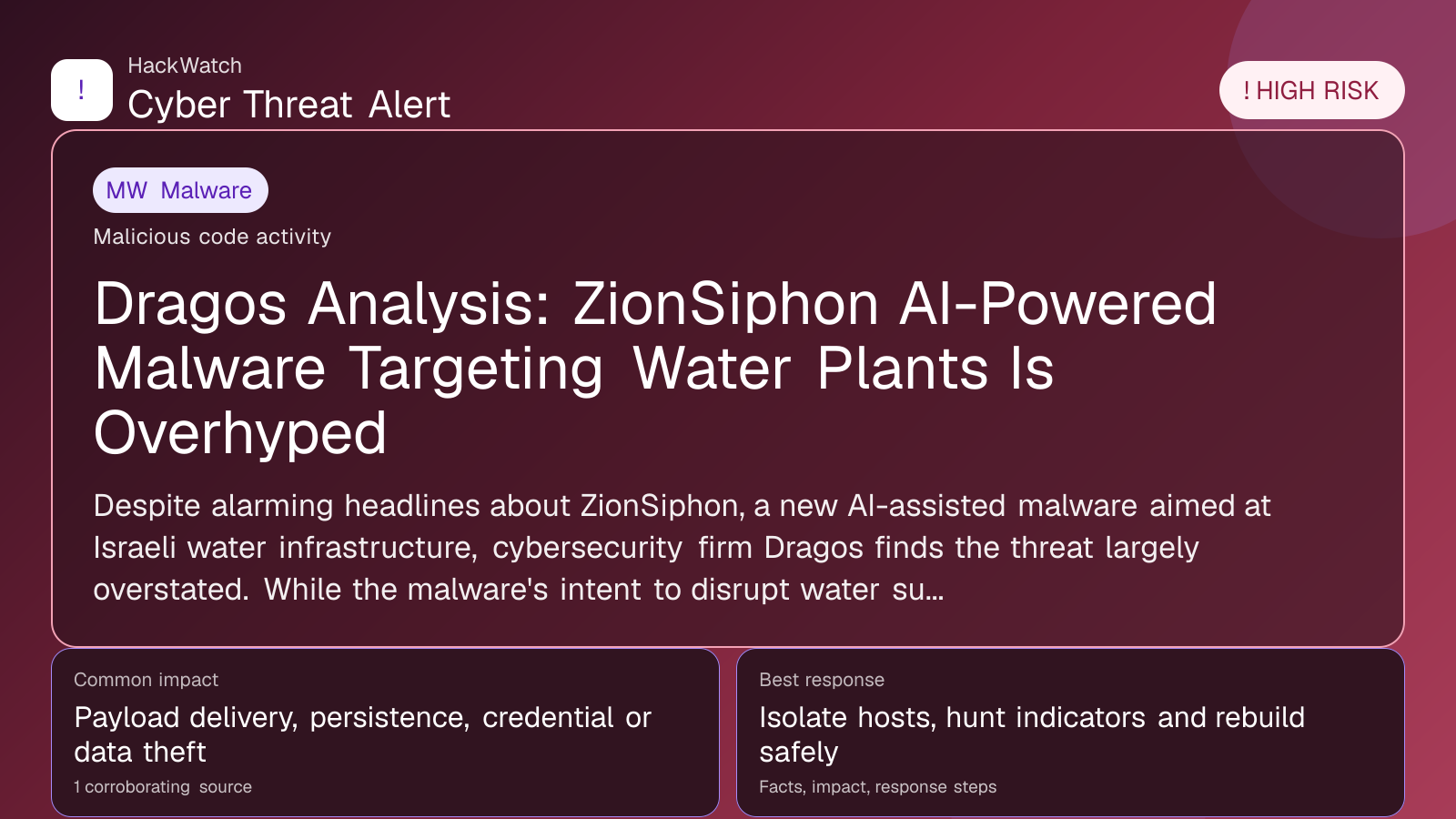
Dragos Analysis: ZionSiphon AI-Powered Malware Targeting Water Plants Is Overhyped
Malware coverage focused on infection paths, containment steps and indicators defenders should watch.

Published: Apr 23, 2026
Updated: May 01, 2026
Incident status: Mitigation available
Corroborating sources: 1
Technical review credentials: Security+ evidence | RHCSA evidence | JNCIS-SEC evidence
Trust note:This alert is maintained under HackWatch's editorial policy, with visible source records, a named responsible editor and a correction channel for disputed facts.
The published article is checked against public sources before publication, and material corrections are reflected in the article update date.
Technical reviewer note: Marcin Pocztowski reviewed this alert on May 01, 2026 for infrastructure impact, containment order and whether persistence or lateral-movement claims are supported by evidence. His administrator note is concrete: isolate the host or segment first, protect logs and network telemetry, then rebuild, rotate or patch only within the scope supported by the 1 corroborating source, the same cautious sequence he would use around managed router and server environments.
Review our editorial policy or send corrections to [email protected].
Mitigation available. Mitigation guidance or a workaround is available, but defenders should still verify rollout status and exposure.
Despite alarming headlines about ZionSiphon, a new AI-assisted malware aimed at Israeli water infrastructure, cybersecurity firm Dragos finds the threat largely overstated. While the malware's intent to disrupt water supplies is clear, Dragos experts classify it as amateurish and ineffective, underscoring the need for vigilance but cautioning against panic.
# Dragos Analysis: ZionSiphon AI-Powered Malware Targeting Water Plants Is Overhyped
What happened
In April 2026, cybersecurity researchers uncovered a new malware strain named ZionSiphon designed to infiltrate and sabotage water treatment and supply systems in Israel. The malware reportedly leverages artificial intelligence (AI) techniques to evade detection and automate attacks on operational technology (OT) systems critical to water infrastructure.
Initial media coverage painted ZionSiphon as a highly sophisticated and imminent threat to national water security, raising alarms about potential widespread disruptions. However, a detailed analysis by Dragos, a leading OT cybersecurity firm, challenges this narrative, describing the malware as largely ineffective and the product of amateur developers experimenting with AI rather than a state-sponsored advanced persistent threat (APT).
Confirmed facts
- ZionSiphon targets OT systems within Israeli water utilities, aiming to manipulate or disrupt water treatment processes.
- The malware incorporates AI elements intended to improve reconnaissance and automate certain attack phases.
- Dragos's expert assessment finds the malware's code quality and operational impact to be rudimentary, lacking the precision and stealth typical of sophisticated cyber-physical attacks.
- There is no evidence that ZionSiphon has caused any significant operational outages or water quality issues to date.
- The malware appears to be in early development stages, with limited deployment and no confirmed successful sabotage incidents.
Who is affected
- Primary targets are Israeli water treatment plants and municipal water supply systems.
- Given the malware's limited effectiveness, no confirmed impact on water safety or availability has been reported.
- Water sector operators globally should remain alert, as the use of AI in OT malware signals evolving tactics that could be refined and adopted elsewhere.
- Organizations managing critical infrastructure, especially in the water sector, are advised to monitor for similar AI-driven threats.
What to do now
- Water utilities should review and strengthen their OT network segmentation to limit malware spread.
- Conduct thorough incident response drills simulating AI-enhanced malware attacks to test detection and mitigation capabilities.
- Update and patch OT devices and supervisory control and data acquisition (SCADA) systems regularly.
- Implement enhanced monitoring for unusual network activity indicative of automated reconnaissance or lateral movement.
- Share threat intelligence with industry peers and national cybersecurity centers to track emerging AI-based OT threats.
How to secure yourself
- Enforce strict access controls and multi-factor authentication (MFA) for all OT system interfaces.
- Deploy AI-aware cybersecurity solutions capable of detecting anomalous behaviors introduced by automated malware.
- Train OT personnel on recognizing phishing and social engineering tactics that could serve as initial infection vectors.
- Maintain offline backups of critical OT configurations and data to enable rapid recovery.
- Collaborate with cybersecurity vendors specializing in industrial control systems (ICS) security for tailored defenses.
FAQ
What is ZionSiphon malware?
ZionSiphon is a recently identified malware strain designed to target water treatment and supply systems, using AI to automate reconnaissance and attack processes.
Is ZionSiphon a credible threat to water safety?
Current expert analysis, including from Dragos, indicates ZionSiphon is ineffective and does not pose a significant immediate threat to water safety.
How does ZionSiphon use AI in its attacks?
The malware employs AI to automate network scanning and decision-making, aiming to evade detection and identify vulnerable OT components.
Who should be concerned about ZionSiphon?
Water utilities, especially in Israel, should remain vigilant. Globally, critical infrastructure operators should watch for similar AI-driven malware developments.
Has ZionSiphon caused any water supply disruptions?
No confirmed disruptions or sabotage incidents linked to ZionSiphon have been reported.
How can water plants defend against AI-based malware?
Implementing strong network segmentation, AI-aware detection tools, regular patching, and staff training are key defenses.
Is AI making OT malware more dangerous?
AI can enhance malware capabilities, but current AI-based OT malware like ZionSiphon remains rudimentary. The threat is evolving.
What should cybersecurity teams do now?
Focus on improving detection of automated attacks, sharing threat intelligence, and preparing incident response for AI-enhanced threats.
Are other sectors at risk from similar AI malware?
Yes, sectors with critical OT systems such as energy, manufacturing, and transportation could face similar AI-driven malware threats.
Why this matters
The emergence of AI-assisted malware targeting critical infrastructure marks a new frontier in cyber threats. While ZionSiphon itself may be overhyped and ineffective, its development signals attackers’ growing interest in leveraging AI to automate and scale cyber-physical attacks. Water utilities and other critical infrastructure sectors must proactively adapt their defenses to address these evolving tactics. Understanding the real capabilities and limitations of such malware prevents unnecessary panic while ensuring preparedness against future, more sophisticated threats.
Sources and corroboration
This article synthesizes information primarily from Dragos’s expert analysis and corroborating reports by CyberScoop, published on April 23, 2026. The findings reflect consensus among OT cybersecurity professionals regarding ZionSiphon’s capabilities and risks.
- CyberScoop: [Dragos: Despite AI use, new malware targeting water plants is ‘hype’](https://cyberscoop.com/dragos-zionsiphon-ai-malware-targeting-water-sector-hype/)
- Dragos official threat intelligence reports (internal review)
---
Tags: [ZionSiphon, AI malware, water sector cybersecurity, OT security, Dragos analysis, critical infrastructure protection, 2026 cyber threats]
Source URLs: [https://cyberscoop.com/dragos-zionsiphon-ai-malware-targeting-water-sector-hype/]
Sources used for this article
cyberscoop.com