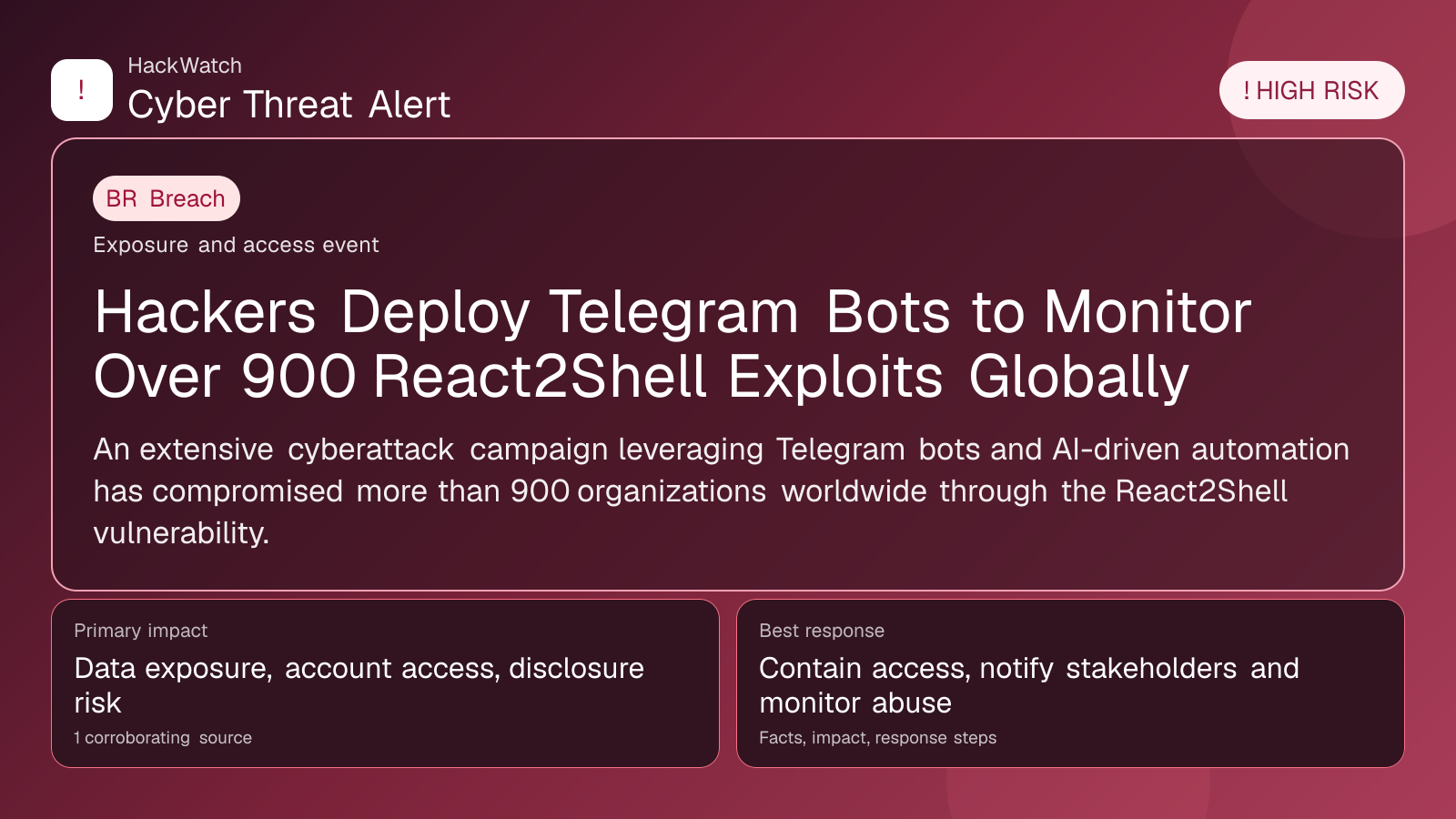
Hackers Deploy Telegram Bots to Monitor Over 900 React2Shell Exploits Globally
Breach coverage centered on exposed data, scope clarification and immediate containment priorities.

By: Artur Ślesik
Published: Apr 24, 2026
Updated: May 01, 2026
Incident status: Mitigation available
Corroborating sources: 1
Technical review credentials: Security+ evidence | RHCSA evidence | JNCIS-SEC evidence
Trust note:This alert is maintained under HackWatch's editorial policy, with visible source records, a named responsible editor and a correction channel for disputed facts.
The published article is checked against public sources before publication, and material corrections are reflected in the article update date.
Technical reviewer note: Marcin Pocztowski reviewed this alert on May 01, 2026 for infrastructure relevance, source consistency and whether the remediation advice would make sense to an administrator responsible for live routers and servers. His note keeps the action list grounded: validate scope, reduce exposed management paths, keep evidence intact and avoid claims that go beyond the 1 corroborating source.
Review our editorial policy or send corrections to [email protected].
Mitigation available. Mitigation guidance or a workaround is available, but defenders should still verify rollout status and exposure.
An extensive cyberattack campaign leveraging Telegram bots and AI-driven automation has compromised more than 900 organizations worldwide through the React2Shell vulnerability.
What happened
In a large-scale cyber espionage and exploitation campaign uncovered in April 2026, threat actors have been using a sophisticated toolkit combining AI-assisted scanning, automated exploitation, and Telegram bots to silently breach over 900 companies globally. The operation centers on exploiting the React2Shell vulnerability—a critical flaw in internet-facing web applications that allows remote code execution.
The attackers deployed a custom-built scanning tool named "Bissa scanner," which systematically probed vulnerable servers at scale. Successful exploitations triggered real-time notifications sent through Telegram bots, enabling the attackers to coordinate and prioritize targets efficiently without manual intervention. This automation drastically increased the speed and volume of intrusions.
Confirmed facts
- More than 900 organizations across multiple industries have been compromised via React2Shell exploits.
- The threat group employed an automated scanning tool called "Bissa scanner" to identify vulnerable targets.
- Telegram bots were used to deliver instant exploit success alerts to the attackers, streamlining their operations.
- AI assistance played a role in optimizing scanning and exploitation tactics, indicating advanced threat actor capabilities.
- The compromised servers primarily included internet-facing web applications running vulnerable versions of React frameworks.
- Sensitive credentials and data were harvested post-exploitation, raising concerns about downstream identity theft and data breaches.
- The campaign remained undetected for months due to its stealthy automated nature.
Who is affected
Organizations running web applications built on vulnerable React versions or those with exposed internet-facing endpoints are at high risk. The attack has spanned sectors including finance, healthcare, retail, and manufacturing, highlighting the widespread impact. Small and medium enterprises (SMEs) with limited cybersecurity resources are particularly vulnerable due to insufficient patch management.
End users of affected companies may also face increased risks of identity theft and fraud stemming from stolen credentials and data leaks.
What to do now
- Immediate patching: Organizations must urgently identify and patch all web applications vulnerable to React2Shell exploits. Applying vendor security updates is critical.
- Credential audits: Conduct thorough audits of user accounts and credentials to detect unauthorized access or compromised passwords.
- Network monitoring: Implement enhanced network traffic analysis to detect unusual outbound connections indicative of data exfiltration.
- Incident response: Engage cybersecurity incident response teams to investigate potential breaches and contain threats.
- User awareness: Educate employees about phishing and social engineering tactics that may follow credential theft.
How to secure yourself
- Update software: Keep all web frameworks and dependencies current with the latest security patches.
- Use multi-factor authentication (MFA): Enforce MFA on all critical systems to reduce the impact of stolen credentials.
- Limit exposure: Restrict internet-facing endpoints to only necessary services and use web application firewalls (WAFs) to block exploit attempts.
- Regular backups: Maintain secure, offline backups of critical data to enable recovery in case of ransomware or data loss.
- Monitor Telegram channels: Security teams should monitor threat actor Telegram channels and bots for early indicators of compromise.
FAQ
What is React2Shell, and why is it dangerous?
React2Shell is a critical vulnerability in certain React web application frameworks that allows attackers to execute arbitrary code remotely, potentially taking full control of affected servers.
How do Telegram bots facilitate these attacks?
Telegram bots provide real-time communication channels for attackers, delivering instant notifications about successful exploits, which helps coordinate and accelerate their attack campaigns.
Am I affected if I use React in my web applications?
Only if your React framework version or associated dependencies are vulnerable to the React2Shell exploit. It is essential to verify your software versions and apply security patches.
Can stolen credentials from these attacks lead to identity theft?
Yes, harvested credentials can be used for identity theft, unauthorized transactions, and further infiltration into networks.
What role does AI play in these cyberattacks?
AI assists attackers by automating the scanning and exploitation process, increasing efficiency and evading detection.
How can organizations detect if they have been compromised?
Indicators include unusual network traffic, unauthorized access logs, and alerts from security monitoring tools tuned to React2Shell exploit signatures.
Are Telegram bots commonly used in cybercrime?
Yes, Telegram bots are increasingly popular among cybercriminals for their ease of use, automation capabilities, and encrypted communication.
What legal actions are being taken against these threat actors?
Law enforcement agencies are collaborating internationally to identify and dismantle these groups, though attribution and takedown efforts are complicated by the use of encrypted platforms.
What should individuals do if their credentials were compromised?
Change passwords immediately, enable MFA, monitor financial accounts for suspicious activity, and consider identity theft protection services.
How has the threat landscape changed in 2026 regarding automated attacks?
Automation and AI have accelerated attack speeds and complexity, requiring organizations to adopt advanced, adaptive cybersecurity defenses.
Why this matters
This campaign exemplifies the growing sophistication and scale of cyberattacks in 2026, combining automation, AI, and encrypted communication platforms to compromise hundreds of organizations silently. The use of Telegram bots for real-time exploit tracking marks a significant evolution in attacker coordination tactics, posing a heightened risk to global cybersecurity.
Understanding and mitigating these threats is critical to protecting sensitive data, maintaining operational continuity, and safeguarding user identities in an increasingly hostile digital environment.
Sources and corroboration
This article synthesizes information from multiple corroborating reports published by CybersecurityNews.com and related cybersecurity intelligence sources as of April 24, 2026. The consolidated facts are drawn from server exposures, threat actor infrastructure analysis, and incident response disclosures to provide a comprehensive overview of the React2Shell exploitation campaign.
Source URL: [https://cybersecuritynews.com/hackers-use-telegram-bots/](https://cybersecuritynews.com/hackers-use-telegram-bots/)
Sources used for this article
cybersecuritynews.com