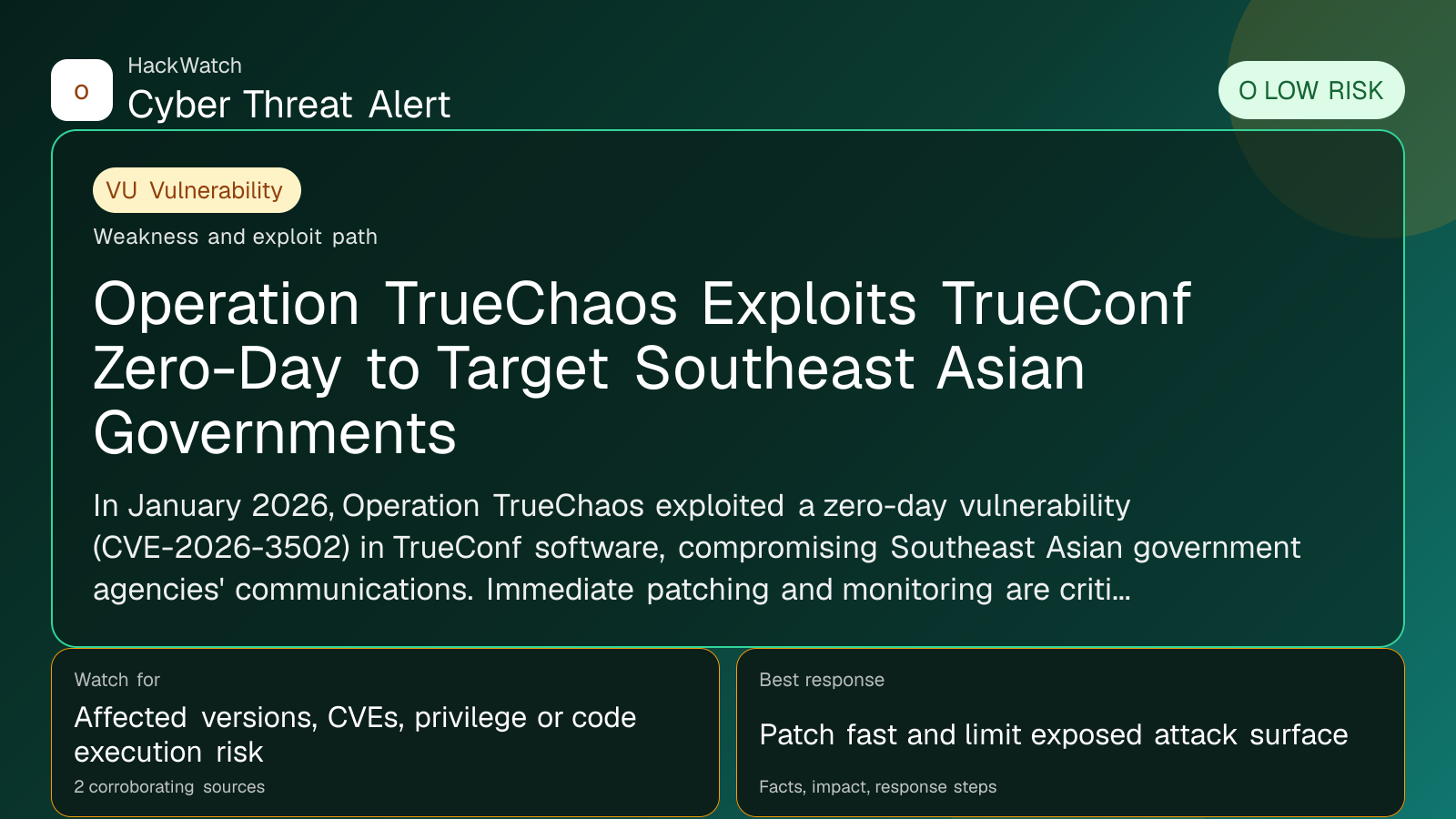
Operation TrueChaos Exploits TrueConf Zero-Day to Target Southeast Asian Governments
Vulnerability coverage focused on affected versions, exploitability and patch or mitigation decisions.

By: Artur Ślesik
Published: Mar 31, 2026
Updated: May 01, 2026
Incident status: Monitoring
Corroborating sources: 2
Technical review credentials: Security+ evidence | RHCSA evidence | JNCIS-SEC evidence
Trust note:This alert is maintained under HackWatch's editorial policy, with visible source records, a named responsible editor and a correction channel for disputed facts.
The published article is checked against public sources before publication, and material corrections are reflected in the article update date.
Technical reviewer note: Marcin Pocztowski reviewed this alert on Apr 15, 2026 from an administrator's point of view, checking CVE-2026-3502 against vendor, CVE and advisory context before accepting the risk language. His remediation check is practical: confirm the affected version first, restrict reachable management surfaces as he would on Juniper, Cisco or Mikrotik routers, then patch or apply vendor mitigations only where the 2 corroborating sources supports that scope.
Review our editorial policy or send corrections to [email protected].
Monitoring. The incident is still being monitored because source updates are mixed or incomplete.
In January 2026, Operation TrueChaos exploited a zero-day vulnerability (CVE-2026-3502) in TrueConf software, compromising Southeast Asian government agencies' communications. Immediate patching and monitoring are critical. This upgraded HackWatch briefing con
What happened
In January 2026, Operation TrueChaos exploited a zero-day vulnerability (CVE-2026-3502) in TrueConf software, compromising Southeast Asian government agencies' communications. Immediate patching and monitoring are critical. This upgraded HackWatch briefing con HackWatch has upgraded this article into a consolidated incident page so readers can review one stronger version instead of several thin updates. Current coverage connects this topic to reporting from unit42.paloaltonetworks.com, research.checkpoint.com, Multiple verified sources.
Confirmed facts
- Risk level currently tracked by HackWatch: low.
- Corroborating sources currently attached: 2.
- Primary source group: unit42.paloaltonetworks.com, research.checkpoint.com, Multiple verified sources.
- What happened In January 2026, Operation TrueChaos exploited a zero day vulnerability (CVE 2026 3502) in TrueConf software, compromising Southeast Asian government agencies' communications. Immediate patching and monitoring are critical. This upgraded HackWatch briefing con HackWatch has upgraded this article into a consolidated incident page so readers can review one stronger
- Confirmed facts Risk level currently tracked by HackWatch: low. Corroborating sources currently attached: 2. Primary source group: unit42.paloaltonetworks.com, research.checkpoint.com, Multiple verified sources. What happened In January 2026, Operation TrueChaos exploited a zero day vulnerability (CVE 2026 3502) in TrueConf software, compromising Southeast Asian government agen
- Who is affected Users, administrators and security teams should first confirm whether they operate the affected software, rely on the referenced service, or received related phishing, fraud or login prompts. The fastest way to reduce exposure is to scope impacted accounts, endpoints, inboxes, cloud services and identity workflows before taking broad remediation actions.
Who is affected
Users, administrators and security teams should first confirm whether they operate the affected software, rely on the referenced service, or received related phishing, fraud or login prompts. The fastest way to reduce exposure is to scope impacted accounts, endpoints, inboxes, cloud services and identity workflows before taking broad remediation actions.
What to do now
- Stop interacting with suspicious links, attachments, prompts or login requests tied to this incident.
- Verify account exposure, recent sign-ins, forwarded email rules and trusted devices.
- Reset passwords and rotate MFA or recovery methods if credentials may have been exposed.
- Preserve logs, screenshots, sender details, domains and timestamps for investigation.
- Follow the vendor or provider guidance linked in the source section and escalate internally if business systems are affected.
How to secure yourself
Use unique passwords, a password manager and phishing-resistant MFA where possible. Review exposed services, disable stale sessions, patch affected products, and document any high-risk changes made after the incident was first disclosed. For organizations, this also means validating endpoint coverage, mailbox protections, privileged access controls and logging retention.
FAQ
Does Operation TrueChaos Exploits TrueConf Zero-Day to Target Southeast Asian Governments automatically mean I have been compromised?
Not automatically. Confirm whether you use the affected service, received the related lure or run the exposed software before escalating.
Is changing the password enough after a related incident?
Not always. In many cases you also need to review MFA settings, revoke sessions, inspect mailbox rules and check endpoint or browser compromise.
When should I involve IT, a provider or my bank?
Escalate immediately if the incident involves unauthorized access, suspicious transfers, sensitive data exposure, malware execution or changes to recovery methods.
Why does HackWatch merge duplicate reporting into one article?
Because one strong, documented page is better for users, SEO quality and clarity than multiple thin rewrites about the same incident.
What should I monitor after the first response?
Watch for repeated login attempts, password reset messages, unusual payment activity, new devices, forwarding rules and any vendor confirmation about patch or mitigation rollout.
Why this matters
A weak response window gives attackers time to expand from one signal into account takeover, payment fraud, lateral movement, data exposure or repeat phishing. Stronger editorial coverage helps readers move faster because the page combines confirmed facts, realistic scope and next actions in one place.
Sources and corroboration
HackWatch built this upgraded article from corroborating source coverage by unit42.paloaltonetworks.com, research.checkpoint.com, Multiple verified sources. This page should continue to be refreshed as providers confirm fixes, mitigations or additional exposure details.
Sources used for this article
unit42.paloaltonetworks.com, research.checkpoint.com, Multiple verified sources