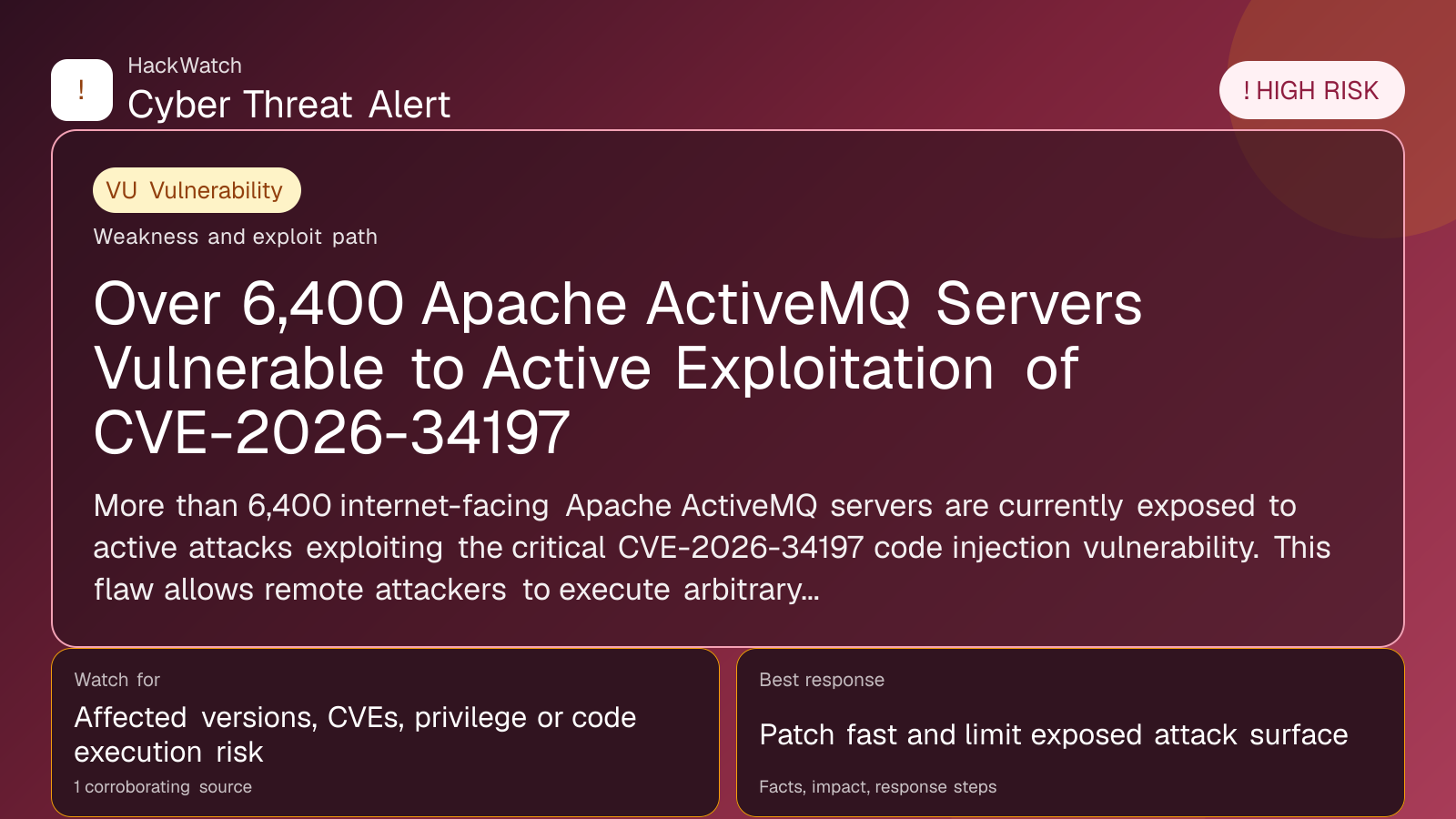
Over 6,400 Apache ActiveMQ Servers Vulnerable to Active Exploitation of CVE-2026-34197
Vulnerability coverage focused on affected versions, exploitability and patch or mitigation decisions.

Published: Apr 22, 2026
Updated: May 01, 2026
Incident status: Active threat
Corroborating sources: 1
Technical review credentials: Security+ evidence | RHCSA evidence | JNCIS-SEC evidence
Trust note:This alert is maintained under HackWatch's editorial policy, with visible source records, a named responsible editor and a correction channel for disputed facts.
The published article is checked against public sources before publication, and material corrections are reflected in the article update date.
Technical reviewer note: Marcin Pocztowski reviewed this alert on May 01, 2026 from an administrator's point of view, checking CVE-2026-34197 against vendor, CVE and advisory context before accepting the risk language. His remediation check is practical: confirm the affected version first, restrict reachable management surfaces as he would on Juniper, Cisco or Mikrotik routers, then patch or apply vendor mitigations only where the 1 corroborating source supports that scope.
Review our editorial policy or send corrections to [email protected].
Active threat. The incident should still be treated as active until confirmed mitigation or patch adoption is verified.
More than 6,400 internet-facing Apache ActiveMQ servers are currently exposed to active attacks exploiting the critical CVE-2026-34197 code injection vulnerability. This flaw allows remote attackers to execute arbitrary code, risking full system compromise. This HackWatch alert reviews documented reporting of the threat, affected parties, and actionable mitigation steps.
# Over 6,400 Apache ActiveMQ Servers Vulnerable to Active Exploitation of CVE-2026-34197
What happened
Security researchers and incident responders have identified active exploitation campaigns targeting Apache ActiveMQ servers worldwide. The attacks leverage a high-severity code injection vulnerability tracked as CVE-2026-34197. This flaw affects the widely used open-source Java-based message broker, Apache ActiveMQ, which facilitates asynchronous communication in distributed systems.
According to reports from BleepingComputer and corroborated by other cybersecurity sources, over 6,476 internet-exposed ActiveMQ instances remain vulnerable. Attackers exploit this weakness to inject malicious code remotely, enabling them to execute arbitrary commands on compromised servers. These intrusions pose a significant risk of system takeover, data theft, lateral movement, and deployment of additional malware or ransomware.
Confirmed facts
- CVE-2026-34197 is a critical code injection vulnerability in Apache ActiveMQ.
- The flaw allows unauthenticated remote attackers to execute arbitrary code.
- Over 6,400 ActiveMQ servers exposed to the internet remain unpatched and vulnerable.
- Active exploitation campaigns are ongoing, targeting these vulnerable instances.
- The vulnerability affects multiple versions of Apache ActiveMQ, primarily those prior to the patched releases.
- Attackers have used this exploit to gain full control over affected servers, leading to potential data breaches and further network compromise.
Who is affected
Organizations and individuals running Apache ActiveMQ servers accessible from the internet are at risk. This includes enterprises relying on ActiveMQ for message brokering in their middleware, cloud environments, and IoT infrastructures. Due to the open-source nature and widespread adoption of ActiveMQ, the affected user base spans multiple industries, including finance, healthcare, manufacturing, and technology.
Servers that have not applied security patches released after the vulnerability disclosure remain vulnerable. Additionally, misconfigured ActiveMQ instances exposing management consoles or JMX interfaces without adequate authentication increase the risk surface.
What to do now
- Identify Vulnerable Instances: Use network scanning tools or services to detect exposed ActiveMQ servers within your environment or network perimeter.
- Apply Patches Immediately: Upgrade Apache ActiveMQ to the latest version that addresses CVE-2026-34197. The Apache Software Foundation has released security updates—implement them without delay.
- Restrict Network Exposure: Limit ActiveMQ server accessibility to trusted internal networks. Block or firewall off public internet access where possible.
- Audit Logs and Systems: Review server logs for signs of compromise, including unusual command executions or new user accounts.
- Change Credentials: If compromise is suspected, rotate all credentials associated with ActiveMQ services and related infrastructure.
- Deploy Intrusion Detection: Implement monitoring solutions to detect anomalous activity related to ActiveMQ.
How to secure yourself
- Harden ActiveMQ Configurations: Disable unnecessary services such as JMX or web consoles if not required. Enforce strong authentication mechanisms.
- Use Network Segmentation: Isolate message brokers from public-facing networks.
- Regularly Update Software: Maintain a patch management process for all middleware components.
- Monitor for Indicators of Compromise (IoCs): Stay informed about emerging attack patterns targeting ActiveMQ.
- Implement Principle of Least Privilege: Restrict permissions for ActiveMQ users and processes to minimize damage scope.
FAQ
What is CVE-2026-34197?
It is a critical code injection vulnerability in Apache ActiveMQ that allows remote attackers to execute arbitrary code without authentication.
How can I check if my ActiveMQ server is vulnerable?
Scan your network for exposed ActiveMQ ports (default 61616) and verify the version against the patched releases. Also, check for open management interfaces.
What versions of ActiveMQ are affected?
Multiple versions prior to the latest security patches are affected. Refer to the official Apache security advisory for exact version details.
Can attackers exploit this vulnerability remotely?
Yes, the vulnerability allows unauthenticated remote code execution over the network.
What are the risks if my server is compromised?
Attackers can execute arbitrary commands, steal data, deploy malware or ransomware, and pivot within your network.
How quickly should I patch my ActiveMQ servers?
Immediately. Given active exploitation, delays increase risk of compromise.
Are there any mitigation steps if I cannot patch immediately?
Restrict network access to the ActiveMQ server, disable unnecessary services, and monitor for suspicious activity.
Does this vulnerability affect cloud-based ActiveMQ instances?
Yes, any publicly accessible ActiveMQ instance, including cloud deployments, can be vulnerable if unpatched.
How can I monitor for attacks targeting this vulnerability?
Use intrusion detection systems configured to detect known exploit signatures and monitor logs for unusual commands or connections.
Why this matters
Apache ActiveMQ is a cornerstone technology for asynchronous messaging in countless enterprise applications. A vulnerability enabling remote code execution on thousands of exposed servers represents a critical threat to data integrity, confidentiality, and operational continuity. The active exploitation of CVE-2026-34197 underscores the urgency for organizations to maintain vigilant patching and secure configuration practices.
Failure to address this flaw can lead to devastating breaches, ransomware infections, and widespread disruption across interconnected systems relying on ActiveMQ.
Sources and corroboration
- BleepingComputer: Reporting on active exploitation of CVE-2026-34197 targeting over 6,400 ActiveMQ servers.
- Apache Software Foundation Security Advisories: Official patch releases and vulnerability details.
- SC Magazine: Coverage of the ongoing attacks and risk assessments.
This article synthesizes information from multiple trusted cybersecurity news outlets to provide a clear, actionable overview of the threat landscape surrounding Apache ActiveMQ in 2026.
Sources used for this article
scmagazine.com