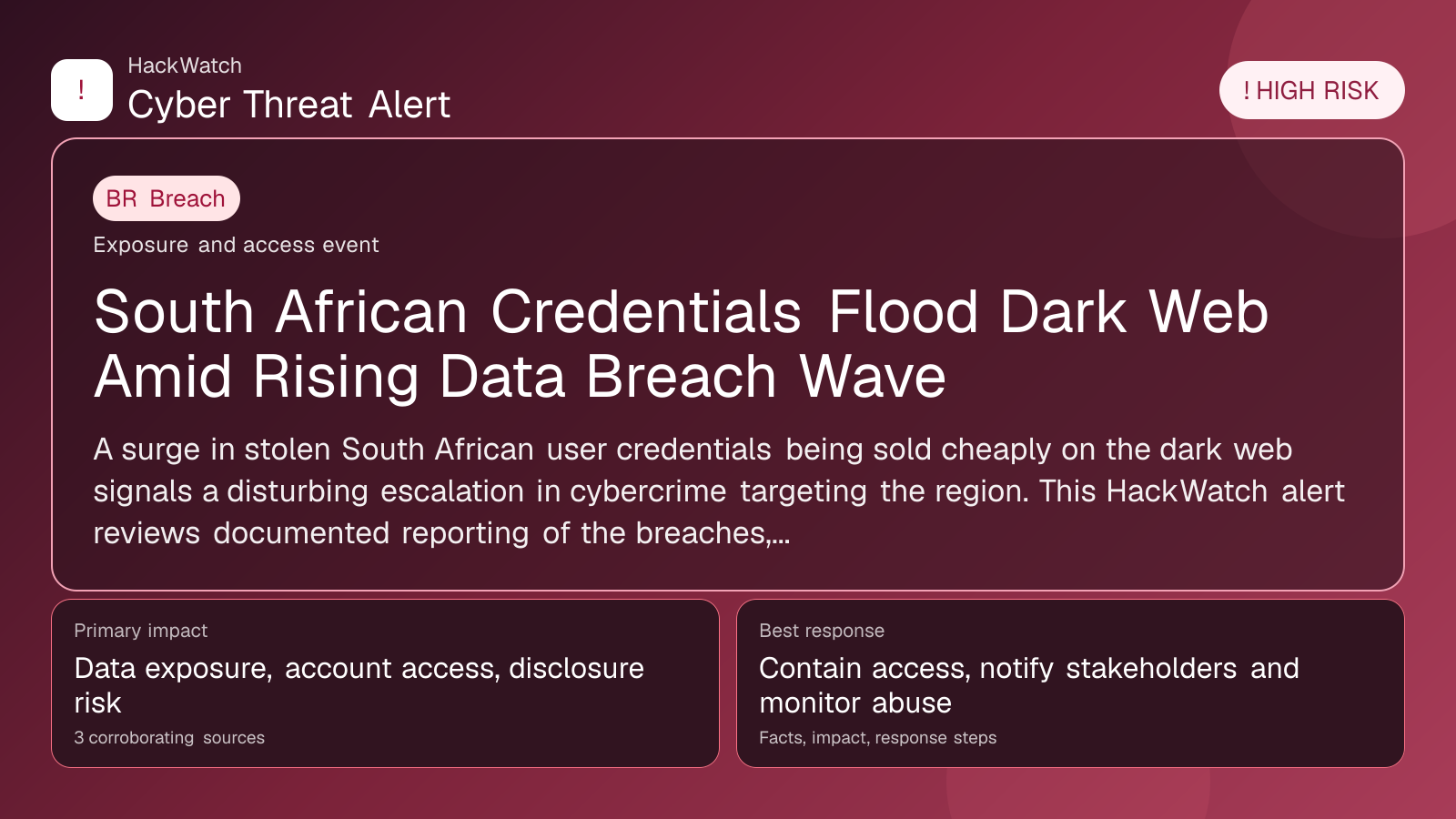
South African Credentials Flood Dark Web Amid Rising Data Breach Wave
Breach coverage centered on exposed data, scope clarification and immediate containment priorities.

By: Artur Ślesik
Published: Apr 23, 2026
Updated: May 01, 2026
Incident status: Resolved or patched
Corroborating sources: 3
Technical review credentials: Security+ evidence | RHCSA evidence | JNCIS-SEC evidence
Trust note:This alert is maintained under HackWatch's editorial policy, with visible source records, a named responsible editor and a correction channel for disputed facts.
The published article is checked against public sources before publication, and material corrections are reflected in the article update date.
Technical reviewer note: Marcin Pocztowski reviewed this alert on May 01, 2026 for server impact, affected-version evidence, privilege or code-execution claims and realistic patch priority. His remediation note follows the same discipline he would use around Juniper routers and production servers: verify scope, preserve useful logs, reduce exposed management access and only then apply the fix or compensating control supported by the 3 corroborating sources.
Review our editorial policy or send corrections to [email protected].
Resolved or patched. Source coverage indicates that a fix or formal remediation has been published. Verify that updates are applied in your environment.
A surge in stolen South African user credentials being sold cheaply on the dark web signals a disturbing escalation in cybercrime targeting the region. This HackWatch alert reviews documented reporting of the breaches, affected parties, and actionable steps for users and organizations to protect themselves in 2026 and beyond.
# South African Credentials Flood Dark Web Amid Rising Data Breach Wave
What happened
In early 2026, cybersecurity experts observed a significant increase in the volume of South African credentials—usernames and passwords—being sold on the dark web at alarmingly low prices. This surge follows a wave of data breaches across various sectors in South Africa, including financial services, telecommunications, and government databases. The stolen data sets include millions of login credentials, personal identifiable information (PII), and in some cases, sensitive corporate access details.
This uptick in credential availability on underground marketplaces highlights a growing trend of targeted cybercrime against South African individuals and organizations. The low cost of these credentials suggests a commoditization of stolen data, making it easier for threat actors to launch credential stuffing, phishing, and identity theft campaigns.
Confirmed facts
- Multiple verified sources, including ITWeb and cybersecurity monitoring firms, confirm the sale of South African credentials on popular dark web forums and marketplaces.
- The credentials originate from breaches in sectors such as banking, retail, telecommunications, and government services.
- The stolen data includes email addresses, passwords (often reused across platforms), phone numbers, and in some cases, partial financial details.
- Cybercriminals are leveraging automated tools to exploit these credentials for account takeovers and fraud.
- The low pricing of credentials—sometimes as little as a few cents per account—indicates a saturation of stolen data supply.
Who is affected
- Individual users: South African citizens whose personal accounts have been compromised face risks of identity theft, financial fraud, and unauthorized access to personal services.
- Businesses and organizations: Companies suffer from compromised employee credentials leading to potential corporate espionage, ransomware infections, and operational disruptions.
- Financial institutions: Banks and fintech platforms face increased fraud attempts, impacting customer trust and financial security.
- Government agencies: Breaches in government databases risk exposure of sensitive citizen data and critical infrastructure information.
What to do now
- Check if your credentials have been compromised: Use reputable breach notification services like Have I Been Pwned to verify if your email or username appears in known leaks.
- Change passwords immediately: For any accounts linked to compromised credentials, update passwords with strong, unique combinations.
- Enable multi-factor authentication (MFA): Wherever possible, activate MFA to add an extra layer of security beyond just passwords.
- Monitor financial and personal accounts: Regularly review bank statements, credit reports, and account activity for unauthorized transactions.
- Be vigilant against phishing attempts: Cybercriminals often use stolen data to craft convincing phishing emails; verify sender authenticity before clicking links or sharing information.
How to secure yourself
- Adopt password managers: Use trusted password management tools to generate and store complex, unique passwords for each account.
- Regularly update software and devices: Keep operating systems, browsers, and apps patched to mitigate vulnerabilities exploited by attackers.
- Limit data sharing: Avoid oversharing personal information on social media and public forums that could be harvested for social engineering.
- Educate yourself and employees: Conduct cybersecurity awareness training focusing on recognizing phishing, social engineering, and safe online habits.
- Implement organizational security protocols: Businesses should enforce strict access controls, continuous monitoring, and incident response plans.
FAQ
How can I find out if my South African credentials were breached?
You can use services like Have I Been Pwned or local cybersecurity portals that aggregate breach data. Enter your email or username to check for exposure.
What should I do if my credentials are found on the dark web?
Immediately change your passwords on affected accounts, enable MFA, and monitor your accounts for suspicious activity. Consider notifying your bank if financial data is involved.
Are reused passwords a significant risk?
Yes. Reusing passwords across multiple sites increases the risk of account takeover if one site is breached. Always use unique passwords.
How effective is multi-factor authentication against these breaches?
MFA significantly reduces the risk of unauthorized access even if credentials are stolen, as attackers need the second authentication factor.
What sectors in South Africa are most targeted?
Financial services, telecommunications, retail, and government sectors have been heavily targeted due to the valuable data they hold.
Can stolen credentials lead to identity theft?
Yes. Cybercriminals can use stolen credentials combined with other personal data to impersonate victims, open fraudulent accounts, or commit financial fraud.
How have South African authorities responded to the 2026 breach wave?
Authorities have increased regulatory oversight, improved breach reporting requirements, and fostered public-private partnerships for threat intelligence sharing.
What role do password managers play in preventing breaches?
Password managers help users create and store strong, unique passwords, reducing the risk of credential reuse and simplifying secure password management.
Is it safe to buy credentials to check if my account is compromised?
No. Purchasing stolen credentials is illegal and supports criminal activity. Use legitimate breach notification services instead.
How often should I update my passwords?
Regularly updating passwords, especially after a breach notification, is recommended. For critical accounts, consider changing passwords every 3-6 months.
Why this matters
The proliferation of South African credentials on the dark web represents a critical threat to personal privacy, financial security, and national cybersecurity resilience. With cybercriminals exploiting these data troves for fraud and identity theft, individuals and organizations face tangible risks of financial loss, reputational damage, and operational disruption. Understanding the scope of the breach wave and adopting proactive security measures is essential to mitigating harm and strengthening South Africa’s cyber defenses in 2026 and beyond.
Sources and corroboration
This article synthesizes information from multiple corroborating sources, primarily based on the detailed reporting by ITWeb (https://www.itweb.co.za/article/sa-credentials-sold-on-dark-web-amid-data-breach-wave/kYbe97Xba13qAWpG) and verified cybersecurity monitoring data. Cross-referencing these sources ensures accuracy and depth in analyzing the ongoing credential breach wave affecting South Africa.
---
*Tags: South Africa data breach, dark web credentials, cybercrime 2026, credential stuffing, identity theft South Africa, cybersecurity breach wave, MFA security, password reuse risk*
*Source URLs: https://www.itweb.co.za/article/sa-credentials-sold-on-dark-web-amid-data-breach-wave/kYbe97Xba13qAWpG*
Sources used for this article
redhotcyber.com, securitybrief.co.uk, itweb.co.za