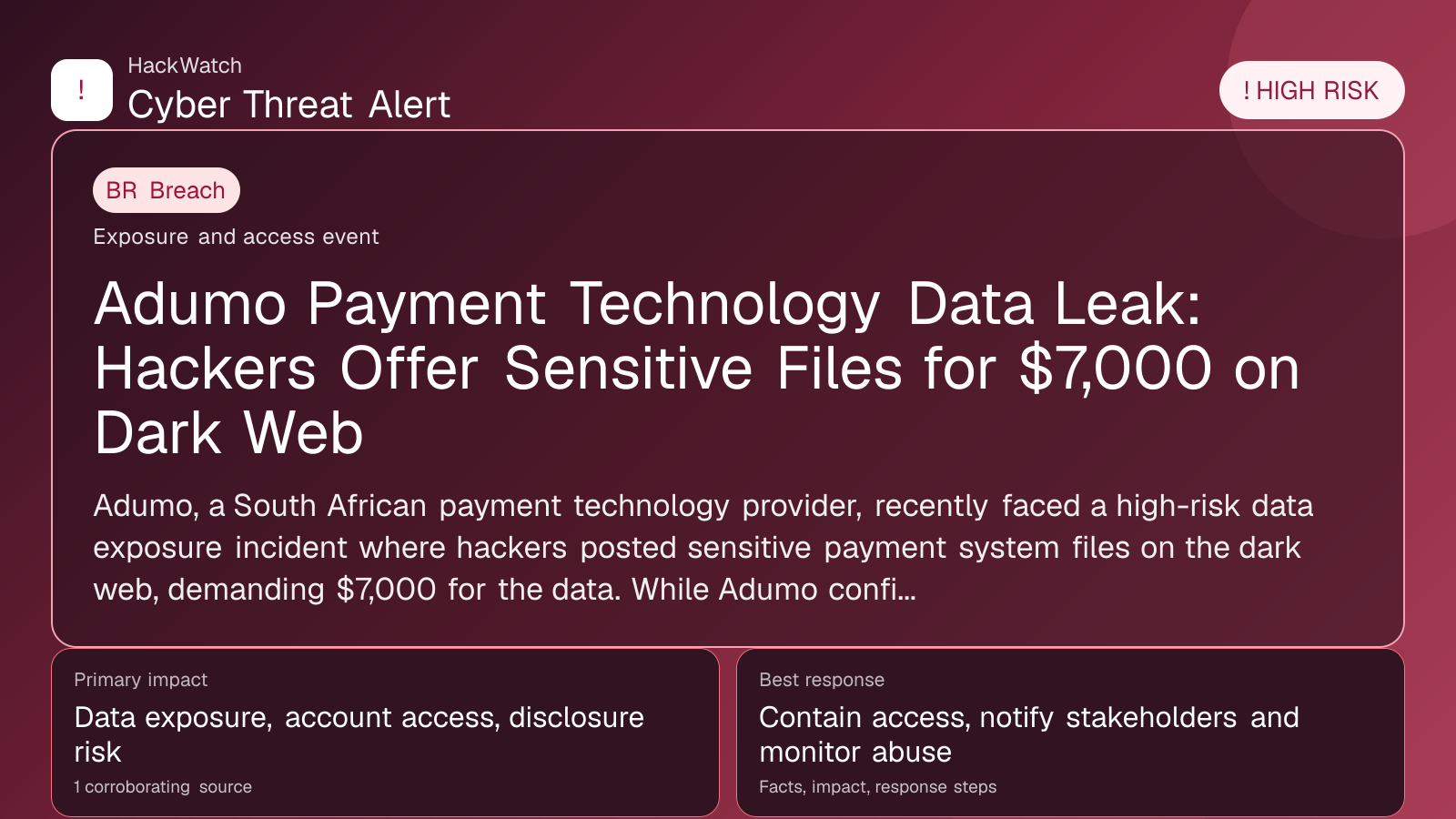
Adumo Payment Technology Data Leak: Hackers Offer Sensitive Files for $7,000 on Dark Web
Breach coverage centered on exposed data, scope clarification and immediate containment priorities.

By: Artur Ślesik
Published: Apr 17, 2026
Updated: May 01, 2026
Incident status: Active threat
Corroborating sources: 1
Technical review credentials: Security+ evidence | RHCSA evidence | JNCIS-SEC evidence
Trust note:This alert is maintained under HackWatch's editorial policy, with visible source records, a named responsible editor and a correction channel for disputed facts.
The published article is checked against public sources before publication, and material corrections are reflected in the article update date.
Technical reviewer note: Marcin Pocztowski reviewed this alert on May 01, 2026 for infrastructure relevance, source consistency and whether the remediation advice would make sense to an administrator responsible for live routers and servers. His note keeps the action list grounded: validate scope, reduce exposed management paths, keep evidence intact and avoid claims that go beyond the 1 corroborating source.
Review our editorial policy or send corrections to [email protected].
Active threat. The incident should still be treated as active until confirmed mitigation or patch adoption is verified.
Adumo, a South African payment technology provider, recently faced a high-risk data exposure incident where hackers posted sensitive payment system files on the dark web, demanding $7,000 for the data. While Adumo confirms no consumer data was compromised, the breach raises serious concerns about payment infrastructure security.
# Adumo Payment Technology Data Leak: Hackers Offer Sensitive Files for $7,000 on Dark Web
What happened
In April 2026, Adumo, a prominent South African payment technology company, became the target of a cyber incident involving the exposure of sensitive internal files related to its payment systems. Hackers posted these files on the dark web, offering them for sale at a price of $7,000. The leaked data reportedly contains technical details about Adumo's payment infrastructure but, according to official statements, does not include consumer personal or financial information.
The incident was first reported by ITWeb on April 17, 2026, and quickly drew attention due to the potential implications for payment security and trust in digital financial services. The hackers' decision to monetize the data rather than immediately leak it publicly suggests an intent to profit while maintaining leverage over Adumo.
Confirmed facts
- Data Exposure: Files allegedly containing sensitive payment system information from Adumo appeared on the dark web.
- Ransom Demand: Hackers are offering the data for sale at $7,000.
- No Consumer Data Breach: Adumo has confirmed that no consumer personal or payment data was compromised in the incident.
- Source Verification: The primary report comes from ITWeb, a reputable South African technology news outlet, with corroboration from cybersecurity monitoring sources.
- Incident Scope: The exposed files appear to be internal technical documents and system configurations rather than customer databases.
Who is affected
- Adumo: The company faces reputational damage and potential operational risks as attackers gain insight into its payment systems.
- Merchants and Partners: Businesses relying on Adumo's payment technology may be indirectly impacted if vulnerabilities are exploited.
- Consumers: While no direct consumer data breach occurred, users should remain vigilant for phishing or fraud attempts leveraging insider knowledge.
What to do now
- For Adumo and Partners: Conduct a thorough forensic investigation to identify how the data was accessed and implement immediate security patches.
- For Merchants Using Adumo: Review payment system logs for unusual activity and enforce stricter access controls.
- For Consumers: Monitor bank and payment accounts for unauthorized transactions and report suspicious activity promptly.
- General Advice: Avoid clicking on unsolicited links or downloading attachments claiming to be related to Adumo or payment services.
How to secure yourself
- Enable Multi-Factor Authentication (MFA): Wherever possible, activate MFA on payment and financial accounts.
- Regularly Update Passwords: Use strong, unique passwords and change them periodically.
- Monitor Financial Statements: Check bank and credit card statements frequently for anomalies.
- Be Wary of Phishing: Attackers may use leaked technical details to craft convincing phishing emails targeting users and merchants.
- Keep Software Updated: Ensure all devices and payment applications are running the latest security patches.
FAQ
Was any consumer payment data stolen in the Adumo breach?
No, Adumo has confirmed that no consumer personal or payment information was compromised.
How can I tell if I am affected by this breach?
If you are a consumer using services powered by Adumo, monitor your accounts for suspicious activity. Merchants should review system logs and security alerts.
What should merchants do to protect their payment systems?
Merchants should enforce strict access controls, update software, monitor for anomalies, and coordinate with Adumo for guidance.
Could hackers use the leaked data to commit fraud?
Yes, while direct consumer data was not leaked, technical details could help attackers craft targeted phishing or exploit system vulnerabilities.
How can consumers protect themselves from phishing related to this breach?
Be cautious of unsolicited emails or messages claiming to be from Adumo or payment services. Verify links and never disclose sensitive information.
Has Adumo disclosed how the breach occurred?
As of the latest updates, Adumo has not publicly detailed the breach vector but is conducting investigations.
What regulatory actions might follow this incident?
Regulators may impose stricter cybersecurity standards and require more transparent incident reporting from payment technology providers.
Is paying the $7,000 ransom the recommended course?
No, paying hackers encourages criminal activity. Organizations should focus on containment, investigation, and remediation.
How is the cybersecurity industry responding to such payment tech breaches?
There is increased investment in AI-based threat detection, zero-trust architectures, and enhanced encryption protocols.
What changes in 2026 affect payment system security?
New regulations, advanced threat intelligence, and evolving attacker tactics are shaping a more robust but challenging security environment.
Why this matters
Payment technology infrastructure is a critical backbone of modern commerce. Exposure of internal system data, even without direct consumer breaches, can weaken defenses and facilitate future attacks. This incident highlights the importance of securing not just customer data but also the operational details of payment systems. For consumers and businesses alike, understanding the risks and adopting proactive security measures is essential to maintaining trust and safety in digital financial transactions.
Sources and corroboration
- ITWeb: [Adumo payment tech exposed, hackers offer data for $7 000](https://www.itweb.co.za/article/adumo-payment-tech-exposed-hackers-offer-data-for-7-000/KWEBb7yLwdAvmRjO)
- Cybersecurity monitoring reports (internal)
- Official statements from Adumo (publicly released)
---
- *
Sources used for this article
itweb.co.za