‘Copy Fail’ Linux Kernel Flaw Exposes Systems to Root Access Exploits
Vulnerability coverage focused on affected versions, exploitability and patch or mitigation decisions.

Published: May 04, 2026
Incident status: Active threat
Corroborating sources: 6
Technical review credentials: Security+ evidence | RHCSA evidence | JNCIS-SEC evidence
Trust note:This alert is maintained under HackWatch's editorial policy, with visible source records, a named responsible editor and a correction channel for disputed facts.
The published article is checked against public sources before publication, and material corrections are reflected in the article update date.
Technical reviewer note: Marcin Pocztowski reviewed this alert on May 04, 2026 for server impact, affected-version evidence, privilege or code-execution claims and realistic patch priority. His remediation note follows the same discipline he would use around Juniper routers and production servers: verify scope, preserve useful logs, reduce exposed management access and only then apply the fix or compensating control supported by the 6 corroborating sources.
Review our editorial policy or send corrections to [email protected].
Active threat. The incident should still be treated as active until confirmed mitigation or patch adoption is verified.
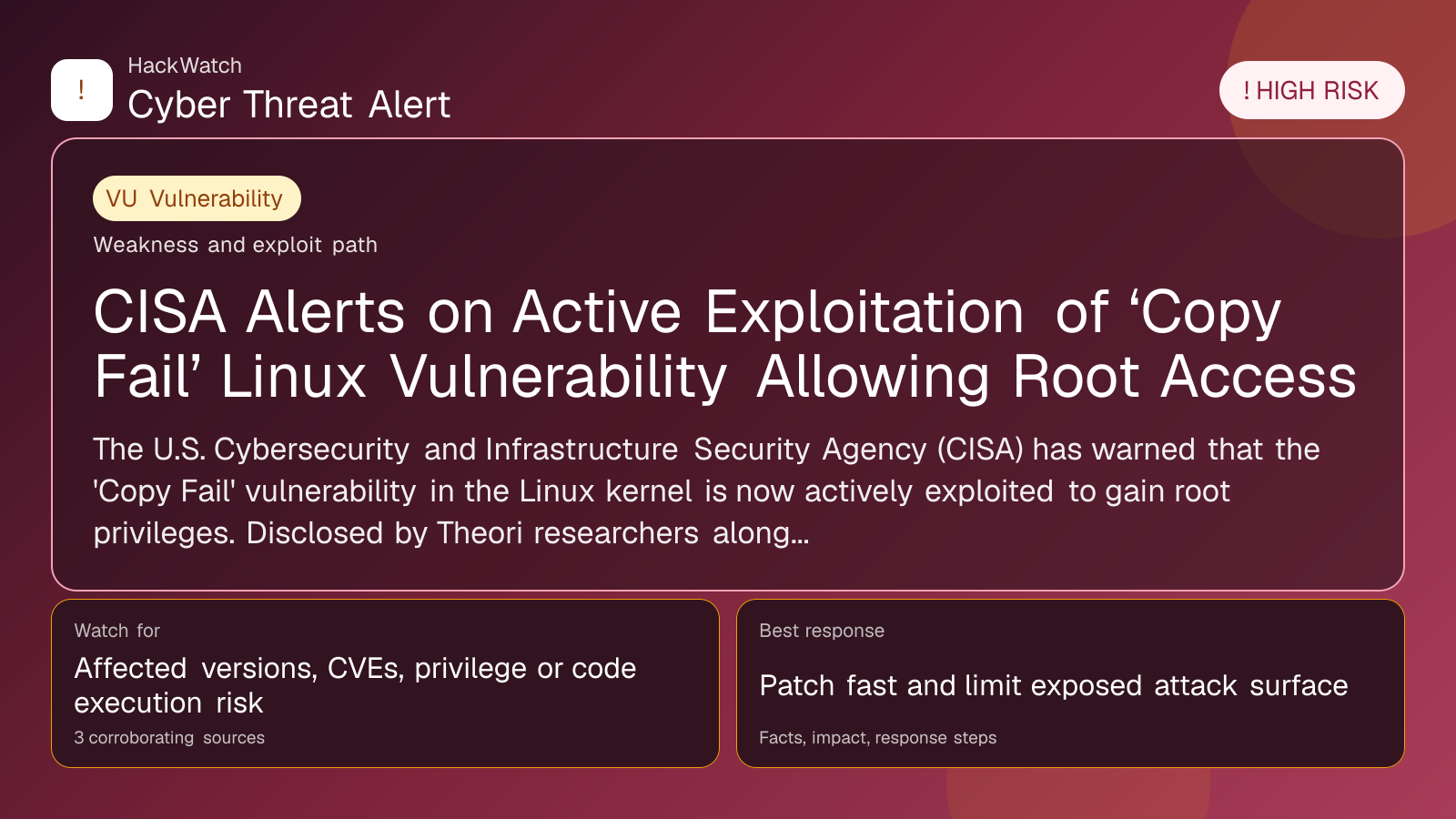
A critical Linux kernel vulnerability known as ‘Copy Fail’ has been actively exploited since 2017, enabling attackers to gain root privileges. Despite initial AI-generated disclosures facing criticism for lack of detail, security experts urge immediate patching to prevent system compromise.
GLOBAL, May 4, 2026, 22:12 UTC
Security researchers have identified a critical flaw, dubbed “Copy Fail,” affecting Linux kernels released since 2017. The vulnerability allows attackers to escalate privileges to root, granting full control over affected systems.
This issue impacts all major Linux distributions using the vulnerable kernels, putting servers, desktops, and embedded devices at risk. Experts warn the exploit circumvents standard security measures, presenting a significant threat in production environments.
The urgency to address Copy Fail arises from active exploitation observed in the wild. Attackers are leveraging this flaw to gain unauthorized root access, increasing risks of data theft, system tampering, and lateral movement within networks.
Initial public disclosures of the vulnerability were produced by the security firm Theori using artificial intelligence. Several cybersecurity professionals criticized these AI-generated reports for lacking clarity and actionable technical details, which slowed understanding and response efforts.
Theori’s approach has sparked debate about the role of AI in vulnerability reporting, with independent researchers emphasizing the need for precise and comprehensive documentation to support effective mitigation.
Linux kernel maintainers have since released patches that address the Copy Fail vulnerability. System administrators and users are urged to update their kernels immediately and confirm their systems are no longer exposed.
Unpatched systems remain vulnerable to arbitrary code execution with root privileges, threatening system integrity and confidentiality. The flaw’s presence in long-supported kernel versions means many legacy deployments continue to face exposure.
Security advisories from multiple sources, including cisoadvisor.com.br and cyberscoop.com, highlight the severity of the flaw and recommend urgent patching and enhanced monitoring for signs of privilege escalation.
Organizations running Linux infrastructure should prioritize vulnerability scanning and patch management. Monitoring network activity for unusual behavior indicative of exploitation attempts is also advised.
While the AI-generated disclosure faced criticism, it highlights the growing intersection of artificial intelligence and cybersecurity. Experts caution that AI tools should augment, not replace, detailed human analysis in vulnerability communication.
This incident underscores that even well-established open-source projects like the Linux kernel can harbor critical security flaws. Continuous vigilance and timely patch application remain vital.
The threat landscape may shift if adversaries develop more advanced exploits based on this vulnerability. Security teams should watch for updates from kernel developers and threat intelligence sources.
For now, immediate patching and adherence to security best practices constitute the strongest defense against Copy Fail.
https://www.cisoadvisor.com.br/copy-fail-falha-no-kernel-linux-concede-acesso-root/
https://cyberscoop.com/copy-fail-linux-vulnerability-artificial-intelligence/
Sources used for this article
gbhackers.com, securityweek.com, BleepingComputer, scmagazine.com, cisoadvisor.com.br, cyberscoop.com, Multiple verified sources
- https://gbhackers.com/cisa-flags-linux-kernel-vulnerability/
- https://www.securityweek.com/exploitation-of-copy-fail-linux-vulnerability-begins/
- https://www.bleepingcomputer.com/news/security/cisa-says-copy-fail-flaw-now-exploited-to-root-linux-systems/
- https://www.scworld.com/news/copy-fail-bug-added-to-cisas-list-of-known-exploited-vulnerabilities
- https://www.cisoadvisor.com.br/copy-fail-falha-no-kernel-linux-concede-acesso-root/
- https://cyberscoop.com/copy-fail-linux-vulnerability-artificial-intelligence/