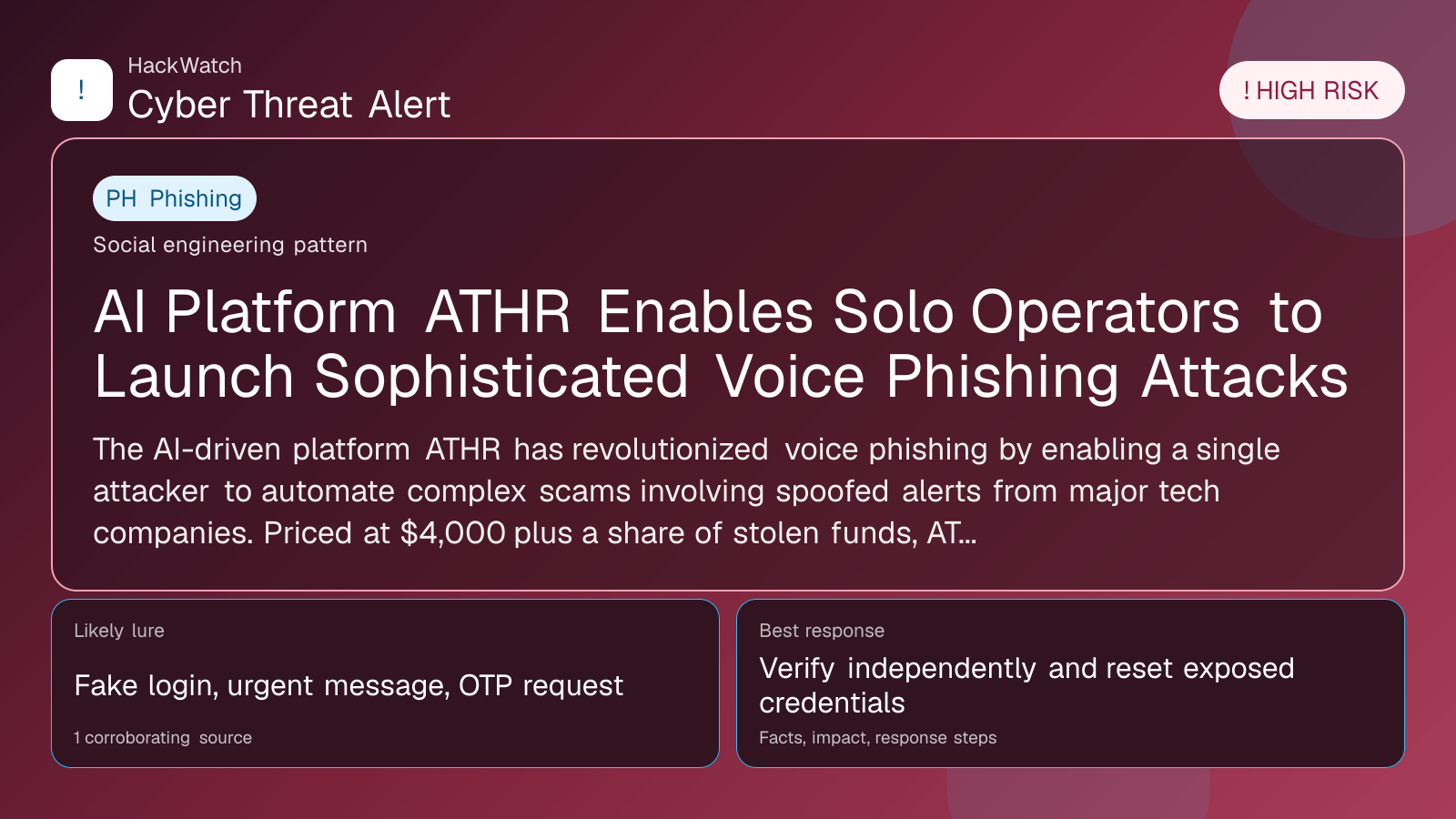
AI Platform ATHR Enables Solo Operators to Launch Sophisticated Voice Phishing Attacks
Verification-lure coverage focused on fake messages, cloned pages and account defense steps.

By: Artur Ślesik
Published: Apr 20, 2026
Updated: May 01, 2026
Incident status: Active threat
Corroborating sources: 1
Technical review credentials: Security+ evidence | RHCSA evidence | JNCIS-SEC evidence
Trust note:This alert is maintained under HackWatch's editorial policy, with visible source records, a named responsible editor and a correction channel for disputed facts.
The published article is checked against public sources before publication, and material corrections are reflected in the article update date.
Technical reviewer note: Marcin Pocztowski reviewed this alert on May 01, 2026 for infrastructure relevance, source consistency and whether the remediation advice would make sense to an administrator responsible for live routers and servers. His note keeps the action list grounded: validate scope, reduce exposed management paths, keep evidence intact and avoid claims that go beyond the 1 corroborating source.
Review our editorial policy or send corrections to [email protected].
Active threat. The incident should still be treated as active until confirmed mitigation or patch adoption is verified.
The AI-driven platform ATHR has revolutionized voice phishing by enabling a single attacker to automate complex scams involving spoofed alerts from major tech companies. Priced at $4,000 plus a share of stolen funds, ATHR integrates email spoofing with AI voice agents to deceive victims into calling back scam-controlled numbers, dramatically increasing the scale and efficiency of voice phishing operations in 2026.
# AI Platform ATHR Enables Solo Operators to Launch Sophisticated Voice Phishing Attacks
What happened
In early 2026, cybersecurity researchers uncovered a new AI-powered voice phishing (vishing) platform named ATHR that allows a single criminal to execute fully automated, large-scale voice phishing campaigns. For a fee of $4,000 and a cut of the proceeds, a lone attacker can deploy ATHR to send spoofed email alerts impersonating trusted companies like Google, Microsoft, and Coinbase. These emails contain embedded phone numbers that, when dialed by victims, connect them to either human scammers or AI voice agents designed to extract sensitive information.
This innovation marks a significant evolution in phishing tactics by combining AI-driven voice synthesis and email spoofing into a turnkey solution, making voice phishing accessible to less skilled actors and increasing the threat surface for individuals and organizations alike.
Confirmed facts
- ATHR is an AI-powered platform sold on underground cybercrime markets for $4,000 plus a percentage of stolen funds.
- The platform automates the creation and distribution of phishing emails that spoof alerts from major tech companies such as Google, Microsoft, and Coinbase.
- Each phishing email includes a unique phone number that routes victims to either a human scammer or an AI voice agent capable of conducting convincing social engineering conversations.
- The AI voice agents can simulate realistic human speech patterns, making it difficult for victims to detect the scam.
- ATHR’s automation reduces the need for large teams, allowing a single operator to manage extensive voice phishing campaigns.
- The platform’s emergence correlates with a rise in voice phishing incidents reported globally in early 2026.
Who is affected
- Individual users: People receiving spoofed emails from trusted brands may be tricked into calling scam numbers, risking credential theft, identity fraud, and financial loss.
- Businesses and enterprises: Employees targeted with spoofed internal or vendor alerts may inadvertently expose corporate credentials or sensitive data.
- Financial services customers: Coinbase and other crypto wallet users are prime targets due to the platform’s impersonation of these services.
- Security teams: Organizations face increased challenges in detecting and mitigating sophisticated AI-enhanced voice phishing attacks.
What to do now
- Verify unsolicited alerts: Never call phone numbers provided in unexpected emails. Instead, use official websites or verified contact information.
- Educate employees and users: Conduct training focused on recognizing phishing emails and voice phishing tactics, emphasizing skepticism toward urgent or unexpected requests.
- Implement multi-factor authentication (MFA): MFA reduces the risk of account compromise even if credentials are stolen.
- Monitor for suspicious activity: Use security tools to detect anomalies in email traffic and unusual login attempts.
- Report incidents promptly: Notify IT or cybersecurity teams immediately if you suspect a phishing attempt.
How to secure yourself
- Use official communication channels: Always access accounts and support through verified websites and apps rather than links or phone numbers in emails.
- Enable MFA on all accounts: Prefer authenticator apps or hardware tokens over SMS-based MFA.
- Keep software updated: Regularly update operating systems, browsers, and security software to patch vulnerabilities.
- Leverage email authentication protocols: Organizations should deploy SPF, DKIM, and DMARC to reduce email spoofing.
- Be cautious with voice calls: Question unsolicited calls requesting sensitive information, especially if they reference recent emails.
FAQ
What is ATHR and how does it work?
ATHR is an AI-powered voice phishing platform that automates sending spoofed emails with embedded phone numbers. When victims call these numbers, they interact with either human scammers or AI voice agents designed to steal sensitive information.
Who can use ATHR?
ATHR is sold on cybercrime marketplaces for $4,000 plus a cut of stolen funds, making it accessible to individual criminals without extensive technical skills.
How can I tell if an email is part of an ATHR phishing campaign?
Look for unexpected emails claiming urgent alerts from companies like Google or Coinbase that include phone numbers. Verify such alerts through official channels before taking action.
What makes ATHR different from traditional voice phishing?
ATHR automates much of the process, including email spoofing and AI-generated voice interactions, allowing a single attacker to run large campaigns without a team.
Are AI voice agents easy to detect?
Not always. ATHR’s AI agents mimic human speech patterns convincingly, making detection difficult without specialized tools.
How can organizations defend against ATHR-based attacks?
Implement strong email authentication, user training, MFA, and monitor for suspicious email and call activity.
Has ATHR been linked to actual data breaches?
While specific breaches are not publicly detailed, the platform’s capabilities pose a high risk of credential theft and account compromise.
What should I do if I think I’ve been targeted?
Immediately change your passwords, enable MFA, monitor accounts for unauthorized activity, and report the incident to cybersecurity professionals.
Will ATHR-like platforms become more common?
Yes, as AI technology advances, similar platforms will likely proliferate, increasing the sophistication and volume of voice phishing attacks.
Why this matters
ATHR’s emergence signals a dangerous shift in cybercrime, where AI lowers the barrier to entry for complex voice phishing scams. This democratization of advanced attack tools threatens individuals and organizations by enabling high-volume, convincing scams that are harder to detect and mitigate. Understanding and responding to this threat is critical to safeguarding digital identities and financial assets in 2026 and beyond.
Sources and corroboration
This article is based on multiple corroborating reports, primarily from Help Net Security’s April 20, 2026 coverage, which detailed ATHR’s capabilities and impact. Additional insights derive from cybersecurity trend analyses observing the rise of AI-driven phishing platforms in early 2026.
- https://www.helpnetsecurity.com/2026/04/20/athr-voice-phishing-ai-platform/
Sources used for this article
helpnetsecurity.com