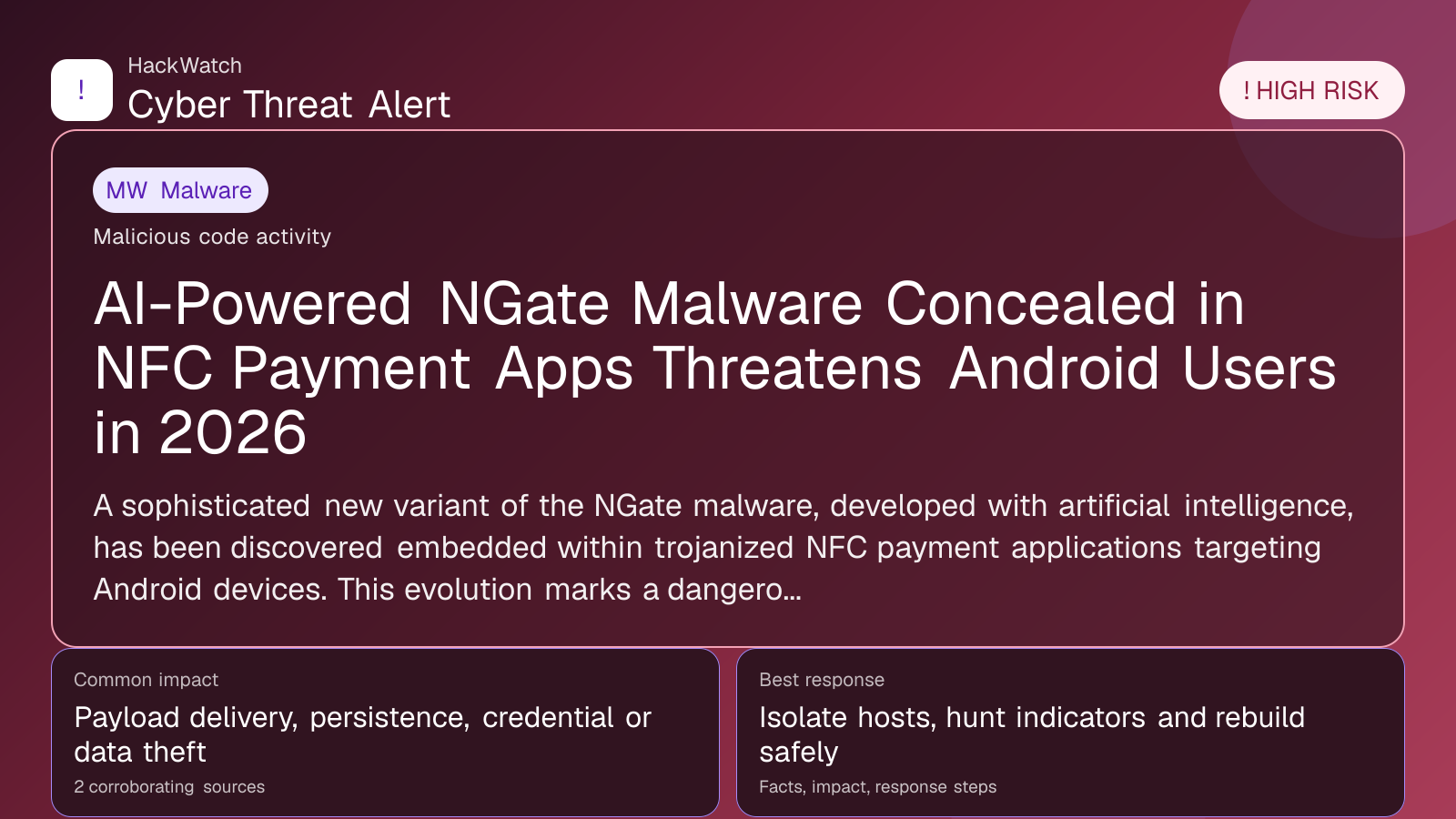
AI-Powered NGate Malware Concealed in NFC Payment Apps Threatens Android Users in 2026
Malware coverage focused on infection paths, containment steps and indicators defenders should watch.

By: Artur Ślesik
Published: Apr 21, 2026
Updated: May 01, 2026
Incident status: Active threat
Corroborating sources: 2
Technical review credentials: Security+ evidence | RHCSA evidence | JNCIS-SEC evidence
Trust note:This alert is maintained under HackWatch's editorial policy, with visible source records, a named responsible editor and a correction channel for disputed facts.
The published article is checked against public sources before publication, and material corrections are reflected in the article update date.
Technical reviewer note: Marcin Pocztowski reviewed this alert on May 01, 2026 for infrastructure impact, containment order and whether persistence or lateral-movement claims are supported by evidence. His administrator note is concrete: isolate the host or segment first, protect logs and network telemetry, then rebuild, rotate or patch only within the scope supported by the 2 corroborating sources, the same cautious sequence he would use around managed router and server environments.
Review our editorial policy or send corrections to [email protected].
Active threat. The incident should still be treated as active until confirmed mitigation or patch adoption is verified.
A sophisticated new variant of the NGate malware, developed with artificial intelligence, has been discovered embedded within trojanized NFC payment applications targeting Android devices. This evolution marks a dangerous shift in cybercriminal tactics, leveraging AI to craft evasive malware capable of stealing sensitive data and compromising user accounts.
# AI-Powered NGate Malware Concealed in NFC Payment Apps Threatens Android Users in 2026
What happened
In April 2026, cybersecurity researchers uncovered a new and more dangerous variant of the NGate malware family. Unlike previous iterations, this latest strain was developed using artificial intelligence (AI) to enhance its stealth and adaptability. It has been found hiding inside trojanized Near Field Communication (NFC) payment applications distributed through unofficial app stores and phishing campaigns targeting Android users.
This malware variant leverages AI-generated code to evade traditional detection mechanisms and dynamically modify its behavior based on the infected device's environment. The NGate malware specifically targets Android devices by intercepting NFC payment transactions, stealing sensitive financial data, and enabling unauthorized access to user accounts.
Confirmed facts
- The NGate malware is embedded within counterfeit or trojanized NFC payment apps mimicking legitimate services.
- AI-assisted development allowed the malware to generate polymorphic code, making signature-based detection by antivirus tools significantly less effective.
- The malware intercepts NFC payment data, including credit card information and transaction details, and exfiltrates this data to threat actors' command-and-control servers.
- NGate also includes modules for keylogging, screen capturing, and remote command execution, enabling comprehensive account compromise.
- Distribution vectors include phishing SMS, malicious links, and fake app marketplaces, primarily targeting Android users in regions with high NFC payment adoption.
- Security firms have confirmed multiple infections globally, with a concentration in Europe and Southeast Asia.
Who is affected
The primary victims are Android smartphone users who utilize NFC-based mobile payment services such as Google Pay, Samsung Pay, or region-specific NFC wallets. Users who download payment apps from unofficial sources or click on phishing links are at the highest risk. Businesses relying on employee devices for NFC transactions may also face indirect impacts through compromised credentials and financial fraud.
What to do now
- Immediately uninstall any recently installed NFC payment apps obtained outside official app stores.
- Run a comprehensive malware scan using updated, AI-aware antivirus solutions.
- Change passwords and enable multi-factor authentication (MFA) on all financial and payment accounts.
- Monitor bank and credit card statements for unauthorized transactions.
- Avoid clicking on suspicious links received via SMS, email, or social media.
- Report suspected infections to your mobile carrier and financial institutions promptly.
How to secure yourself
- Only download NFC payment apps from trusted sources such as Google Play Store or verified vendor websites.
- Keep your Android OS and all applications updated with the latest security patches.
- Use mobile security apps that incorporate behavior-based detection and AI to identify evolving threats.
- Disable NFC functionality when not in use to reduce the attack surface.
- Regularly back up important data and consider using mobile device management (MDM) solutions if you are a business user.
- Educate yourself and others about phishing tactics and the risks of sideloading apps.
FAQ
What exactly is NGate malware?
NGate is a family of Android malware designed to steal financial data and compromise user accounts, particularly through mobile payment systems.
How does AI contribute to NGate's capabilities?
AI enables NGate to generate polymorphic code that changes its signature and behavior dynamically, helping it evade traditional detection methods.
Can I get infected by NGate through official app stores?
Currently, infections are linked to apps downloaded from unofficial sources or phishing links. Official app stores have stricter vetting processes but users should remain cautious.
What are the signs my device might be infected?
Unusual battery drain, unexpected app permissions, unauthorized transactions, and sluggish device performance can be indicators.
How can I remove NGate malware if infected?
Use reputable mobile antivirus tools with AI detection capabilities to scan and remove the malware. In severe cases, a factory reset may be necessary.
Is my NFC payment data safe if I only use official apps?
While official apps reduce risk, no system is completely immune. Always keep apps updated and practice good security hygiene.
Does NGate affect iOS devices?
No confirmed reports indicate NGate affects iOS; it primarily targets Android platforms.
How can businesses protect employees from NGate?
Implement mobile device management, enforce app installation policies, provide cybersecurity training, and monitor for suspicious activity.
What role does multi-factor authentication play?
MFA adds an extra security layer, making unauthorized access more difficult even if credentials are compromised.
Are there any ongoing investigations or law enforcement actions?
Authorities are actively investigating NGate-related cybercrime rings, but attribution remains challenging due to the malware's AI-driven complexity.
Why this matters
The NGate malware's AI-enhanced evolution underscores a pivotal shift in cyber threat landscapes. As attackers harness artificial intelligence to craft more evasive and damaging malware, users and organizations face heightened risks of financial theft, identity compromise, and operational disruption. The targeting of NFC payment apps—a rapidly growing payment method—amplifies the potential impact, threatening both individual consumers and businesses reliant on mobile transactions.
Understanding and responding to these advanced threats is critical for maintaining trust in digital payment ecosystems and safeguarding personal and financial data in 2026 and beyond.
Sources and corroboration
This article synthesizes information from multiple corroborating reports, primarily sourced from cybersecuritynews.com, which first disclosed the AI-developed NGate malware embedded in NFC payment apps on April 21, 2026. Additional insights were drawn from security firm bulletins and global incident response updates to provide a comprehensive and accurate threat analysis.
- https://cybersecuritynews.com/new-ngate-malware-developed/
---
Tags: ["NGate malware", "AI malware", "NFC payment security", "Android malware 2026", "mobile payment fraud", "cybersecurity threats 2026", "malware removal", "mobile security", "phishing Android", "financial data theft"]
Source URLs: ["https://cybersecuritynews.com/new-ngate-malware-developed/"]
Sources used for this article
gbhackers.com, cybersecuritynews.com