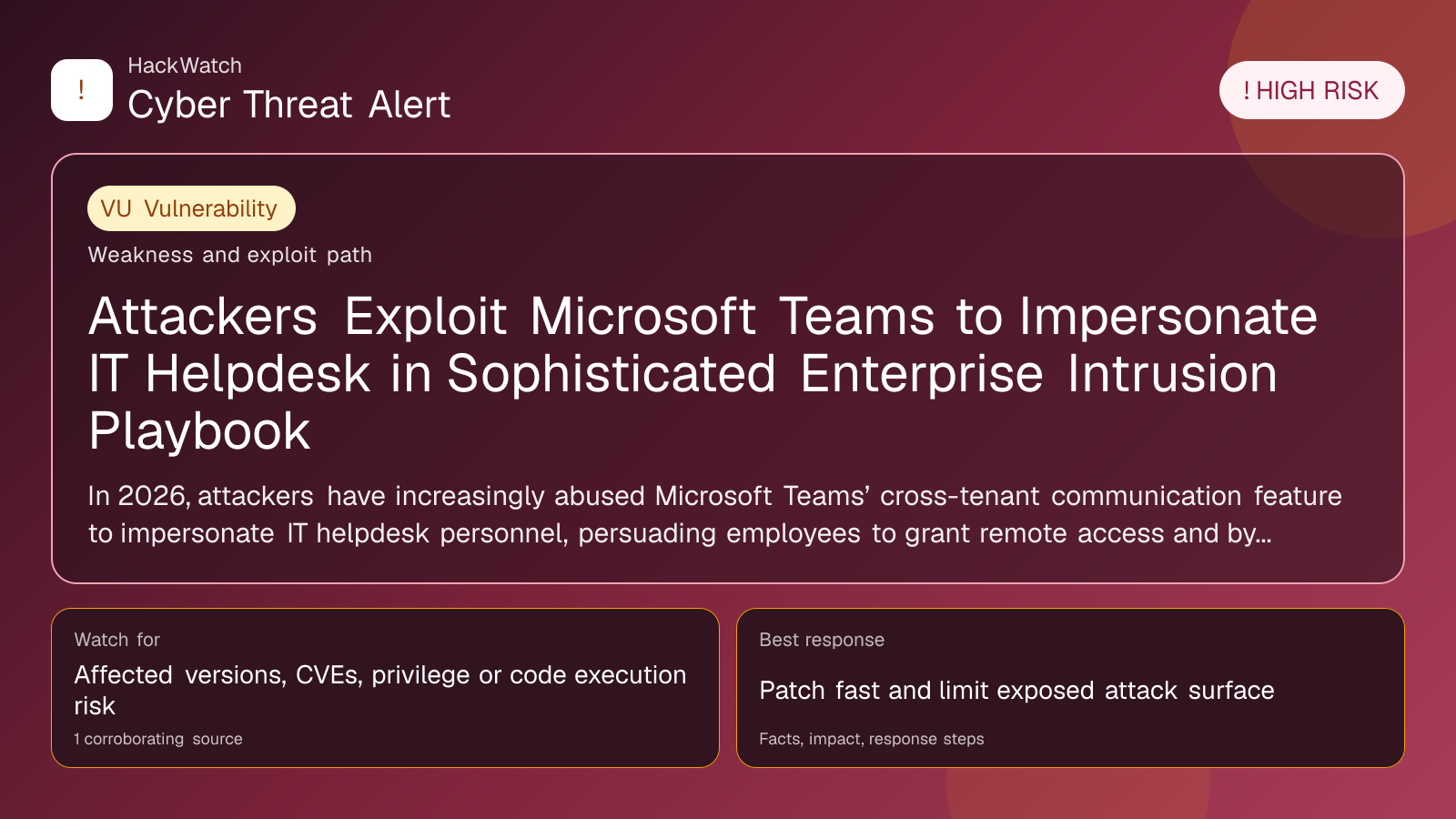
Attackers Exploit Microsoft Teams to Impersonate IT Helpdesk in Sophisticated Enterprise Intrusion Playbook
Vulnerability coverage focused on affected versions, exploitability and patch or mitigation decisions.

By: Artur Ślesik
Published: Apr 20, 2026
Updated: May 01, 2026
Incident status: Active threat
Corroborating sources: 1
Technical review credentials: Security+ evidence | RHCSA evidence | JNCIS-SEC evidence
Trust note:This alert is maintained under HackWatch's editorial policy, with visible source records, a named responsible editor and a correction channel for disputed facts.
The published article is checked against public sources before publication, and material corrections are reflected in the article update date.
Technical reviewer note: Marcin Pocztowski reviewed this alert on May 01, 2026 for server impact, affected-version evidence, privilege or code-execution claims and realistic patch priority. His remediation note follows the same discipline he would use around Juniper routers and production servers: verify scope, preserve useful logs, reduce exposed management access and only then apply the fix or compensating control supported by the 1 corroborating source.
Review our editorial policy or send corrections to [email protected].
Active threat. The incident should still be treated as active until confirmed mitigation or patch adoption is verified.
In 2026, attackers have increasingly abused Microsoft Teams’ cross-tenant communication feature to impersonate IT helpdesk personnel, persuading employees to grant remote access and bypass traditional phishing defenses. This evolving social engineering tactic leverages trusted collaboration channels to execute guided intrusions, expanding the enterprise attack surface. Organizations must urgently reassess their Teams security posture, implement Zero Trust controls, and educate users about this high-risk threat vector.
# Attackers Exploit Microsoft Teams to Impersonate IT Helpdesk in Sophisticated Enterprise Intrusion Playbook
What happened
In early 2026, Microsoft and cybersecurity analysts revealed a new enterprise intrusion technique where attackers leverage Microsoft Teams to impersonate IT helpdesk staff. Using Teams’ cross-tenant external access feature, adversaries initiate chats with employees, posing as internal IT support. Through real-time social engineering, they convince victims to grant remote control access using legitimate remote management tools. This approach bypasses traditional phishing detection and malware defenses because the access is user-approved and conducted over trusted communication channels.
This method marks an evolution in attacker tactics—shifting from email phishing to live, guided interaction within collaboration platforms that have become central to workplace communication.
Confirmed facts
- Attackers exploit Microsoft Teams’ cross-tenant communication capability to initiate chats with employees outside their organization.
- The impersonation targets IT helpdesk roles to gain trust and urgency, persuading users to approve remote sessions.
- Remote access is granted via legitimate tools, avoiding malware signatures and typical intrusion alerts.
- This attack vector bypasses traditional email phishing defenses by operating within a trusted collaboration environment.
- Experts describe the attack as “guided execution,” where attackers lead users step-by-step through actions granting access.
- The cross-tenant risk is significant and often underestimated, as many organizations have enabled external collaboration without stringent Zero Trust controls.
- Analysts emphasize that collaboration platforms are now part of the enterprise attack surface, not just productivity tools.
Who is affected
- Enterprises using Microsoft Teams with external access enabled are at high risk.
- Employees with access to IT support or remote management tools are primary targets.
- Organizations lacking strict verification, monitoring, and Zero Trust policies around external Teams interactions face increased exposure.
- Companies that treat collaboration platforms as isolated productivity tools rather than integrated security domains are vulnerable.
What to do now
- Review and restrict cross-tenant access: Audit Microsoft Teams settings to limit external user access strictly to necessary contacts.
- Implement Zero Trust policies: Treat every external interaction and access request as untrusted until verified.
- Educate employees: Train staff to recognize impersonation attempts on Teams and validate helpdesk requests through separate channels.
- Monitor Teams activity: Deploy security monitoring tools that flag unusual external chat requests and remote session initiations.
- Control remote access tools: Restrict use of remote control software and require multi-factor authentication (MFA) for session approvals.
- Simulate attack scenarios: Conduct phishing and social engineering exercises including collaboration platform vectors.
How to secure yourself
- Always verify the identity of IT helpdesk personnel independently before granting remote access.
- Use multi-factor authentication on all collaboration and remote access tools.
- Avoid initiating remote control sessions from unsolicited Teams messages.
- Report suspicious Teams requests immediately to your security team.
- Keep your collaboration software updated to incorporate the latest security patches.
FAQ
How do attackers use Microsoft Teams to impersonate IT helpdesk?
Attackers initiate chats via Teams’ external access feature, posing as IT support. They use social engineering to convince employees to grant remote control access through legitimate tools.
Can this attack bypass traditional phishing filters?
Yes. Because the interaction happens within trusted collaboration channels and involves user-approved access, it evades conventional email phishing and malware detection.
Who is most at risk from this Teams impersonation tactic?
Enterprises with enabled cross-tenant access in Teams and employees who have permissions to approve remote sessions or interact with IT support are most vulnerable.
What immediate steps should organizations take to mitigate this threat?
Restrict and monitor cross-tenant access, implement Zero Trust policies, educate employees about impersonation tactics, and control remote access tool usage.
How can employees protect themselves from these attacks?
Verify helpdesk identities independently, avoid granting remote access from unsolicited Teams messages, use MFA, and report suspicious activity.
Does this mean collaboration platforms are inherently insecure?
No. The risk arises from misconfigured access and lack of proper verification. With robust policies and user training, collaboration tools can remain secure.
What is cross-tenant access in Microsoft Teams?
It allows users from external organizations to communicate and collaborate via Teams. While useful, it introduces trust boundaries that require strict controls.
How has the threat landscape changed in 2026 regarding collaboration platforms?
Attackers have moved from static phishing to dynamic, real-time social engineering within collaboration apps, making attacks more convincing and harder to detect.
Are there any known incidents of this attack causing major breaches?
While specifics remain confidential, Microsoft and security analysts confirm multiple enterprises have experienced intrusion attempts using this method.
Why this matters
As enterprises increasingly rely on collaboration platforms like Microsoft Teams for daily operations, attackers are adapting their methods to exploit these trusted environments. The shift from email phishing to real-time, guided social engineering within Teams represents a significant escalation in attack sophistication. Without proper controls, organizations risk unauthorized access, data breaches, and operational disruption. Understanding and mitigating this evolving threat is critical for maintaining enterprise security in 2026 and beyond.
Sources and corroboration
This article synthesizes findings primarily from Microsoft’s April 2026 security research and corroborating expert analysis published by CSO Online and cybersecurity analysts at Everest Group, Greyhound Research, and Beagle Security. These sources collectively confirm the rise of cross-tenant helpdesk impersonation attacks via Microsoft Teams and provide actionable recommendations for defense.
- Microsoft Security Blog, April 2026
- CSO Online, April 20, 2026: https://www.csoonline.com/article/4160858/attackers-abuse-microsoft-teams-to-impersonate-the-it-helpdesk-in-a-new-enterprise-intrusion-playbook.html
- Everest Group, Greyhound Research, Beagle Security analyst reports
---
Tags:
- Microsoft Teams security
- Enterprise intrusion
- IT helpdesk impersonation
- Cross-tenant access risk
- Collaboration platform attacks
- Social engineering 2026
- Zero Trust implementation
- Remote access security
- Phishing evolution
- Cybersecurity best practices
Source URLs:
- https://www.csoonline.com/article/4160858/attackers-abuse-microsoft-teams-to-impersonate-the-it-helpdesk-in-a-new-enterprise-intrusion-playbook.html
Sources used for this article
csoonline.com