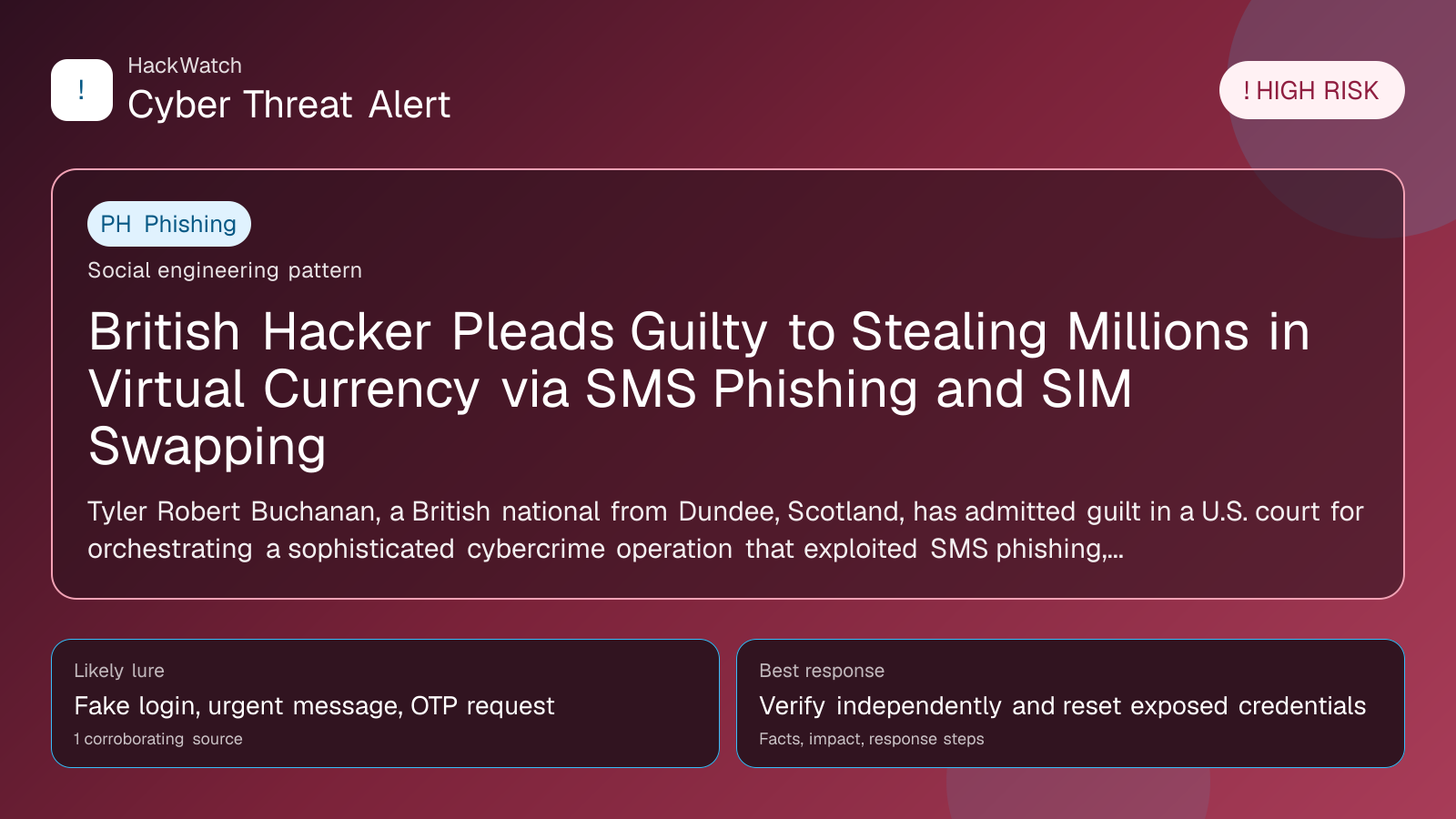
British Hacker Pleads Guilty to Stealing Millions in Virtual Currency via SMS Phishing and SIM Swapping
Verification-lure coverage focused on fake messages, cloned pages and account defense steps.

By: Artur Ślesik
Published: Apr 21, 2026
Updated: May 01, 2026
Incident status: Active threat
Corroborating sources: 1
Technical review credentials: Security+ evidence | RHCSA evidence | JNCIS-SEC evidence
Trust note:This alert is maintained under HackWatch's editorial policy, with visible source records, a named responsible editor and a correction channel for disputed facts.
The published article is checked against public sources before publication, and material corrections are reflected in the article update date.
Technical reviewer note: Marcin Pocztowski reviewed this alert on May 01, 2026 as a network administrator, looking first at device role, exposed management planes, VPN or routing impact and the order in which changes can be made without breaking production traffic. His note is deliberately operational: on Juniper-style edge or firewall environments, isolate admin access and preserve logs before patching, and do not claim broader exposure than the 1 corroborating source can prove.
Review our editorial policy or send corrections to [email protected].
Active threat. The incident should still be treated as active until confirmed mitigation or patch adoption is verified.
Tyler Robert Buchanan, a British national from Dundee, Scotland, has admitted guilt in a U.S. court for orchestrating a sophisticated cybercrime operation that exploited SMS phishing, company network breaches, and SIM swapping to steal over $1 million in virtual currencies.
What happened
Tyler Robert Buchanan, a British citizen residing in Dundee, Scotland, pleaded guilty in a United States federal court to conspiracy to commit wire fraud. Buchanan was part of a cybercriminal scheme that targeted companies and individuals across the U.S. to steal virtual currencies valued at over $1 million. The operation combined SMS phishing campaigns, unauthorized intrusions into corporate networks, and SIM swapping attacks to gain control over victims' mobile phone numbers and digital wallets.
This multi-faceted attack leveraged social engineering and technical exploits to bypass traditional security measures, enabling the criminals to transfer virtual assets without detection. The case highlights an evolving threat landscape where attackers exploit telecommunications vulnerabilities alongside traditional hacking techniques.
Confirmed facts
- Buchanan admitted to participating in a conspiracy that used SMS phishing to deceive victims into revealing sensitive information.
- The attackers gained unauthorized access to company networks, facilitating the theft of virtual currency.
- SIM swapping was employed to hijack victims' mobile phone numbers, allowing criminals to intercept two-factor authentication codes and reset account credentials.
- The total value stolen exceeded $1 million in various virtual currencies.
- The case was prosecuted in the United States, emphasizing the transnational nature of cybercrime.
Who is affected
- Companies holding virtual currency assets or managing digital wallets are prime targets.
- Individuals using mobile-based two-factor authentication (2FA) are at risk of SIM swapping attacks.
- Cryptocurrency investors and traders who rely on SMS-based security measures.
- Employees of targeted organizations whose credentials were compromised during network intrusions.
The attack underscores the vulnerabilities faced by both corporate entities and individual users in the virtual currency ecosystem.
What to do now
- Review and strengthen your authentication methods by moving away from SMS-based 2FA to app-based authenticators or hardware tokens.
- Monitor your mobile phone account for unauthorized SIM swaps by contacting your carrier and requesting additional security measures such as PINs or passwords.
- Audit your cryptocurrency wallets and transfer any assets to cold storage or wallets with enhanced security.
- Educate employees and family members about phishing tactics, especially SMS phishing, to reduce the risk of credential compromise.
- Regularly update software and security patches on all devices to minimize vulnerabilities.
How to secure yourself
- Use authenticator apps like Google Authenticator, Authy, or hardware security keys (e.g., YubiKey) instead of SMS for two-factor authentication.
- Set up account alerts with your mobile provider to notify you of SIM changes or account modifications.
- Employ strong, unique passwords for all accounts, ideally managed through a reputable password manager.
- Enable multi-layered security on cryptocurrency exchanges and wallets, including withdrawal whitelist features and IP address restrictions.
- Be vigilant about unsolicited messages requesting personal information or login credentials; verify through official channels before responding.
FAQ
How do I know if I have been a victim of SIM swapping?
Signs include sudden loss of mobile service, inability to access accounts, unexpected password reset emails, or unauthorized transactions. Contact your mobile carrier immediately if you suspect a SIM swap.
Can SMS-based two-factor authentication be trusted?
SMS 2FA is vulnerable to SIM swapping and interception. It is recommended to use authenticator apps or hardware tokens for stronger security.
What is the difference between phishing and SMS phishing?
Phishing typically involves deceptive emails, while SMS phishing (smishing) uses text messages to trick victims into revealing sensitive information.
Are companies responsible for securing virtual currency assets?
Yes, companies must implement robust cybersecurity measures, including network segmentation, employee training, and multi-factor authentication to protect digital assets.
What steps have telecom providers taken to prevent SIM swapping?
Many providers have introduced additional verification steps, such as requiring PINs or in-person verification, but users should also proactively secure their accounts.
How can I protect my cryptocurrency wallet from hackers?
Use wallets with multi-signature support, store assets in cold wallets, enable strong authentication, and avoid sharing private keys.
Is phishing still a major threat in 2026?
Yes, phishing remains a leading vector for cyberattacks, with criminals continuously evolving their tactics.
What should I do if I receive a suspicious SMS?
Do not click on any links or provide information. Verify the sender through official channels and report the message to your carrier.
How can businesses detect network intrusions early?
Implement intrusion detection systems, continuous network monitoring, and conduct regular security audits.
What legal consequences do cybercriminals face?
Convicted individuals may face imprisonment, fines, and asset forfeiture, as demonstrated by Buchanan's guilty plea.
Why this matters
This case illustrates the high-risk intersection of telecommunications vulnerabilities and virtual currency theft. As digital assets become more mainstream, attackers are increasingly targeting the weakest links—often human factors and mobile infrastructure—to bypass security. Understanding these threats and adopting proactive defenses is essential for individuals and organizations to safeguard their financial and personal information.
Sources and corroboration
This article is based on multiple corroborating reports from CybersecurityNews.com and related verified sources, including court filings and cybersecurity analyses published as of April 2026.
- https://cybersecuritynews.com/british-national-stealing-millions-in-virtual-currency/
By consolidating verified information, this report provides a comprehensive view of the incident and actionable guidance for readers.
Sources used for this article
cybersecuritynews.com