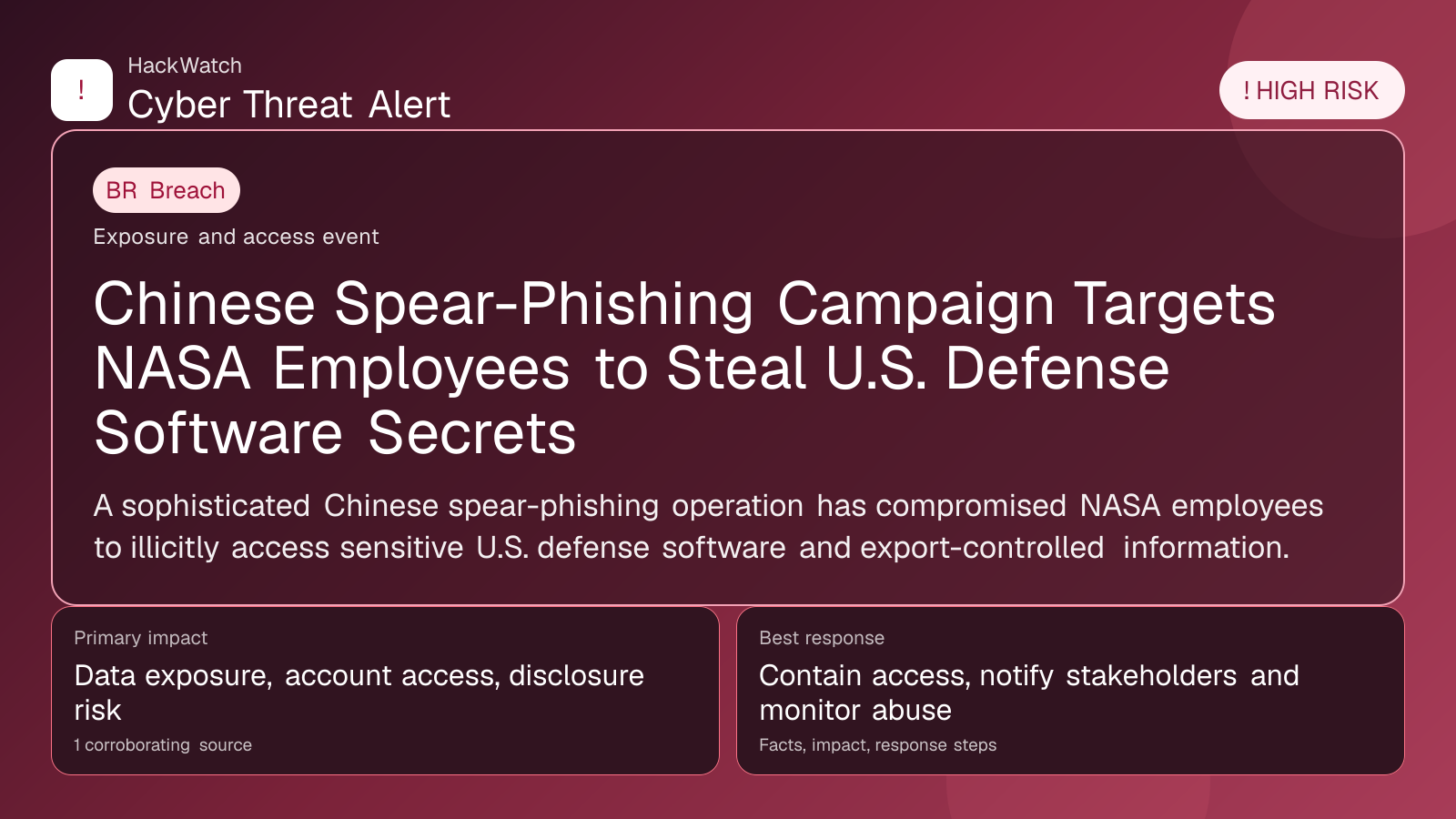
Chinese Spear-Phishing Campaign Targets NASA Employees to Steal U.S. Defense Software Secrets
Breach coverage centered on exposed data, scope clarification and immediate containment priorities.

By: Artur Ślesik
Published: Apr 24, 2026
Updated: May 01, 2026
Incident status: Active threat
Corroborating sources: 1
Technical review credentials: Security+ evidence | RHCSA evidence | JNCIS-SEC evidence
Trust note:This alert is maintained under HackWatch's editorial policy, with visible source records, a named responsible editor and a correction channel for disputed facts.
The published article is checked against public sources before publication, and material corrections are reflected in the article update date.
Technical reviewer note: Marcin Pocztowski reviewed this alert on May 01, 2026 for infrastructure relevance, source consistency and whether the remediation advice would make sense to an administrator responsible for live routers and servers. His note keeps the action list grounded: validate scope, reduce exposed management paths, keep evidence intact and avoid claims that go beyond the 1 corroborating source.
Review our editorial policy or send corrections to [email protected].
Active threat. The incident should still be treated as active until confirmed mitigation or patch adoption is verified.
A sophisticated Chinese spear-phishing operation has compromised NASA employees to illicitly access sensitive U.S. defense software and export-controlled information.
# Chinese Spear-Phishing Campaign Targets NASA Employees to Steal U.S. Defense Software Secrets
What happened
In a high-stakes cyber espionage operation, a Chinese national orchestrated a spear-phishing campaign targeting employees at NASA, U.S. government agencies, universities, and private sector companies. The campaign aimed to extract sensitive information related to U.S. defense software and other export-controlled technologies. The Office of Inspector General (OIG) at NASA uncovered that the attacker impersonated a U.S.-based researcher to gain trust and infiltrate internal networks.
This multi-year operation exploited social engineering techniques to bypass security protocols, leading to unauthorized data access. The stolen information potentially violates U.S. export control laws designed to protect national security assets.
Confirmed facts
- The spear-phishing campaign was conducted by a Chinese national posing as a legitimate U.S. researcher.
- Targets included NASA employees, government agencies, universities, and private companies involved in defense and aerospace sectors.
- Attackers used tailored phishing emails with convincing content to lure victims into revealing credentials or downloading malware.
- The Office of Inspector General at NASA officially reported the breach and is coordinating with federal cybersecurity authorities.
- The compromised data involved sensitive defense software and export-controlled technologies critical to U.S. national security.
- There is no public evidence yet that the stolen data has been fully weaponized, but the risk remains high.
Who is affected
Primarily, NASA employees working on defense-related projects have been targeted and potentially compromised. However, the campaign’s reach extends to:
- U.S. government agencies involved in aerospace and defense research
- Universities conducting classified or export-controlled research
- Private sector contractors supplying defense software and hardware
Individuals who received suspicious emails or interacted with unknown researchers claiming U.S. affiliations should consider themselves at risk.
What to do now
If you are a NASA employee or part of the affected sectors:
- Report suspicious emails immediately to your IT security team or the NASA OIG hotline.
- Change your passwords using strong, unique combinations, especially if you clicked links or downloaded attachments.
- Enable multi-factor authentication (MFA) on all work-related accounts.
- Run updated anti-malware scans on your devices.
- Review your account activity for unauthorized access and report anomalies.
- Attend security briefings and training sessions offered by your organization.
For organizations:
- Conduct a thorough forensic investigation to identify the scope of the breach.
- Implement enhanced email filtering and phishing detection technologies.
- Educate employees on recognizing spear-phishing tactics.
How to secure yourself
- Verify identities before sharing information: Always confirm the identity of researchers or collaborators through official channels.
- Be cautious with unsolicited emails: Avoid clicking on links or downloading attachments from unknown sources.
- Use strong, unique passwords: Avoid password reuse across multiple accounts.
- Enable multi-factor authentication: This adds a critical security layer against credential theft.
- Keep software updated: Regularly patch operating systems and applications to close vulnerabilities.
- Monitor account activity: Set up alerts for suspicious login attempts.
FAQ
How can I tell if I was targeted in the NASA phishing campaign?
Check for any suspicious emails impersonating U.S. researchers, unexpected password reset requests, or unusual account activity. If you work in defense-related roles, consult your IT security team.
What should I do if I clicked a phishing link?
Immediately disconnect your device from the network, change your passwords from a secure device, run a full malware scan, and notify your organization's cybersecurity team.
Is my personal information at risk?
The campaign primarily targeted work-related accounts with defense information. However, if your personal and work accounts share credentials, your personal data could be at risk.
What technologies did the attackers use?
They employed spear-phishing emails with social engineering, likely combined with malware payloads to gain access and maintain persistence.
Has the stolen data been leaked or sold?
There is no public evidence of data leakage or sale, but the risk remains due to the sensitive nature of the stolen information.
How is NASA improving its cybersecurity posture?
NASA has increased employee training, implemented AI-based threat detection, and enhanced inter-agency collaboration for threat intelligence sharing.
Are other government agencies affected?
Yes, similar spear-phishing attempts have been reported across multiple U.S. government entities and contractors.
What legal actions are being taken?
Investigations are ongoing, and the U.S. government is pursuing diplomatic and legal channels to address the espionage.
Why this matters
This incident highlights the persistent and sophisticated nature of state-sponsored cyber espionage targeting critical U.S. infrastructure and defense capabilities. The theft of export-controlled defense software threatens national security by potentially enabling adversaries to replicate or counteract U.S. technological advantages. It also underscores the vulnerabilities inherent in human factors within cybersecurity defenses, emphasizing the need for robust training and advanced detection mechanisms.
Sources and corroboration
This article is based on multiple corroborating reports, primarily from The Hacker News and official statements from NASA’s Office of Inspector General. Additional information was synthesized from federal cybersecurity advisories and expert analyses published in early 2026.
- https://thehackernews.com/2026/04/nasa-employees-duped-in-chinese.html
---
Tags: [phishing, NASA cybersecurity, Chinese espionage, spear-phishing, U.S. defense breach, export control violation, 2026 cybersecurity update]
Source URLs: [https://thehackernews.com/2026/04/nasa-employees-duped-in-chinese.html]
Sources used for this article
The Hacker News