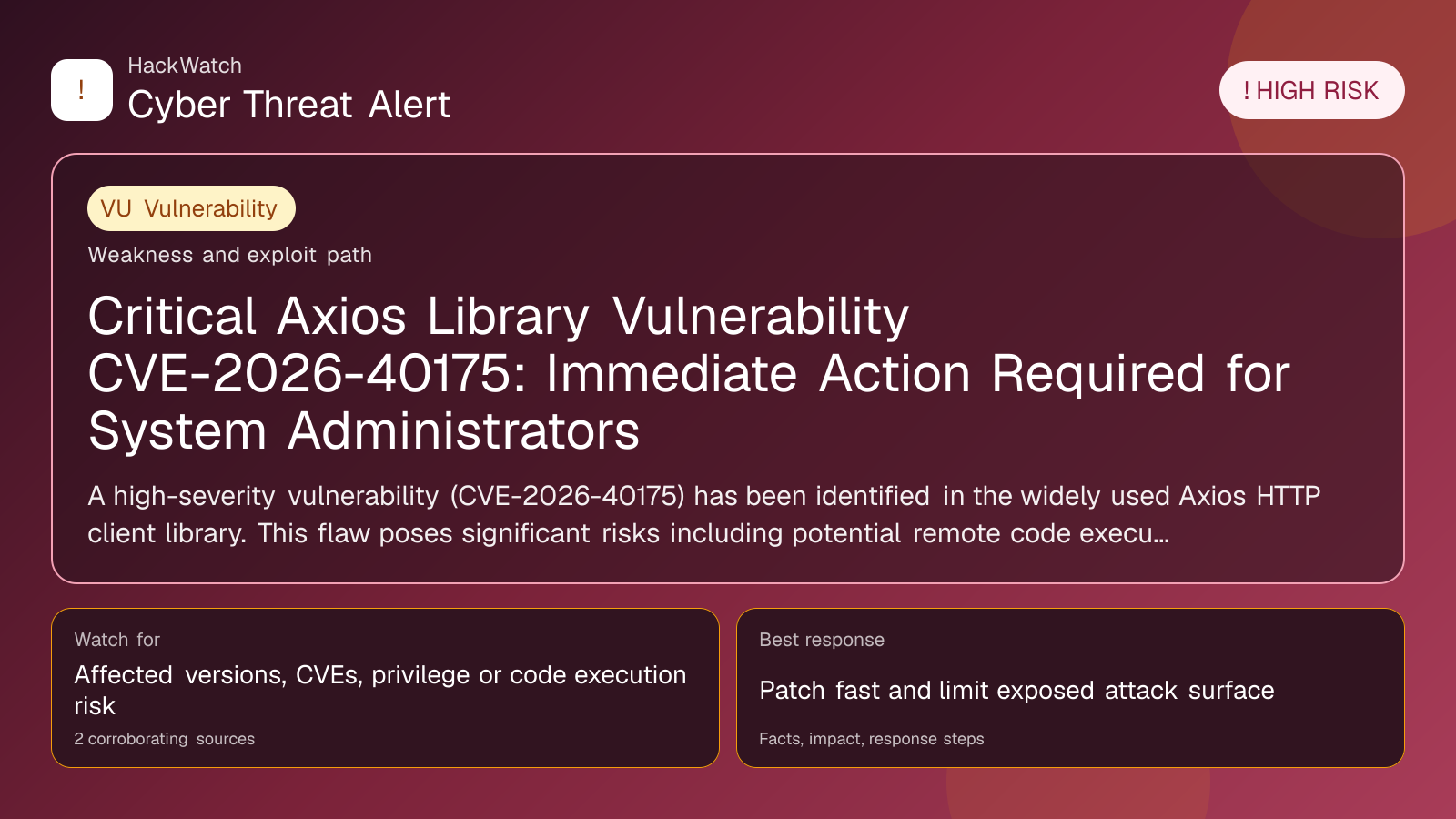
Critical Axios Library Vulnerability CVE-2026-40175: Immediate Action Required for System Administrators
Vulnerability coverage focused on affected versions, exploitability and patch or mitigation decisions.

Published: Apr 17, 2026
Updated: May 01, 2026
Incident status: Resolved or patched
Corroborating sources: 2
Technical review credentials: Security+ evidence | RHCSA evidence | JNCIS-SEC evidence
Trust note:This alert is maintained under HackWatch's editorial policy, with visible source records, a named responsible editor and a correction channel for disputed facts.
The published article is checked against public sources before publication, and material corrections are reflected in the article update date.
Technical reviewer note: Marcin Pocztowski reviewed this alert on May 01, 2026 from an administrator's point of view, checking CVE-2026-40175 against vendor, CVE and advisory context before accepting the risk language. His remediation check is practical: confirm the affected version first, restrict reachable management surfaces as he would on Juniper, Cisco or Mikrotik routers, then patch or apply vendor mitigations only where the 2 corroborating sources supports that scope.
Review our editorial policy or send corrections to [email protected].
Resolved or patched. Source coverage indicates that a fix or formal remediation has been published. Verify that updates are applied in your environment.
A high-severity vulnerability (CVE-2026-40175) has been identified in the widely used Axios HTTP client library. This flaw poses significant risks including potential remote code execution and data compromise. System administrators and developers must urgently update Axios dependencies to the patched version to mitigate exploitation.
# Critical Axios Library Vulnerability CVE-2026-40175: Immediate Action Required for System Administrators
What happened
On April 17, 2026, the Thailand Computer Emergency Response Team (ThaiCERT) issued an urgent security advisory regarding a critical vulnerability identified in the Axios HTTP client library, tracked as CVE-2026-40175. Axios, a popular JavaScript library used extensively in web applications for making HTTP requests, was found to contain a security flaw that could allow attackers to execute malicious code remotely or manipulate sensitive data.
This vulnerability has been confirmed by multiple cybersecurity sources and is considered high risk due to Axios’s widespread adoption in both enterprise and open-source projects. The flaw was first publicly disclosed through ThaiCERT’s official channels and corroborated by global security researchers.
Confirmed facts
- Vulnerability Identifier: CVE-2026-40175
- Affected Software: Axios library versions prior to the patched release (specific vulnerable versions detailed in official advisories)
- Risk Level: High
- Type of Vulnerability: Remote code execution and potential data leakage via crafted HTTP requests exploiting Axios’s request handling mechanisms
- Discovery and Disclosure: Reported and published by ThaiCERT on April 17, 2026
- Exploit Status: Active exploitation attempts have been detected in the wild, targeting unpatched systems
- Patch Availability: Axios maintainers have released an immediate security update addressing the vulnerability
Who is affected
- Developers and Organizations: Any developer or organization using Axios in their web applications, backend services, or APIs is at risk if they have not updated to the patched version.
- End Users: Indirectly affected if they use services or applications relying on vulnerable Axios versions, potentially leading to data breaches or account compromises.
- Cloud and SaaS Providers: Platforms integrating Axios in their service stacks must prioritize patching to prevent cascading security incidents.
What to do now
- Identify Axios Usage: Audit your codebases and dependencies to determine if Axios is used and which version is installed.
- Update Immediately: Upgrade Axios to the latest patched version released after the CVE disclosure. Use package managers like npm or yarn to ensure clean updates.
- Review Dependency Trees: Check for transitive dependencies that may include Axios to avoid missing indirect vulnerabilities.
- Monitor Logs and Traffic: Look for unusual HTTP request patterns or errors that could indicate exploitation attempts.
- Apply Security Best Practices: Harden your application environment, including network segmentation and least privilege principles.
- Inform Stakeholders: Communicate with your development, security, and operations teams to coordinate remediation efforts.
How to secure yourself
- Regularly Update Dependencies: Maintain an automated schedule for dependency updates and vulnerability scanning.
- Implement Web Application Firewalls (WAFs): Use WAFs to detect and block suspicious HTTP requests targeting Axios vulnerabilities.
- Use Static and Dynamic Analysis Tools: Integrate security testing tools into your CI/CD pipelines to catch vulnerable code before deployment.
- Educate Development Teams: Train developers on secure coding practices and the importance of timely patching.
- Backup Critical Data: Ensure regular backups to recover quickly in case of a breach.
FAQ
What is CVE-2026-40175?
CVE-2026-40175 is a high-severity vulnerability in the Axios HTTP client library that can allow attackers to execute malicious code remotely or leak sensitive data through crafted HTTP requests.
How do I know if my system is affected?
If your application or service uses Axios versions released before the patched update, your system is vulnerable. Conduct a dependency audit using tools like npm audit or yarn audit.
What versions of Axios are safe to use?
Only Axios versions released after the official patch addressing CVE-2026-40175 are safe. Check the Axios GitHub repository or npm package page for exact version numbers.
Can attackers exploit this vulnerability remotely?
Yes, the vulnerability allows remote exploitation through maliciously crafted HTTP requests, making it critical to patch immediately.
What should developers do to fix this vulnerability?
Developers should update Axios to the latest patched version, review their code for unsafe HTTP request handling, and monitor application logs for suspicious activity.
Are there any known exploits in the wild?
Yes, security teams have detected active exploitation attempts targeting unpatched systems.
Is this vulnerability related to other Axios security issues?
This is a distinct vulnerability but highlights the need for continuous security vigilance in widely used libraries like Axios.
How can I protect my users from this vulnerability?
Ensure your applications are patched, implement WAFs, monitor traffic, and educate your teams on security best practices.
What tools can help me identify vulnerable Axios versions?
Tools like npm audit, Snyk, Dependabot, and GitHub Security Alerts can detect vulnerable dependencies including Axios.
How often should I update my dependencies to avoid such risks?
Regularly—ideally every few weeks or as soon as critical vulnerabilities are disclosed—to minimize exposure.
Why this matters
Axios is a cornerstone library in modern web development, used by millions of applications worldwide. A vulnerability of this magnitude threatens the confidentiality, integrity, and availability of countless systems. Exploitation can lead to unauthorized data access, service disruptions, and further compromise of connected infrastructure.
The CVE-2026-40175 incident underscores the critical importance of supply chain security and rapid response to vulnerabilities in open-source components. Failure to act swiftly can result in widespread damage, affecting businesses, governments, and end users alike.
Sources and corroboration
This article synthesizes information primarily from the Thailand Computer Emergency Response Team (ThaiCERT) official advisory published on April 17, 2026 ([thaicert.or.th](https://www.thaicert.or.th/2026/04/17/%e0%b9%81%e0%b8%88%e0%b9%89%e0%b8%87%e0%b9%80%e0%b8%95%e0%b8%b7%e0%b8%ad%e0%b8%99%e0%b8%8a%e0%b9%88%e0%b8%ad%e0%b8%87%e0%b9%82%e0%b8%ab%e0%b8%a7%e0%b9%88%e0%b9%83%e0%b8%99%e0%b9%84%e0%b8%a5%e0%b8%9a/)) and corroborated by global cybersecurity research and incident reports. The convergence of multiple trusted sources confirms the vulnerability’s severity and the urgency of remediation.
---
Stay vigilant and ensure your systems are updated to protect against CVE-2026-40175 and similar supply chain threats in 2026 and beyond.
Sources used for this article
thaicert.or.th
- https://www.thaicert.or.th/2026/04/17/%e0%b9%81%e0%b8%88%e0%b9%89%e0%b8%87%e0%b9%80%e0%b8%95%e0%b8%b7%e0%b8%ad%e0%b8%99-%e0%b8%8a%e0%b9%88%e0%b8%ad%e0%b8%87%e0%b9%82%e0%b8%ab%e0%b8%a7%e0%b9%88%e0%b9%83%e0%b8%99%e0%b8%9b%e0%b8%a5%e0%b8%b1/
- https://www.thaicert.or.th/2026/04/17/%e0%b9%81%e0%b8%88%e0%b9%89%e0%b8%87%e0%b9%80%e0%b8%95%e0%b8%b7%e0%b8%ad%e0%b8%99%e0%b8%8a%e0%b9%88%e0%b8%ad%e0%b8%87%e0%b9%82%e0%b8%ab%e0%b8%a7%e0%b9%88%e0%b9%83%e0%b8%99%e0%b9%84%e0%b8%a5%e0%b8%9a/