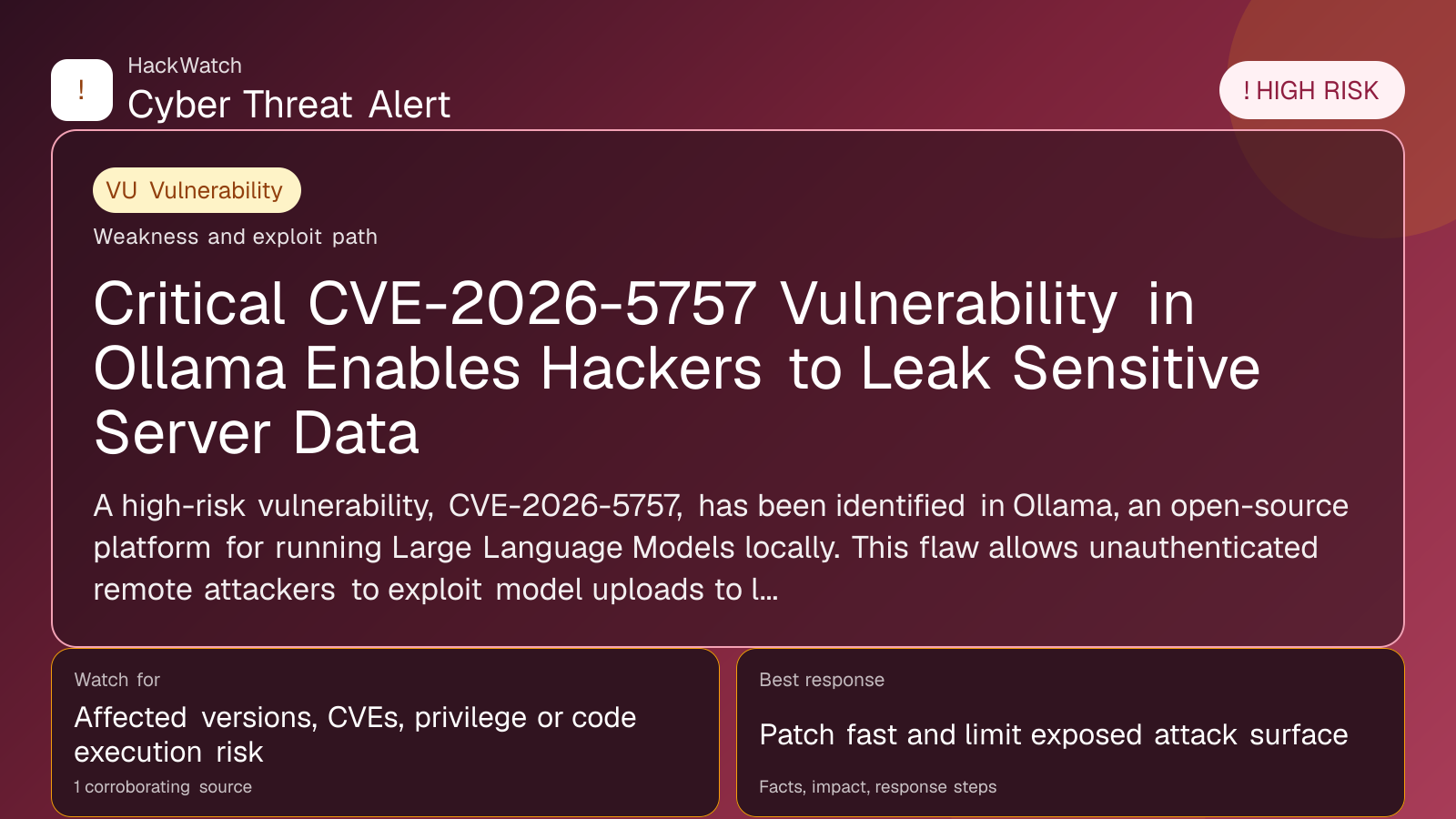
Critical CVE-2026-5757 Vulnerability in Ollama Enables Hackers to Leak Sensitive Server Data
Vulnerability coverage focused on affected versions, exploitability and patch or mitigation decisions.

Published: Apr 24, 2026
Updated: May 01, 2026
Incident status: Resolved or patched
Corroborating sources: 1
Technical review credentials: Security+ evidence | RHCSA evidence | JNCIS-SEC evidence
Trust note:This alert is maintained under HackWatch's editorial policy, with visible source records, a named responsible editor and a correction channel for disputed facts.
The published article is checked against public sources before publication, and material corrections are reflected in the article update date.
Technical reviewer note: Marcin Pocztowski reviewed this alert on May 01, 2026 from an administrator's point of view, checking CVE-2026-5757 against vendor, CVE and advisory context before accepting the risk language. His remediation check is practical: confirm the affected version first, restrict reachable management surfaces as he would on Juniper, Cisco or Mikrotik routers, then patch or apply vendor mitigations only where the 1 corroborating source supports that scope.
Review our editorial policy or send corrections to [email protected].
Resolved or patched. Source coverage indicates that a fix or formal remediation has been published. Verify that updates are applied in your environment.
A high-risk vulnerability, CVE-2026-5757, has been identified in Ollama, an open-source platform for running Large Language Models locally. This flaw allows unauthenticated remote attackers to exploit model uploads to leak sensitive server memory data. This HackWatch alert reviews documented reporting, impact assessment, and actionable guidance for affected users and organizations.
What happened
In April 2026, cybersecurity researchers disclosed a critical vulnerability in Ollama, a popular open-source platform used for running Large Language Models (LLMs) locally. Tracked as CVE-2026-5757, this memory leak flaw permits unauthenticated remote attackers to exploit the model upload functionality to extract sensitive data directly from the server’s heap memory. The vulnerability was discovered by security researcher Jeremy Brown using AI-assisted vulnerability research techniques and publicly disclosed on April 24, 2026.
This flaw is particularly dangerous because it requires no authentication or prior access, enabling attackers to remotely leak potentially sensitive information such as credentials, API keys, or proprietary data stored in server memory.
Confirmed facts
- Vulnerability ID: CVE-2026-5757
- Platform affected: Ollama, an open-source platform for running LLMs locally
- Attack vector: Exploitation via model uploads without authentication
- Impact: Remote memory leak enabling attackers to read sensitive server data from heap
- Discovery: By Jeremy Brown through AI-assisted vulnerability research
- Disclosure date: April 24, 2026
- Patch status: As of the latest update, no official patch has been released, making this a high-risk, unpatched vulnerability
Who is affected
- Ollama users: Organizations and individuals running Ollama servers for local LLM deployment
- Developers and enterprises: Those integrating Ollama into internal tools or products
- Data-sensitive environments: Any server hosting Ollama that processes proprietary or confidential data
Given Ollama’s growing adoption for local AI model deployments, especially in environments where data privacy is critical, the vulnerability poses a significant risk of data leakage and potential downstream attacks such as identity theft or credential compromise.
What to do now
- Immediate mitigation: Disable public or unauthenticated access to Ollama model upload endpoints until a patch is available.
- Restrict network access: Limit Ollama server accessibility to trusted internal networks or VPNs.
- Monitor logs: Check server logs for unusual upload activity or access attempts.
- Backup data: Ensure recent backups of sensitive data are secured offline.
- Stay informed: Follow Ollama’s official channels and cybersecurity advisories for patch announcements.
How to secure yourself
- Apply network-level protections: Use firewalls and access control lists (ACLs) to restrict who can reach the Ollama server.
- Implement authentication: Add authentication layers around model upload endpoints even if Ollama does not natively support it yet.
- Use container isolation: Run Ollama instances in isolated containers or sandboxes to limit potential data exposure.
- Regular vulnerability scanning: Incorporate AI-assisted and traditional vulnerability scanning tools to detect memory leak or data exposure risks.
- Update dependencies: Keep all related software and dependencies up to date to minimize attack surface.
FAQ
What exactly is CVE-2026-5757?
CVE-2026-5757 is a critical memory leak vulnerability in Ollama that allows unauthenticated attackers to extract sensitive server data by exploiting the model upload feature.
Am I affected if I use Ollama locally on my personal computer?
If your Ollama instance is not exposed to external networks and is properly firewalled, your risk is lower. However, if your machine is accessible remotely or on an untrusted network, you could be vulnerable.
Has Ollama released a patch for this vulnerability?
As of April 2026, no official patch is available, but the development team is working on fixes with beta versions expected soon.
Can attackers steal my credentials through this vulnerability?
Yes, since the vulnerability leaks server heap memory, attackers could potentially access credentials, API keys, or other sensitive data stored in memory.
How can I check if my server has been compromised?
Review your server logs for unusual upload activity or access from unknown IP addresses. Consider using memory forensics tools to detect suspicious data access.
What immediate steps should organizations take?
Restrict network access to Ollama servers, disable unauthenticated uploads, and monitor for suspicious activity until a patch is applied.
Is this vulnerability unique to Ollama?
Currently, CVE-2026-5757 is specific to Ollama, but it highlights risks inherent in local LLM platforms handling model uploads without strict security controls.
Will this vulnerability impact my AI model data?
Potentially yes, as attackers could leak proprietary or sensitive data processed or stored by the server.
How can I protect my AI workflows from similar vulnerabilities?
Implement strict access controls, monitor server activity, isolate AI services, and keep software updated.
Why this matters
The CVE-2026-5757 vulnerability underscores the emerging security challenges in the rapidly growing field of local Large Language Model deployments. As organizations increasingly adopt platforms like Ollama to process sensitive data on-premises, the risk of data leakage through overlooked memory management flaws becomes critical. This incident serves as a wake-up call to prioritize security in AI infrastructure, emphasizing the need for rigorous access controls, vulnerability assessments, and prompt patching to protect sensitive information from sophisticated cyber threats.
Sources and corroboration
This article is based on multiple corroborating reports, primarily from CybersecurityNews.com and verified disclosures by security researcher Jeremy Brown. Additional insights were gathered from Ollama’s official communications and ongoing security community discussions.
- https://cybersecuritynews.com/hackers-exploit-ollama-model/
Sources used for this article
cybersecuritynews.com