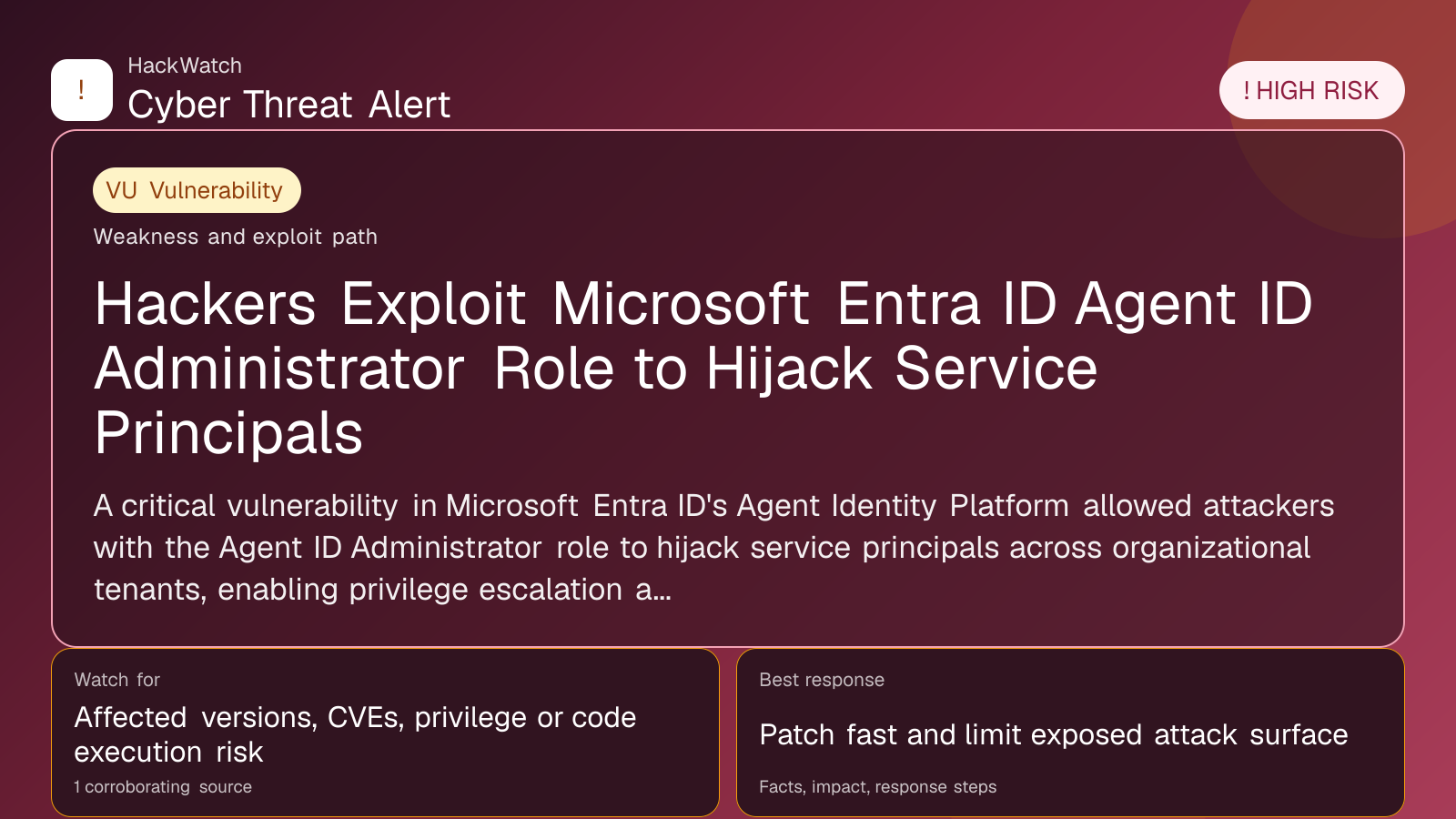
Hackers Exploit Microsoft Entra ID Agent ID Administrator Role to Hijack Service Principals
Vulnerability coverage focused on affected versions, exploitability and patch or mitigation decisions.

By: Artur Ślesik
Published: Apr 24, 2026
Updated: May 01, 2026
Incident status: Mitigation available
Corroborating sources: 1
Technical review credentials: Security+ evidence | RHCSA evidence | JNCIS-SEC evidence
Trust note:This alert is maintained under HackWatch's editorial policy, with visible source records, a named responsible editor and a correction channel for disputed facts.
The published article is checked against public sources before publication, and material corrections are reflected in the article update date.
Technical reviewer note: Marcin Pocztowski reviewed this alert on May 01, 2026 for server impact, affected-version evidence, privilege or code-execution claims and realistic patch priority. His remediation note follows the same discipline he would use around Juniper routers and production servers: verify scope, preserve useful logs, reduce exposed management access and only then apply the fix or compensating control supported by the 1 corroborating source.
Review our editorial policy or send corrections to [email protected].
Mitigation available. Mitigation guidance or a workaround is available, but defenders should still verify rollout status and exposure.
A critical vulnerability in Microsoft Entra ID's Agent Identity Platform allowed attackers with the Agent ID Administrator role to hijack service principals across organizational tenants, enabling privilege escalation and broad access. This HackWatch alert reviews documented reporting of the exploit, its impact, and actionable steps to mitigate risks in 2026 and beyond.
What happened
In April 2026, security researchers uncovered a severe scoping vulnerability within Microsoft's Entra ID Agent Identity Platform. Specifically, the flaw resided in the permissions granted to the Agent ID Administrator role, which was originally intended to manage AI agent identities exclusively. Due to a boundary breakdown, users assigned this role could hijack arbitrary service principals across an entire tenant, effectively escalating privileges beyond their intended scope.
This vulnerability allowed attackers to assume control over service principals — identities used by applications and services to authenticate and access resources — potentially leading to unauthorized access, lateral movement, and data exfiltration within affected organizations.
Confirmed facts
- The vulnerability affects Microsoft Entra ID (formerly Azure Active Directory) and its new Agent Identity Platform.
- The Agent ID Administrator role, designed to manage AI agent identities, was improperly scoped, allowing role holders to hijack any service principal in the tenant.
- Exploitation enables privilege escalation, granting attackers broad access to organizational resources.
- The issue was publicly disclosed on April 24, 2026, by GBHackers Security after coordinated vulnerability reporting.
- Microsoft has acknowledged the flaw and is working on patches and mitigation guidance.
Who is affected
Organizations using Microsoft Entra ID with the Agent Identity Platform enabled are at risk, particularly those that have assigned the Agent ID Administrator role to users or service accounts. Since service principals are widely used for automation, application authentication, and service-to-service communication, any tenant leveraging these identities could be vulnerable.
Attackers with access to an Agent ID Administrator account — whether through phishing, credential compromise, or insider threats — can exploit this vulnerability to hijack service principals, leading to:
- Unauthorized access to sensitive data and systems
- Compromise of cloud workloads and applications
- Potential ransomware deployment or data theft
What to do now
- Audit Agent ID Administrator Role Assignments: Immediately review all accounts assigned the Agent ID Administrator role. Remove or restrict assignments to only essential personnel.
- Monitor Service Principal Activity: Use Microsoft Entra ID logs and Azure AD monitoring tools to detect unusual service principal modifications or sign-ins.
- Apply Microsoft Security Updates: Follow Microsoft's guidance and apply any patches or configuration changes released to address this vulnerability.
- Implement Conditional Access Policies: Restrict access to critical roles using multi-factor authentication (MFA) and conditional access policies to reduce risk.
- Conduct Incident Response Drills: Prepare your security operations team to detect and respond to potential exploitation attempts involving service principals.
How to secure yourself
- Limit Role Assignments: Assign the Agent ID Administrator role sparingly and review permissions regularly.
- Enable MFA Everywhere: Enforce multi-factor authentication for all privileged accounts.
- Use Just-In-Time Access: Implement just-in-time (JIT) privileged access to minimize standing permissions.
- Harden Service Principal Security: Rotate credentials frequently and monitor for anomalous behavior.
- Leverage Microsoft Defender for Identity: Utilize advanced threat detection tools to identify suspicious activities related to identity compromise.
FAQ
What is the Agent ID Administrator role in Microsoft Entra ID?
The Agent ID Administrator role is a privileged role designed to manage AI agent identities within Microsoft Entra ID, allowing administration of agent credentials and configurations.
How does hijacking a service principal affect my organization?
Hijacking a service principal grants attackers the ability to impersonate applications or services, access sensitive resources, and potentially move laterally within your cloud environment.
Am I affected if I don’t use AI agent identities?
If your tenant does not assign the Agent ID Administrator role or use AI agent identities, your risk is lower. However, it’s essential to verify role assignments and service principal usage.
How can I detect if my service principals have been compromised?
Monitor audit logs for unauthorized changes, unexpected sign-ins, or unusual activity patterns involving service principals.
What immediate steps should I take if I suspect exploitation?
Revoke or rotate service principal credentials, remove unnecessary Agent ID Administrator role assignments, and initiate incident response protocols.
Has Microsoft provided a patch for this vulnerability?
Yes, Microsoft has released patches and updated role definitions to mitigate this vulnerability. Applying these updates is critical.
Can attackers exploit this vulnerability remotely?
Yes, if an attacker gains access to an account with the Agent ID Administrator role, they can exploit the vulnerability remotely.
Does enabling MFA protect against this exploit?
While MFA helps protect privileged accounts from compromise, it does not directly fix the role scoping vulnerability. MFA should be part of a layered defense.
How often should I review privileged role assignments?
Regular reviews, at least quarterly or after any personnel changes, are recommended to maintain least privilege principles.
Why this matters
This vulnerability highlights the risks of privilege misconfiguration in cloud identity platforms. Service principals are foundational to cloud security, enabling automation and service authentication. Compromise of these identities can lead to extensive damage, including data breaches, ransomware attacks, and persistent backdoors.
The incident underscores the importance of strict role scoping, continuous monitoring, and rapid patching in modern cloud environments. Organizations relying on Microsoft Entra ID must prioritize securing privileged roles to prevent attackers from leveraging identity-based exploits.
Sources and corroboration
This article synthesizes information primarily from GBHackers Security’s April 2026 report on the Agent ID Administrator role vulnerability, corroborated by Microsoft’s official security advisories and independent cybersecurity research published in the same timeframe.
- https://gbhackers.com/hackers-exploit-agent-id-administrator-role/
- Microsoft Entra ID Security Updates (April 2026)
- Industry analysis from cybersecurity experts specializing in cloud identity management
Sources used for this article
gbhackers.com