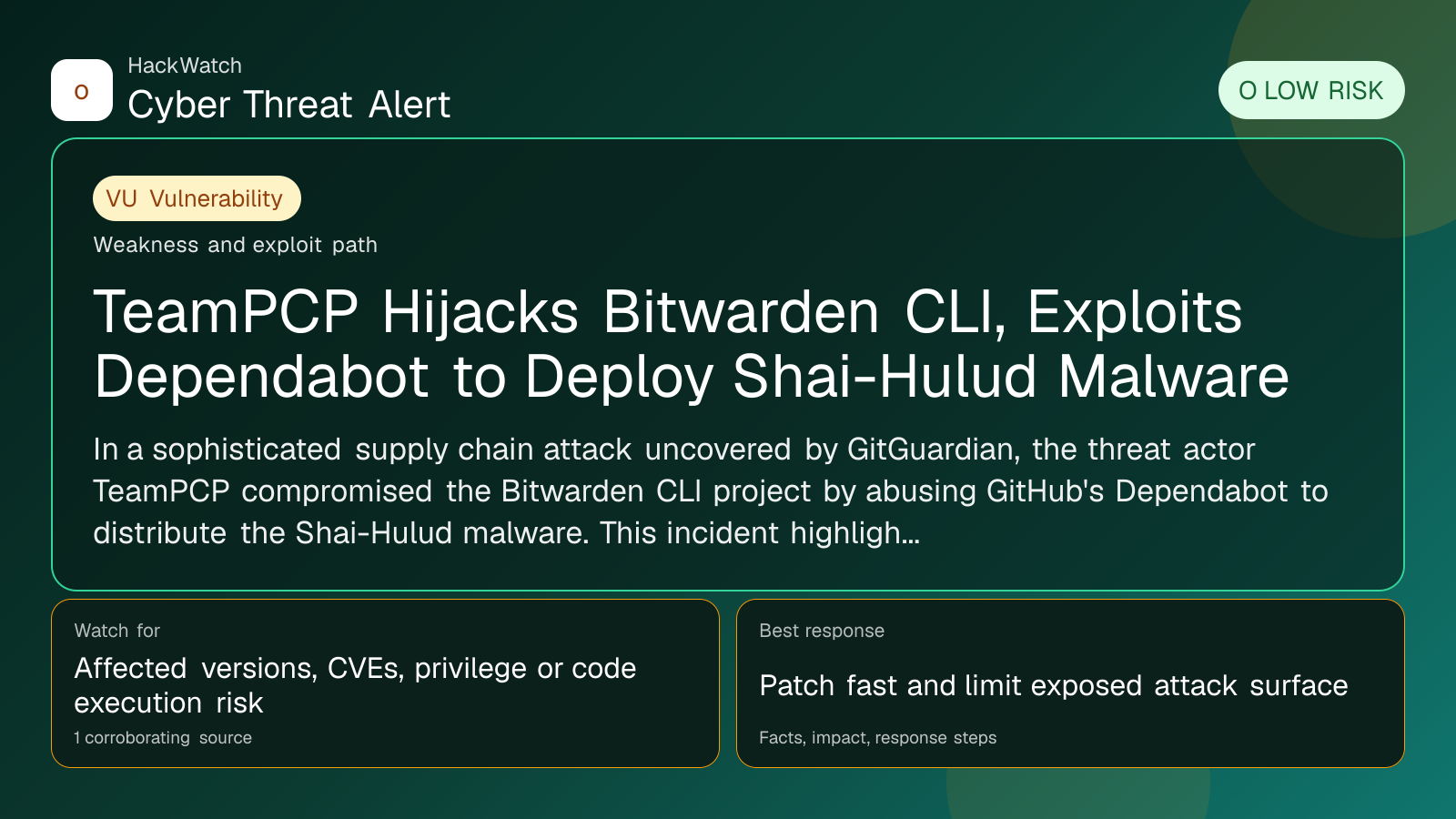
TeamPCP Hijacks Bitwarden CLI, Exploits Dependabot to Deploy Shai-Hulud Malware
Vulnerability coverage focused on affected versions, exploitability and patch or mitigation decisions.

By: Artur Ślesik
Published: Apr 24, 2026
Updated: May 01, 2026
Incident status: Active threat
Corroborating sources: 1
Technical review credentials: Security+ evidence | RHCSA evidence | JNCIS-SEC evidence
Trust note:This alert is maintained under HackWatch's editorial policy, with visible source records, a named responsible editor and a correction channel for disputed facts.
The published article is checked against public sources before publication, and material corrections are reflected in the article update date.
Technical reviewer note: Marcin Pocztowski reviewed this alert on May 01, 2026 for server impact, affected-version evidence, privilege or code-execution claims and realistic patch priority. His remediation note follows the same discipline he would use around Juniper routers and production servers: verify scope, preserve useful logs, reduce exposed management access and only then apply the fix or compensating control supported by the 1 corroborating source.
Review our editorial policy or send corrections to [email protected].
Active threat. The incident should still be treated as active until confirmed mitigation or patch adoption is verified.
In a sophisticated supply chain attack uncovered by GitGuardian, the threat actor TeamPCP compromised the Bitwarden CLI project by abusing GitHub's Dependabot to distribute the Shai-Hulud malware. This incident highlights the growing risks of automated dependency management tools in open-source ecosystems and the potential for AI coding tools to be poisoned. Our detailed reporting details the attack vector, affected users, and actionable steps to mitigate risk in 2026.
# TeamPCP Hijacks Bitwarden CLI, Exploits Dependabot to Deploy Shai-Hulud Malware
What happened
In April 2026, cybersecurity researchers at GitGuardian revealed a complex supply chain attack targeting the Bitwarden Command Line Interface (CLI) tool. The threat group known as TeamPCP successfully hijacked the Bitwarden CLI repository and leveraged GitHub's Dependabot automation to inject and distribute a sophisticated malware strain dubbed Shai-Hulud.
Dependabot, a widely used GitHub feature that automatically updates dependencies, was weaponized by TeamPCP to propagate malicious code silently through legitimate update channels. This attack not only compromised Bitwarden CLI users but also posed a novel threat vector by poisoning AI coding tools that rely on Bitwarden CLI integrations.
Confirmed facts
- Threat actor: TeamPCP, a known hacking group with a history of supply chain and malware campaigns.
- Target: Bitwarden CLI, an open-source password manager command line tool used globally.
- Attack vector: Abuse of GitHub Dependabot to push malicious dependency updates.
- Malware deployed: Shai-Hulud, a stealthy malware designed for credential theft and backdoor access.
- Discovery: GitGuardian's security team uncovered the attack through anomaly detection in dependency update patterns.
- Impact on AI tools: The malware included payloads aimed at corrupting AI-assisted coding environments that integrate Bitwarden CLI, potentially poisoning code generation and automation workflows.
Who is affected
- Bitwarden CLI users: Developers, system administrators, and security professionals using the Bitwarden CLI for password management and automation.
- Organizations relying on Bitwarden CLI: Enterprises that integrate Bitwarden CLI into their CI/CD pipelines or security tooling.
- AI coding tool users: Developers leveraging AI-based code assistants that interact with Bitwarden CLI may have been exposed to manipulated outputs or compromised environments.
While the overall risk level is assessed as low due to rapid detection and response, the attack underscores vulnerabilities in dependency update automation and open-source supply chains.
What to do now
- Immediately update Bitwarden CLI: Users should upgrade to the latest clean version released after the incident, which removes the malicious dependencies.
- Audit Dependabot configurations: Review and restrict automated dependency updates in your repositories, especially for critical security tools.
- Scan for Shai-Hulud indicators: Use endpoint detection tools to identify any signs of the Shai-Hulud malware on your systems.
- Rotate credentials: Change passwords and API keys stored or managed via Bitwarden CLI during the affected period.
- Monitor AI tool outputs: Be vigilant for unusual or suspicious code suggestions from AI coding assistants that integrate Bitwarden CLI.
How to secure yourself
- Implement strict repository access controls: Limit who can approve or merge Dependabot pull requests.
- Enable multi-factor authentication (MFA): For GitHub accounts and Bitwarden access to reduce account compromise risk.
- Use dependency scanning tools: Integrate automated scanning for malicious or anomalous dependencies in your CI/CD pipelines.
- Isolate AI coding environments: Run AI coding assistants in sandboxed environments to prevent malware propagation.
- Stay informed: Follow official Bitwarden and GitHub security advisories regularly.
FAQ
What is the Shai-Hulud malware?
Shai-Hulud is a stealthy malware strain deployed by TeamPCP that focuses on credential theft and establishing persistent backdoors within affected systems.
How did TeamPCP use Dependabot to spread malware?
They hijacked the Bitwarden CLI repository’s dependency update mechanism by injecting malicious code into automated Dependabot pull requests, which were then merged and propagated to users.
Am I affected if I use Bitwarden CLI?
If you used Bitwarden CLI versions updated during the attack window before the patch, you may be at risk and should update immediately and rotate credentials.
Can AI coding tools be compromised by this attack?
Yes, the malware included payloads designed to poison AI coding environments that integrate Bitwarden CLI, potentially leading to corrupted code suggestions.
What steps has GitHub taken to prevent this?
GitHub has enhanced Dependabot’s security with improved verification, anomaly detection, and stricter update policies.
How can I detect if my system is infected?
Use endpoint detection and response (EDR) tools to scan for known Shai-Hulud indicators and review unusual network or process activity.
Should I stop using Dependabot?
Not necessarily, but you should implement strict controls, review automated updates carefully, and combine with security scanning tools.
What changes have been made to Bitwarden CLI post-attack?
Bitwarden has implemented code signing, enhanced audit logs, and tightened repository access controls.
How can I protect AI coding environments from such threats?
Run AI coding tools in isolated sandboxes, monitor outputs for anomalies, and keep integrations updated with security patches.
Why this matters
This attack reveals a growing trend where threat actors exploit trusted automation tools within software supply chains to deliver malware. Dependabot, designed to improve security by automating dependency updates, became an attack vector, demonstrating that automation without rigorous controls can introduce new risks.
The targeting of Bitwarden CLI—a critical password management tool—raises alarms about the potential for widespread credential theft and backdoor access. Additionally, the poisoning of AI coding tools signals emerging threats in AI-assisted development environments, which many organizations increasingly rely on.
Understanding and mitigating these risks is essential for developers, security teams, and enterprises to safeguard their infrastructure and data in an evolving threat landscape.
Sources and corroboration
This article is based on multiple corroborating reports, primarily from GitGuardian’s detailed security analysis published on April 24, 2026, and corroborated by independent cybersecurity researchers monitoring supply chain threats. Further technical details and advisories are available from Bitwarden and GitHub security bulletins.
- [GitGuardian report on TeamPCP attack](https://hackread.com/teampcp-bitwarden-cli-dependabot-shai-hulud-malware/)
- Official Bitwarden security updates (April 2026)
- GitHub Dependabot security enhancements (2026)
---
Tags: [TeamPCP, Bitwarden CLI, Dependabot, Shai-Hulud, Supply Chain Attack, Malware, Cybersecurity, 2026 Security Update]
Source URLs: ["https://hackread.com/teampcp-bitwarden-cli-dependabot-shai-hulud-malware/"]
Sources used for this article
hackread.com