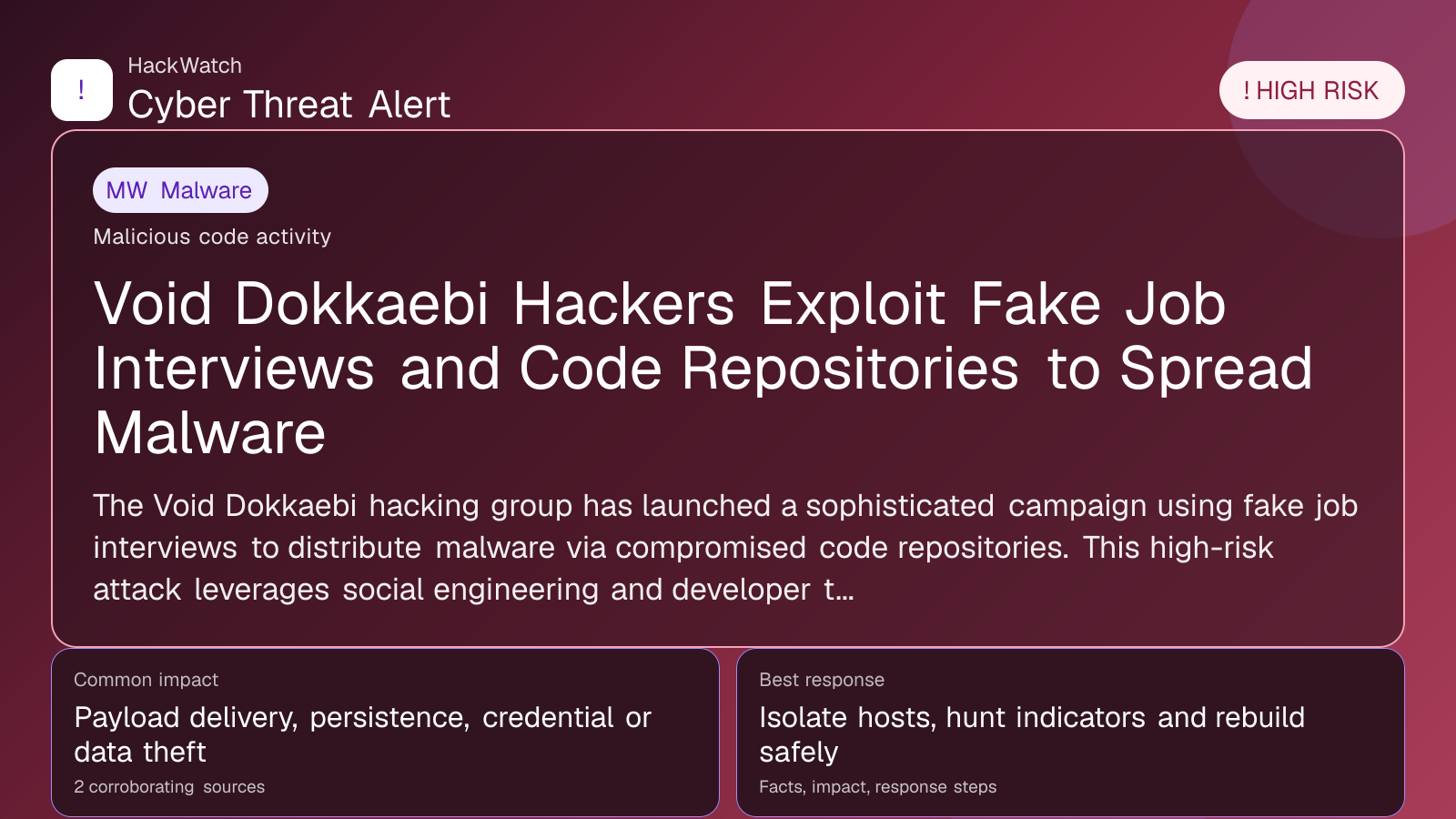
Void Dokkaebi Hackers Exploit Fake Job Interviews and Code Repositories to Spread Malware
Malware coverage focused on infection paths, containment steps and indicators defenders should watch.

By: Artur Ślesik
Published: Apr 24, 2026
Updated: May 01, 2026
Incident status: Active threat
Corroborating sources: 2
Technical review credentials: Security+ evidence | RHCSA evidence | JNCIS-SEC evidence
Trust note:This alert is maintained under HackWatch's editorial policy, with visible source records, a named responsible editor and a correction channel for disputed facts.
The published article is checked against public sources before publication, and material corrections are reflected in the article update date.
Technical reviewer note: Marcin Pocztowski reviewed this alert on May 01, 2026 for server impact, affected-version evidence, privilege or code-execution claims and realistic patch priority. His remediation note follows the same discipline he would use around Juniper routers and production servers: verify scope, preserve useful logs, reduce exposed management access and only then apply the fix or compensating control supported by the 2 corroborating sources.
Review our editorial policy or send corrections to [email protected].
Active threat. The incident should still be treated as active until confirmed mitigation or patch adoption is verified.
The Void Dokkaebi hacking group has launched a sophisticated campaign using fake job interviews to distribute malware via compromised code repositories. This high-risk attack leverages social engineering and developer trust to infiltrate organizations, posing significant threats to cybersecurity worldwide.
# Void Dokkaebi Hackers Exploit Fake Job Interviews and Code Repositories to Spread Malware
What happened
In early 2026, cybersecurity researchers uncovered a high-risk campaign orchestrated by the notorious hacking group known as Void Dokkaebi. This group has been using fake job interview processes to lure software developers and IT professionals into downloading malware disguised within legitimate-looking code repositories. By impersonating recruiters and creating convincing job interview scenarios, Void Dokkaebi successfully infiltrates corporate environments and developer networks.
The attack vector involves sending targeted phishing emails inviting candidates to participate in technical interviews. These interviews require candidates to clone or download code from repositories hosted on popular platforms like GitHub or GitLab. However, these repositories are trojanized with malware that, once executed, grants the attackers remote access or steals sensitive credentials.
This method is particularly dangerous because it exploits the trust developers place in code repositories and the natural inclination to engage with potential employers, making detection and prevention more challenging.
Confirmed facts
- Void Dokkaebi has been confirmed to use fake job interview invitations as a social engineering tactic.
- The malware is embedded in code repositories that appear legitimate and are hosted on well-known platforms.
- Victims are primarily software developers and IT professionals targeted globally.
- The malware payload includes remote access trojans (RATs) and credential stealers.
- The campaign has been active since late 2025 and intensified in early 2026.
- This attack vector complements other Void Dokkaebi tactics, such as fake CAPTCHA pages used to trigger costly international SMS fraud, indicating a multifaceted approach to cybercrime.
Who is affected
The primary victims are software developers, IT professionals, and job seekers in the technology sector. Companies hiring remotely or through online platforms are at increased risk, especially those that do not have stringent verification processes for recruitment communications.
Organizations with remote hiring practices or those relying heavily on external contractors and freelancers face elevated threats, as attackers exploit the blurred lines between personal and professional digital environments.
Additionally, the broader tech community is at risk due to the potential for malware to spread laterally once inside a network.
What to do now
- Verify all job interview invitations: Independently confirm the legitimacy of recruiters and interview requests by contacting the company through official channels.
- Avoid downloading code from unverified repositories: Only clone or download code from trusted sources and verify repository authenticity.
- Use sandbox environments: Test any downloaded code in isolated environments before running it on your primary machine.
- Update security software: Ensure antivirus and endpoint protection solutions are up to date to detect known malware signatures.
- Educate teams: Conduct awareness training about social engineering tactics involving fake job interviews and code repository malware.
How to secure yourself
- Enable multi-factor authentication (MFA): Protect accounts on code repositories and communication platforms.
- Use code signing: Verify the integrity and origin of code before use.
- Implement network segmentation: Limit the potential spread of malware within organizational networks.
- Regularly audit access logs: Monitor for unusual activity on code repositories and development environments.
- Maintain updated backups: Ensure critical data can be restored in case of compromise.
FAQ
How can I tell if a job interview invitation is fake?
Look for inconsistencies in email domains, unsolicited contact from unknown recruiters, requests to download code from unfamiliar repositories, and pressure to act quickly. Always verify through official company channels.
Is downloading code from GitHub safe?
GitHub is generally safe, but only if you trust the repository source. Always check the repository owner’s credibility, review code when possible, and avoid downloading from unknown or suspicious accounts.
What kind of malware does Void Dokkaebi use?
They primarily use remote access trojans (RATs) and credential stealers embedded in code repositories to gain unauthorized access and exfiltrate data.
Can this attack affect non-technical users?
While the primary targets are developers, the malware can spread within networks, potentially impacting broader organizational systems.
What should companies do to protect against this threat?
Implement strict recruitment verification processes, educate employees on social engineering tactics, enforce secure coding practices, and monitor network activity for anomalies.
Has Void Dokkaebi used other attack methods?
Yes, they have also employed fake CAPTCHA pages to induce costly international SMS fraud, demonstrating a multi-pronged attack strategy.
Are there tools to detect trojanized code repositories?
Security tools with behavioral analysis and repository scanning capabilities can help detect malicious code. Some platforms have started integrating these features natively.
What is the risk of ignoring these warnings?
Ignoring these threats can lead to credential theft, unauthorized access, data breaches, financial losses, and damage to organizational reputation.
Why this matters
This campaign highlights a critical shift in cybercriminal tactics, leveraging trusted professional processes like job interviews to bypass traditional security defenses. By weaponizing code repositories—a cornerstone of modern software development—Void Dokkaebi exploits inherent trust within developer communities.
Understanding and mitigating these risks is essential not only for individual developers but also for organizations that depend on secure software supply chains and remote hiring practices. The attack underscores the importance of integrating human-centric threat awareness with technical security measures.
Sources and corroboration
This article synthesizes information from multiple corroborating reports, primarily from CybersecurityNews.com, which detailed both the fake job interview malware distribution and related campaigns involving fake CAPTCHA pages used for SMS fraud. These sources provide a comprehensive view of Void Dokkaebi’s evolving tactics and the broader implications for cybersecurity in 2026.
- https://cybersecuritynews.com/void-dokkaebi-hackers-use-fake-job-interviews/
- https://cybersecuritynews.com/hackers-use-fake-captcha-pages/
---
Tags: [Void Dokkaebi, malware, fake job interviews, code repository malware, social engineering, cybersecurity 2026, phishing, remote access trojan, credential theft, developer security]
Source URLs: ["https://cybersecuritynews.com/void-dokkaebi-hackers-use-fake-job-interviews/", "https://cybersecuritynews.com/hackers-use-fake-captcha-pages/"]
Sources used for this article
cybersecuritynews.com