Deep#Door Backdoor Targets Windows Systems for Espionage and Disruption
Malware coverage focused on infection paths, containment steps and indicators defenders should watch.

Published: May 01, 2026
Incident status: Resolved or patched
Corroborating sources: 3
Technical review credentials: Security+ evidence | RHCSA evidence | JNCIS-SEC evidence
Trust note:This alert is maintained under HackWatch's editorial policy, with visible source records, a named responsible editor and a correction channel for disputed facts.
The published article is checked against public sources before publication, and material corrections are reflected in the article update date.
Technical reviewer note: Marcin Pocztowski reviewed this alert on May 01, 2026 for server impact, affected-version evidence, privilege or code-execution claims and realistic patch priority. His remediation note follows the same discipline he would use around Juniper routers and production servers: verify scope, preserve useful logs, reduce exposed management access and only then apply the fix or compensating control supported by the 3 corroborating sources.
Review our editorial policy or send corrections to [email protected].
Resolved or patched. Source coverage indicates that a fix or formal remediation has been published. Verify that updates are applied in your environment.
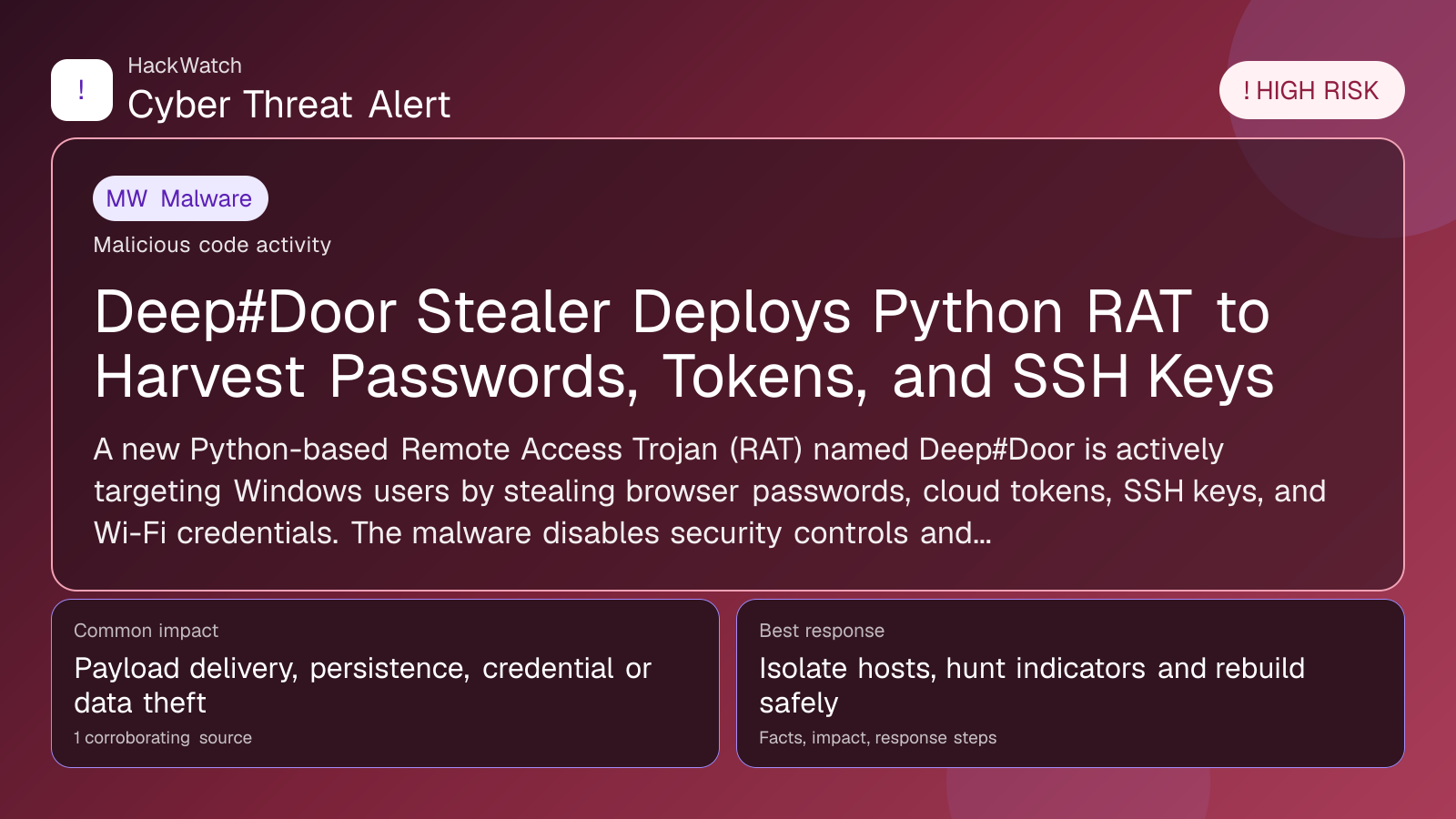
Researchers have uncovered Deep#Door, a Python-based backdoor targeting Windows systems that maintains persistent access for espionage and disruption. Security experts advise organizations to enhance endpoint monitoring and tighten defenses amid growing risks from this advanced malware.
GLOBAL, May 1, 2026, 11:33 UTC
- Deep#Door is a stealthy backdoor written in Python, designed to infiltrate Windows environments.
- It establishes persistent access, enabling long-term espionage and operational interference.
- Organizations should prioritize endpoint scans and network monitoring to detect this threat.
Cybersecurity researchers have identified Deep#Door, a sophisticated backdoor framework that compromises Windows machines by implanting persistent malware. Developed in Python, the backdoor enables threat actors to maintain undetected access over extended periods, facilitating data theft and potential system sabotage.
Deep#Door's significance stems from its stealth and persistence, which allow attackers to evade common detection tools. This capability raises alarm for critical sectors including government agencies and infrastructure operators, where prolonged intrusion could disrupt operations or leak sensitive information.
The malware operates by installing an implant that mimics legitimate Windows processes, complicating detection efforts. Its Python-based architecture provides modularity, allowing attackers to adapt the backdoor for various mission objectives.
SecurityWeek detailed the technical aspects of Deep#Door on May 1, 2026, highlighting its use of encrypted communications and obfuscated code to bypass endpoint defenses and network monitoring systems. These features underscore its advanced design.
Attribution remains inconclusive, though the backdoor's complexity suggests a well-funded actor, possibly a state-sponsored group focused on intelligence collection and disruption campaigns.
Organizations are advised to conduct comprehensive endpoint analyses, focusing on unusual Python process activity and verifying system file integrity. Network traffic should be scrutinized for encrypted or anomalous connections that could indicate backdoor communications.
Incident response teams should isolate compromised devices promptly and perform forensic investigations to assess breach scope. Given Deep#Door’s persistence, full system reimaging may be required to eradicate infections.
The emergence of Deep#Door illustrates a broader trend of attackers leveraging versatile programming languages like Python to develop evasive malware. This evolution challenges traditional detection methods and demands enhanced cybersecurity postures.
Administrators should ensure security solutions are up to date and configured to detect script-based threats. Measures such as application whitelisting and restricting execution privileges can reduce the risk of backdoor deployment.
Robust network segmentation and strict access controls are critical to limit lateral movement if a system is compromised.
Ongoing monitoring of Deep#Door variants and related attack campaigns is essential. Security vendors and intelligence agencies are expected to release updated detection signatures and mitigation strategies as new information emerges.
In summary, Deep#Door presents a high-risk threat to Windows systems, capable of sustained espionage and disruption. Prompt detection and decisive remediation are vital to mitigate its impact.
---
What is Deep#Door?
A Python-based backdoor framework that installs a persistent implant on Windows systems to facilitate espionage and operational disruption.
How does Deep#Door spread?
Initial infection methods remain under investigation but likely involve targeted phishing or exploitation of software vulnerabilities to deploy the Python payload.
Who is behind Deep#Door?
The actor remains unidentified; however, the malware’s sophistication points to a state-sponsored or highly skilled threat group.
How can organizations detect Deep#Door?
Monitoring for unusual Python processes, encrypted communications, and system anomalies is crucial. Endpoint detection tools with script analysis capabilities are recommended.
What actions should be taken if infection is suspected?
Isolate affected devices immediately, conduct forensic analysis, and consider full system reimaging to remove persistent implants.
Is Deep#Door exclusive to Windows?
Currently, the backdoor targets Windows platforms, exploiting Windows-specific persistence mechanisms.
How to protect systems against Deep#Door?
Keep software patched, enforce application whitelisting, limit execution privileges, and implement network segmentation to reduce exposure.
---
Immediate steps:
- Perform endpoint scans focusing on Python-related activity.
- Analyze network traffic for encrypted or unusual connections.
- Investigate recent phishing or exploit attempts.
- Update detection tools with the latest Deep#Door signatures.
- Educate staff on targeted phishing threats.
Security best practices:
- Apply security patches promptly.
- Use application control to restrict script execution.
- Employ multi-factor authentication.
- Segment critical systems to contain breaches.
- Maintain regular backups and test recovery procedures.
---
Security researchers continue to track Deep#Door activity through mid-2026. New variants with enhanced evasion tactics have surfaced. Vendors have issued updated detection rules, and intelligence sharing among organizations has increased. Maintaining vigilance through trusted cybersecurity channels remains essential.
Source: https://www.securityweek.com/sophisticated-deepdoor-backdoor-enables-espionage-disruption/
Sources used for this article
gbhackers.com, cybersecuritynews.com, securityweek.com