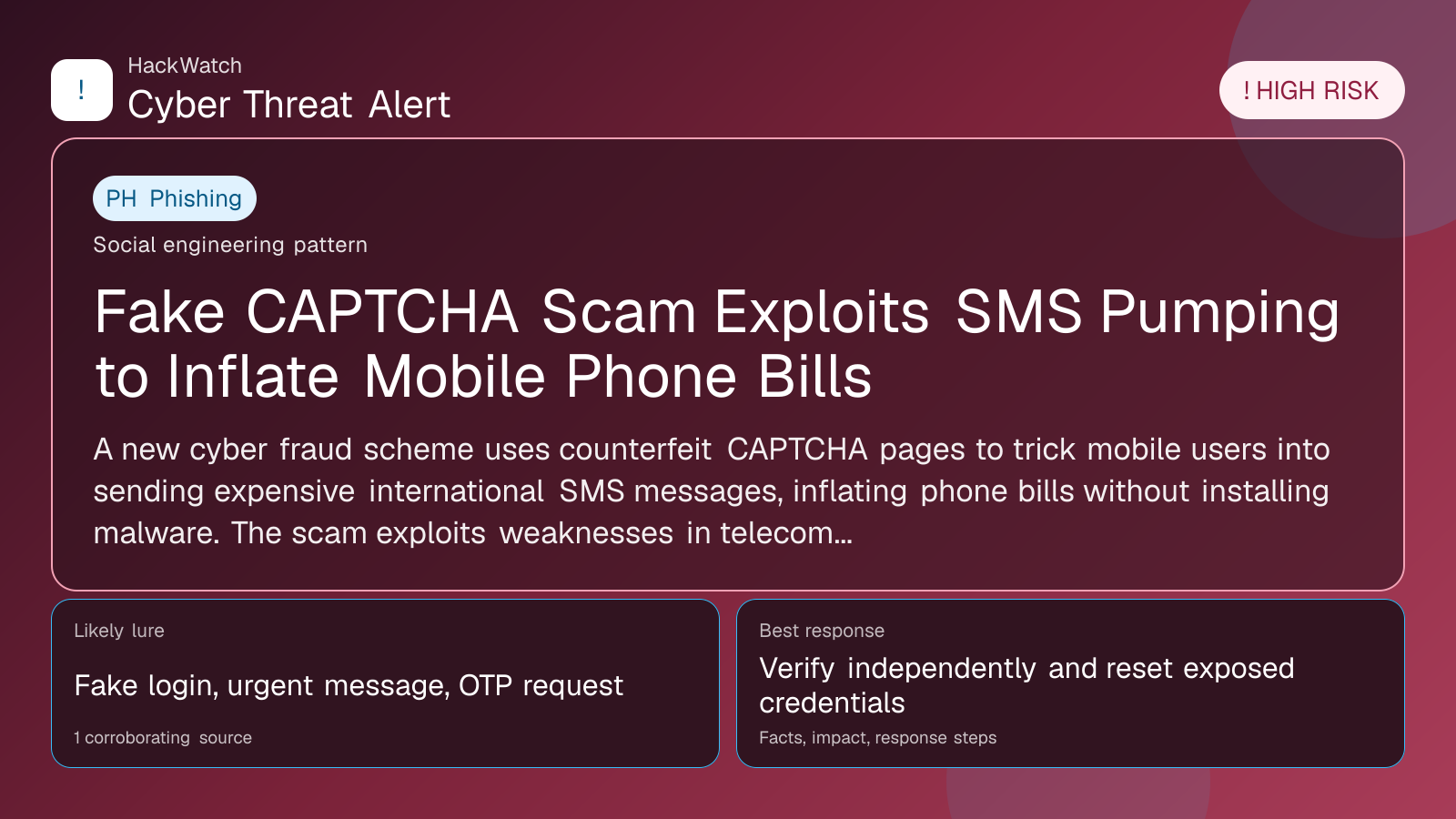
New Fake CAPTCHA Scam Exploits SMS Pumping to Inflate Victims’ Phone Bills
Verification-lure coverage focused on fake messages, cloned pages and account defense steps.

By: Artur Ślesik
Published: May 01, 2026
Incident status: Active threat
Corroborating sources: 2
Technical review credentials: Security+ evidence | RHCSA evidence | JNCIS-SEC evidence
Trust note:This alert is maintained under HackWatch's editorial policy, with visible source records, a named responsible editor and a correction channel for disputed facts.
The published article is checked against public sources before publication, and material corrections are reflected in the article update date.
Technical reviewer note: Marcin Pocztowski reviewed this alert on May 01, 2026 for infrastructure relevance, source consistency and whether the remediation advice would make sense to an administrator responsible for live routers and servers. His note keeps the action list grounded: validate scope, reduce exposed management paths, keep evidence intact and avoid claims that go beyond the 2 corroborating sources.
Review our editorial policy or send corrections to [email protected].
Active threat. The incident should still be treated as active until confirmed mitigation or patch adoption is verified.
A new fraud scheme uses counterfeit CAPTCHA challenges to covertly send international SMS messages from victims’ phones, leading to unexpected charges. By mimicking a routine online verification step, the scam inflates phone bills without user consent.
GLOBAL, May 1, 2026, 07:50 UTC
- Fraudsters deploy fake CAPTCHA pages to initiate SMS pumping attacks
- Victims incur high phone bills from unsolicited international text messages
- The scam bypasses typical user suspicion by mimicking legitimate verification steps
A recently identified fraud campaign exploits counterfeit CAPTCHA prompts to trigger multiple international SMS messages from users’ mobile devices. This SMS pumping tactic results in inflated phone bills without the victim’s awareness, cybersecuritynews.com reported.
The scam takes advantage of the ubiquity of CAPTCHA tests—those challenges that verify a user is human—to disguise its malicious activity. When users encounter the fake CAPTCHA, their phones are used to send premium-rate or international SMS texts, generating charges that appear later on their bills.
This approach is particularly effective because it leverages a familiar security step. Users tend to comply with CAPTCHA prompts without suspicion, enabling fraudsters to operate under the radar. The attackers profit from the fees telecom providers charge for these unsolicited messages.
Experts warn that many victims only realize they have been targeted after receiving unexpectedly high phone bills. The costs can be substantial, especially when messages are sent to premium or international numbers.
Telecom companies and cybersecurity firms are investigating the campaign’s reach. Early findings suggest the scam is global, impacting regions where premium SMS services are available.
Users are advised to carefully review phone bills for unusual SMS charges and report suspicious activity to their carriers promptly. Blocking unknown or premium SMS numbers and installing mobile security apps can reduce exposure.
This incident highlights evolving fraud tactics that monetize routine online behaviors. It underscores the importance of vigilance during common interactions like CAPTCHA verification.
The threat is likely to persist as attackers refine their methods, potentially combining SMS pumping with other fraud techniques. Authorities urge mobile users to monitor accounts closely and maintain updated device security.
Some carriers are exploring enhanced detection systems to flag abnormal SMS activity. Meanwhile, cybersecurity advisories emphasize educating users about risks posed by unsolicited SMS prompts disguised as legitimate web functions.
The campaign’s use of fake CAPTCHA pages signals a shift in social engineering, blending technical manipulation with psychological deception to maximize impact.
No single defense can fully block this scam yet, but layered security measures and user awareness are critical. The situation remains dynamic, with further updates expected.
Users suspecting exposure should contact their mobile providers immediately and review recent message activity for unauthorized SMS.
This scam serves as a reminder that even standard security checks can be weaponized, demanding continuous vigilance from users and service providers alike.
For additional guidance on protection and recognizing suspicious SMS activity, see the following recommendations.
Frequently Asked Questions
Q: How can I tell if I’ve been affected?
Check your phone bill for unusual international or premium SMS charges. Sudden spikes in messaging fees are a key indicator.
Q: Will antivirus software detect this scam?
Traditional antivirus may not detect it since the scam exploits web pages and SMS functions. Mobile security apps with SMS monitoring offer better protection.
Q: What should I do if I see a suspicious CAPTCHA prompt?
Avoid interacting with it. Close the browser tab or app immediately and do not enter any information.
Q: Are certain devices or carriers more vulnerable?
Any SMS-capable device can be targeted. Vulnerability depends largely on carrier policies around premium SMS blocking.
Q: Can premium SMS messages be blocked?
Many carriers allow blocking premium or international SMS. Contact your provider to enable these restrictions.
Immediate Actions
- Review recent phone bills for unfamiliar SMS charges.
- Contact your carrier to dispute unauthorized fees.
- Enable carrier-level blocking of premium and international SMS if available.
- Avoid interacting with suspicious CAPTCHA prompts.
- Keep your device’s OS and security software updated.
Security Tips
- Use mobile security apps that monitor SMS activity.
- Restrict browser and app permissions related to SMS sending.
- Educate yourself on phishing and social engineering tactics.
- Regularly check messaging logs for unknown sent messages.
- Report suspicious sites or apps to authorities.
Sources used for this article
gbhackers.com, cybersecuritynews.com