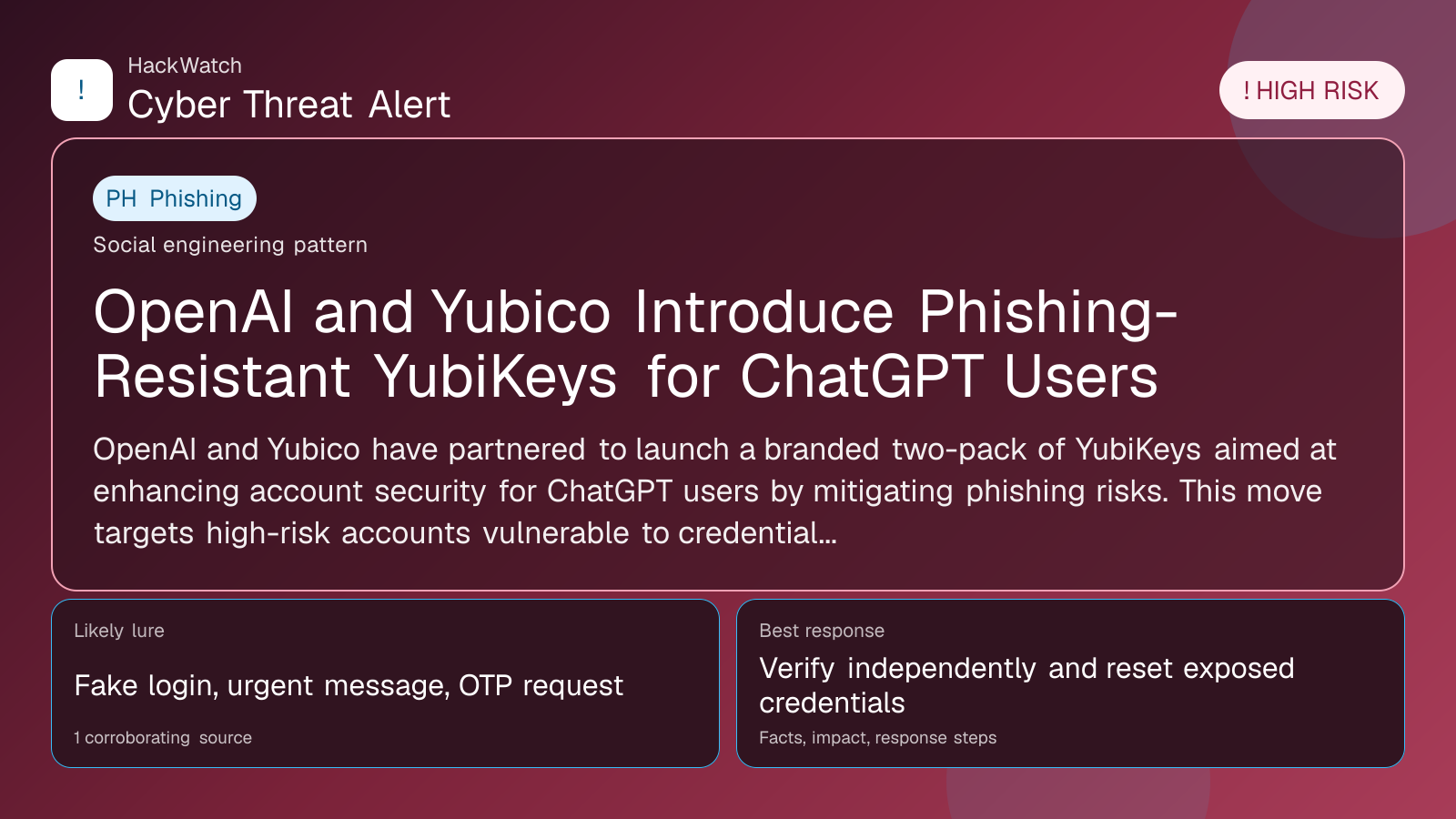
OpenAI and Yubico Introduce Phishing-Resistant YubiKeys for ChatGPT Users
Verification-lure coverage focused on fake messages, cloned pages and account defense steps.

By: Artur Ślesik
Published: May 01, 2026
Incident status: Active threat
Corroborating sources: 1
Technical review credentials: Security+ evidence | RHCSA evidence | JNCIS-SEC evidence
Trust note:This alert is maintained under HackWatch's editorial policy, with visible source records, a named responsible editor and a correction channel for disputed facts.
The published article is checked against public sources before publication, and material corrections are reflected in the article update date.
Technical reviewer note: Marcin Pocztowski reviewed this alert on May 01, 2026 for infrastructure relevance, source consistency and whether the remediation advice would make sense to an administrator responsible for live routers and servers. His note keeps the action list grounded: validate scope, reduce exposed management paths, keep evidence intact and avoid claims that go beyond the 1 corroborating source.
Review our editorial policy or send corrections to [email protected].
Active threat. The incident should still be treated as active until confirmed mitigation or patch adoption is verified.
OpenAI and Yubico have partnered to launch a branded two-pack of YubiKeys aimed at enhancing account security for ChatGPT users by mitigating phishing risks. This move targets high-risk accounts vulnerable to credential theft and unauthorized access.
GLOBAL, May 1, 2026, 02:35 UTC
London, May 1, 2026, 03:35 UTC
- OpenAI and Yubico release a branded two-pack of YubiKeys for ChatGPT users.
- The hardware keys provide strong phishing-resistant multi-factor authentication.
- The initiative targets protection of high-risk accounts against credential theft.
OpenAI and Yubico have unveiled a new partnership to provide ChatGPT users with a branded two-pack of YubiKeys, hardware security keys designed to prevent phishing attacks and secure high-risk accounts. The announcement comes amid growing concerns over credential theft and unauthorized access to AI platforms.
Phishing attacks, which trick users into revealing login credentials, remain a leading cause of account compromise. By integrating physical security keys like YubiKeys, OpenAI aims to add a robust layer of defense that is resistant to such social engineering tactics.
The YubiKey devices use public key cryptography to authenticate users without transmitting passwords, making it significantly harder for attackers to intercept or reuse credentials. This approach aligns with industry best practices for multi-factor authentication (MFA), especially for accounts with elevated privileges or sensitive data.
OpenAI’s branded YubiKey package includes two hardware tokens, encouraging users to have a backup key in case one is lost or damaged. This reduces the risk of lockout while maintaining strong security standards.
The move reflects a broader industry trend where technology companies are promoting hardware-based MFA to combat increasingly sophisticated phishing campaigns. Google and Microsoft have similarly advocated for security keys to protect user accounts.
Users of ChatGPT and related OpenAI services can purchase the YubiKey two-pack directly from Yubico or through OpenAI’s platform. The companies recommend enabling the keys as part of the login process to enhance account security.
Experts note that while hardware keys are highly effective, adoption rates remain low due to user convenience factors. OpenAI’s co-branding effort may help increase awareness and uptake among its user base.
Security analysts caution that no single solution is foolproof. Users should combine hardware MFA with vigilant security practices, including monitoring account activity and using unique passwords.
Looking ahead, the partnership signals OpenAI’s commitment to securing AI-driven services as they become more embedded in daily workflows and critical applications.
What to Do Now
Users concerned about phishing risks should consider purchasing the OpenAI-branded YubiKey two-pack. Enabling hardware MFA can drastically reduce the chance of account takeover. Backup keys should be stored securely to avoid lockout.
How to Secure Yourself
- Register your YubiKey with your OpenAI account.
- Use unique, strong passwords alongside the hardware key.
- Remain alert for phishing attempts and suspicious login notifications.
- Keep your backup key in a safe place.
Sources used for this article
securitybrief.co.uk