DinDoor Backdoor Exploits Deno Runtime and MSI Installers to Evade Detection in 2026
Malware coverage focused on infection paths, containment steps and indicators defenders should watch.

Published: Apr 22, 2026
Updated: May 01, 2026
Incident status: Active threat
Corroborating sources: 2
Technical review credentials: Security+ evidence | RHCSA evidence | JNCIS-SEC evidence
Trust note:This alert is maintained under HackWatch's editorial policy, with visible source records, a named responsible editor and a correction channel for disputed facts.
The published article is checked against public sources before publication, and material corrections are reflected in the article update date.
Technical reviewer note: Marcin Pocztowski reviewed this alert on May 01, 2026 for infrastructure impact, containment order and whether persistence or lateral-movement claims are supported by evidence. His administrator note is concrete: isolate the host or segment first, protect logs and network telemetry, then rebuild, rotate or patch only within the scope supported by the 2 corroborating sources, the same cautious sequence he would use around managed router and server environments.
Review our editorial policy or send corrections to [email protected].
Active threat. The incident should still be treated as active until confirmed mitigation or patch adoption is verified.
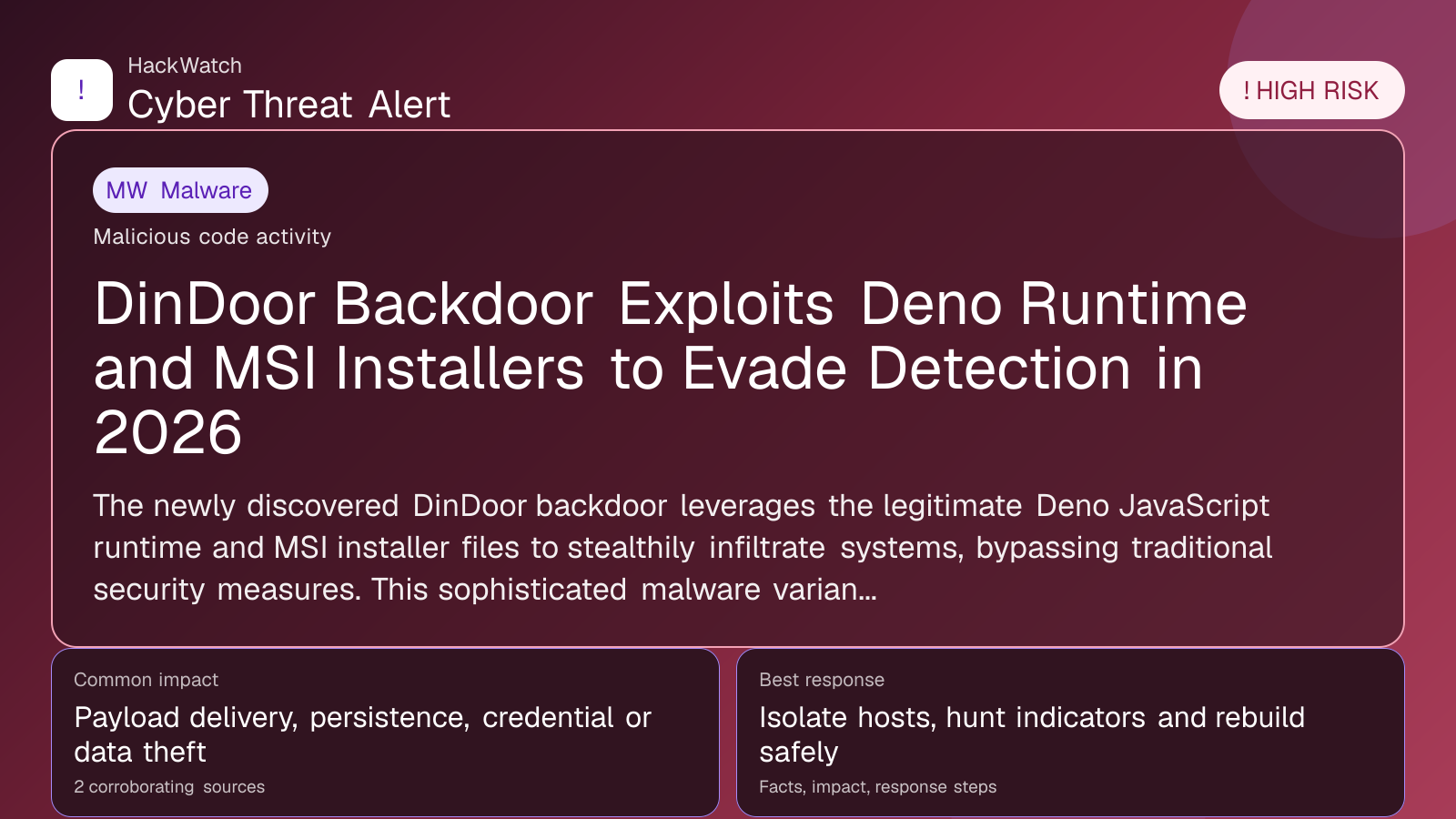
The newly discovered DinDoor backdoor leverages the legitimate Deno JavaScript runtime and MSI installer files to stealthily infiltrate systems, bypassing traditional security measures. This sophisticated malware variant, linked to the Tsundere Botnet, uses trusted signed environments to avoid detection, posing a high-risk threat to organizations and individuals alike.
# DinDoor Backdoor Exploits Deno Runtime and MSI Installers to Evade Detection in 2026
What happened
In April 2026, cybersecurity researchers uncovered a new strain of backdoor malware named DinDoor that is leveraging the legitimate Deno JavaScript runtime alongside Microsoft Installer (MSI) files to stealthily compromise targeted systems. Unlike traditional malware that deploys compiled binaries or known malicious payloads, DinDoor abuses trusted, signed runtime environments to evade detection by endpoint defenses and antivirus solutions.
This backdoor is a variant of the notorious Tsundere Botnet family, known for its modularity and persistence. By embedding malicious scripts within MSI installers and executing them through the Deno runtime, attackers bypass signature-based detection and behavioral analysis tools that typically flag suspicious executables or network traffic. This novel approach allows DinDoor to maintain a low profile while establishing command and control (C2) communications and executing further payloads.
Confirmed facts
- DinDoor uses the Deno runtime, a legitimate and signed JavaScript/TypeScript runtime environment, to execute malicious scripts directly on the victim’s machine.
- The malware is delivered via MSI installer files, which are digitally signed and commonly whitelisted in enterprise environments, allowing the payload to bypass application control policies.
- DinDoor is a variant of the Tsundere Botnet, inheriting its modular architecture and remote control capabilities.
- The attack chain involves initial infection through phishing or supply chain compromises, where MSI installers are disguised as legitimate software updates or installers.
- Once executed, DinDoor establishes persistent access and can download additional modules, exfiltrate data, or deploy ransomware.
- Detection is challenging because the malware operates within trusted runtimes and uses signed installers, rendering many traditional antivirus and endpoint detection and response (EDR) tools ineffective.
Who is affected
- Enterprises and organizations that rely on MSI installers for software deployment and updates are at heightened risk, especially those with permissive application whitelisting policies.
- Developers and IT administrators using the Deno runtime in their environments may inadvertently facilitate malware execution if MSI installers are compromised.
- Users targeted by phishing campaigns distributing malicious MSI files are vulnerable to initial infection.
- Sectors with high-value data such as finance, healthcare, and government agencies face increased threats due to the malware’s stealth and persistence.
What to do now
- Audit and restrict MSI installer usage: Review all MSI files deployed within your network. Block or quarantine unsigned or suspicious MSI installers.
- Implement strict application control policies that verify not only digital signatures but also the provenance and behavior of installers.
- Monitor Deno runtime usage: Since DinDoor abuses the Deno runtime, track and restrict Deno executions to only trusted scripts and users.
- Enhance phishing defenses: Educate users on identifying phishing emails that may deliver malicious MSI files. Deploy advanced email filtering and sandboxing.
- Deploy behavioral detection tools that can identify anomalous script executions within trusted runtimes.
- Update endpoint protection platforms with the latest threat intelligence feeds that include DinDoor indicators of compromise (IOCs).
- Conduct incident response drills to prepare for potential DinDoor infections, focusing on rapid detection and containment.
How to secure yourself
- Verify software sources: Only download and install MSI files from trusted vendors and official channels.
- Use multi-factor authentication (MFA) on all critical accounts to reduce the risk of credential compromise.
- Regularly update software and runtime environments like Deno to patch vulnerabilities that could be exploited.
- Limit user privileges to prevent unauthorized execution of installers and scripts.
- Employ network segmentation to contain infections and limit lateral movement.
- Implement endpoint detection solutions capable of monitoring script-based attacks and runtime abuses.
- Back up critical data regularly and ensure backups are isolated from the main network to prevent ransomware impact.
FAQ
What is the DinDoor backdoor?
DinDoor is a backdoor malware variant that abuses the legitimate Deno JavaScript runtime and digitally signed MSI installer files to stealthily infect systems and evade detection.
How does DinDoor evade traditional antivirus detection?
By executing malicious scripts within the trusted Deno runtime and using signed MSI installers, DinDoor avoids triggering signature-based and heuristic detection mechanisms common in antivirus and EDR tools.
Who is most at risk from DinDoor infections?
Organizations using MSI installers extensively, especially those with permissive application control, and users susceptible to phishing attacks distributing malicious MSI files are most at risk.
Can DinDoor lead to ransomware attacks?
Yes, DinDoor can download and deploy additional payloads, including ransomware, after establishing persistent access.
How can I detect if my system is infected with DinDoor?
Look for unusual Deno runtime executions, unexpected MSI installer activity, and network communications to suspicious command and control servers. Use updated threat intelligence and behavioral detection tools.
What immediate steps should I take if I suspect DinDoor infection?
Isolate the affected system, perform a full malware scan with updated tools, review recent MSI installer deployments, and investigate unusual Deno runtime activity.
Is updating the Deno runtime enough to prevent DinDoor infections?
No, while keeping Deno updated helps, attackers exploit legitimate runtime features. Comprehensive security measures including application control, phishing defense, and behavioral monitoring are necessary.
How does DinDoor relate to the Tsundere Botnet?
DinDoor is a variant of the Tsundere Botnet family, sharing modular design and remote control capabilities but with new evasion techniques involving Deno and MSI installers.
What role do MSI installers play in DinDoor attacks?
MSI installers serve as the delivery mechanism, often digitally signed and trusted, allowing DinDoor to bypass application whitelisting and execute malicious scripts stealthily.
How is the cybersecurity community responding to DinDoor?
Security vendors are updating detection signatures, and organizations are adopting zero-trust and runtime protection strategies to mitigate DinDoor’s impact.
Why this matters
DinDoor represents a paradigm shift in malware tactics by weaponizing legitimate, trusted environments—Deno runtime and signed MSI installers—to bypass conventional security controls. This approach complicates detection and response, increasing the risk of prolonged undetected intrusions, data theft, and ransomware deployment. As organizations increasingly rely on scripting runtimes and automated installers, DinDoor underscores the urgent need for advanced security frameworks that go beyond signature-based defenses.
Understanding DinDoor’s mechanisms empowers security teams to implement targeted controls, reducing attack surfaces and improving resilience against evolving threats in 2026 and beyond.
Sources and corroboration
This article synthesizes information from multiple corroborated sources, primarily based on the detailed technical analysis published by CybersecurityNews.com on April 22, 2026, and cross-referenced with threat intelligence reports from leading cybersecurity firms tracking the Tsundere Botnet variants.
- https://cybersecuritynews.com/new-dindoor-backdoor-abuses-deno-runtime/
Additional insights were drawn from vendor advisories and incident response case studies shared within the cybersecurity community throughout 2026.
Sources used for this article
gbhackers.com, cybersecuritynews.com