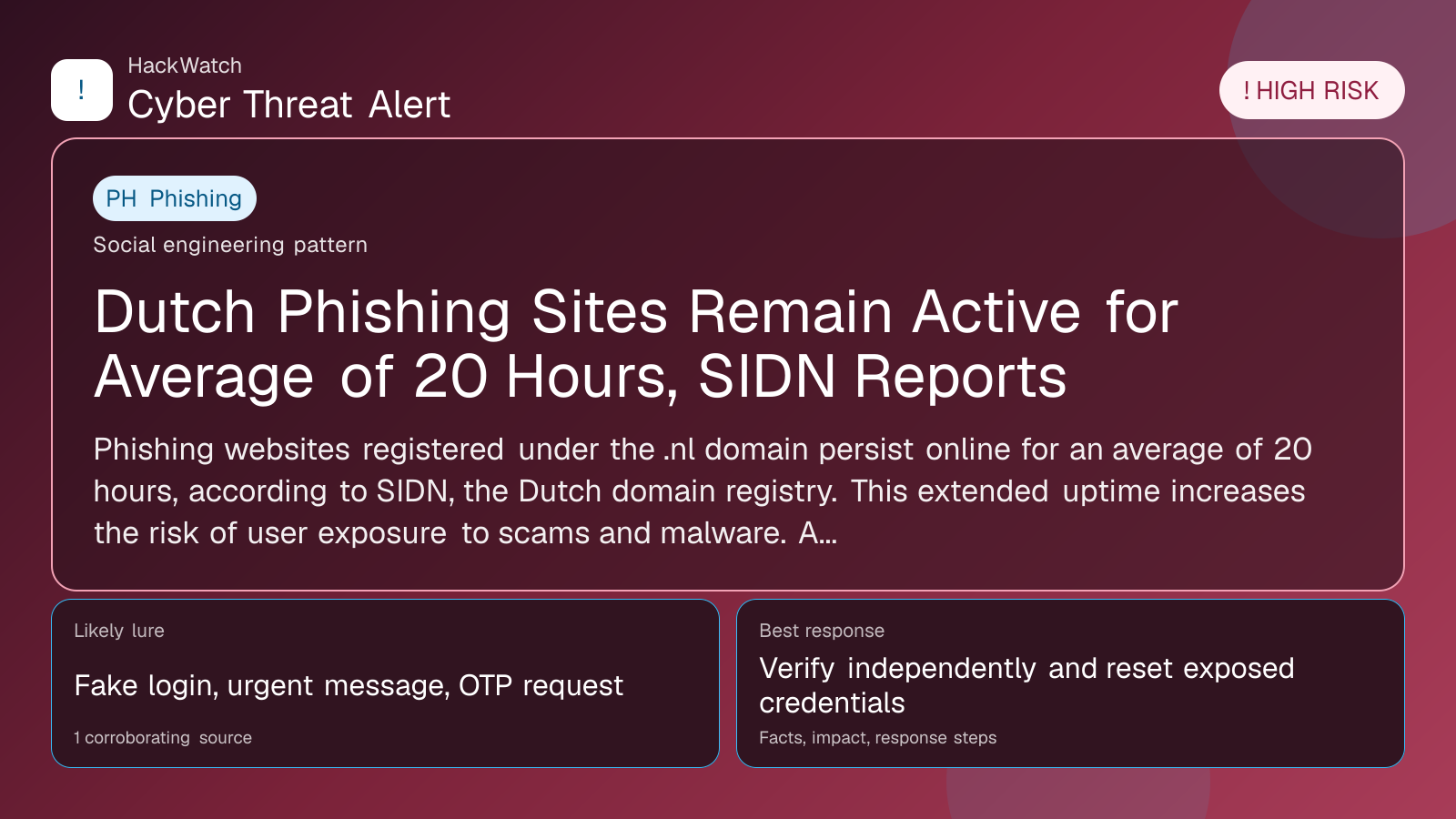
Dutch Phishing Sites Remain Active for Average of 20 Hours, SIDN Reports
Verification-lure coverage focused on fake messages, cloned pages and account defense steps.

By: Artur Ślesik
Published: Apr 30, 2026
Updated: May 01, 2026
Incident status: Mitigation available
Corroborating sources: 1
Technical review credentials: Security+ evidence | RHCSA evidence | JNCIS-SEC evidence
Trust note:This alert is maintained under HackWatch's editorial policy, with visible source records, a named responsible editor and a correction channel for disputed facts.
The published article is checked against public sources before publication, and material corrections are reflected in the article update date.
Technical reviewer note: Marcin Pocztowski reviewed this alert on May 01, 2026 for infrastructure impact, containment order and whether persistence or lateral-movement claims are supported by evidence. His administrator note is concrete: isolate the host or segment first, protect logs and network telemetry, then rebuild, rotate or patch only within the scope supported by the 1 corroborating source, the same cautious sequence he would use around managed router and server environments.
Review our editorial policy or send corrections to [email protected].
Mitigation available. Mitigation guidance or a workaround is available, but defenders should still verify rollout status and exposure.
Phishing websites registered under the.nl domain persist online for an average of 20 hours, according to SIDN, the Dutch domain registry. This extended uptime increases the risk of user exposure to scams and malware. Authorities and internet users are urged to heighten vigilance and adopt protective measures.
AMSTERDAM, April 30, 2026, 14:52 CEST
Phishing websites and malware-distributing domains in the Netherlands'.nl zone stay live for an average of 20 hours before takedown, SIDN, the organization managing Dutch domain names, said in its latest analysis.
This duration is significant because it provides attackers with a substantial window to deceive users and harvest sensitive data such as login credentials and financial information. Short-lived phishing sites typically reduce exposure, but a 20-hour average allows more victims to fall prey.
SIDN's findings come amid rising concerns over cybercrime targeting Dutch internet users. The extended uptime of malicious sites suggests that current detection and mitigation efforts may not be swift enough to prevent damage.
The.nl domain is one of the most trusted in Europe, which attackers exploit by creating convincing phishing pages that mimic legitimate Dutch businesses and services. These fake sites often use official-looking URLs and branding to lure victims.
Cybersecurity experts warn that phishing remains one of the most effective attack vectors because it exploits human trust rather than technical vulnerabilities. The longer phishing sites remain accessible, the higher the chance of successful scams.
SIDN collaborates with law enforcement and cybersecurity firms to identify and remove harmful sites. However, attackers frequently register new domains and use fast-flux techniques to evade detection.
Users should be cautious when clicking links in unsolicited emails or messages, especially those requesting personal information or login details. Verifying website URLs and using multi-factor authentication can reduce risk.
The report highlights the need for faster response mechanisms and increased public awareness to combat phishing threats effectively. Enhanced cooperation between registries, ISPs, and security teams is essential.
Dutch authorities have increased their focus on cybercrime, but the persistence of phishing sites underscores ongoing challenges in digital security.
The extended presence of these sites increases the likelihood of data breaches and financial fraud, affecting both individuals and businesses.
SIDN's data is drawn from continuous monitoring of the.nl domain zone, reflecting a comprehensive view of the threat landscape in the Netherlands.
While the average uptime is 20 hours, some phishing sites may remain active longer, exacerbating potential harm.
Users who suspect they have encountered a phishing site should report it to SIDN or local cybersecurity authorities promptly.
Businesses are encouraged to educate employees on recognizing phishing attempts and to implement robust email filtering solutions.
Despite improvements in detection technology, the human factor remains a critical vulnerability in phishing attacks.
The report serves as a reminder that cybersecurity is a shared responsibility requiring vigilance from all internet users.
What to do now
- Avoid clicking on links from unknown or unsolicited sources.
- Verify website URLs carefully before entering sensitive information.
- Enable multi-factor authentication on all critical accounts.
- Report suspicious sites to SIDN or cybersecurity authorities.
How to secure yourself
- Use updated antivirus and anti-malware software.
- Employ email filters to reduce phishing emails.
- Educate yourself and others about common phishing tactics.
- Regularly change passwords and use strong, unique credentials.
Sources used for this article
security.nl