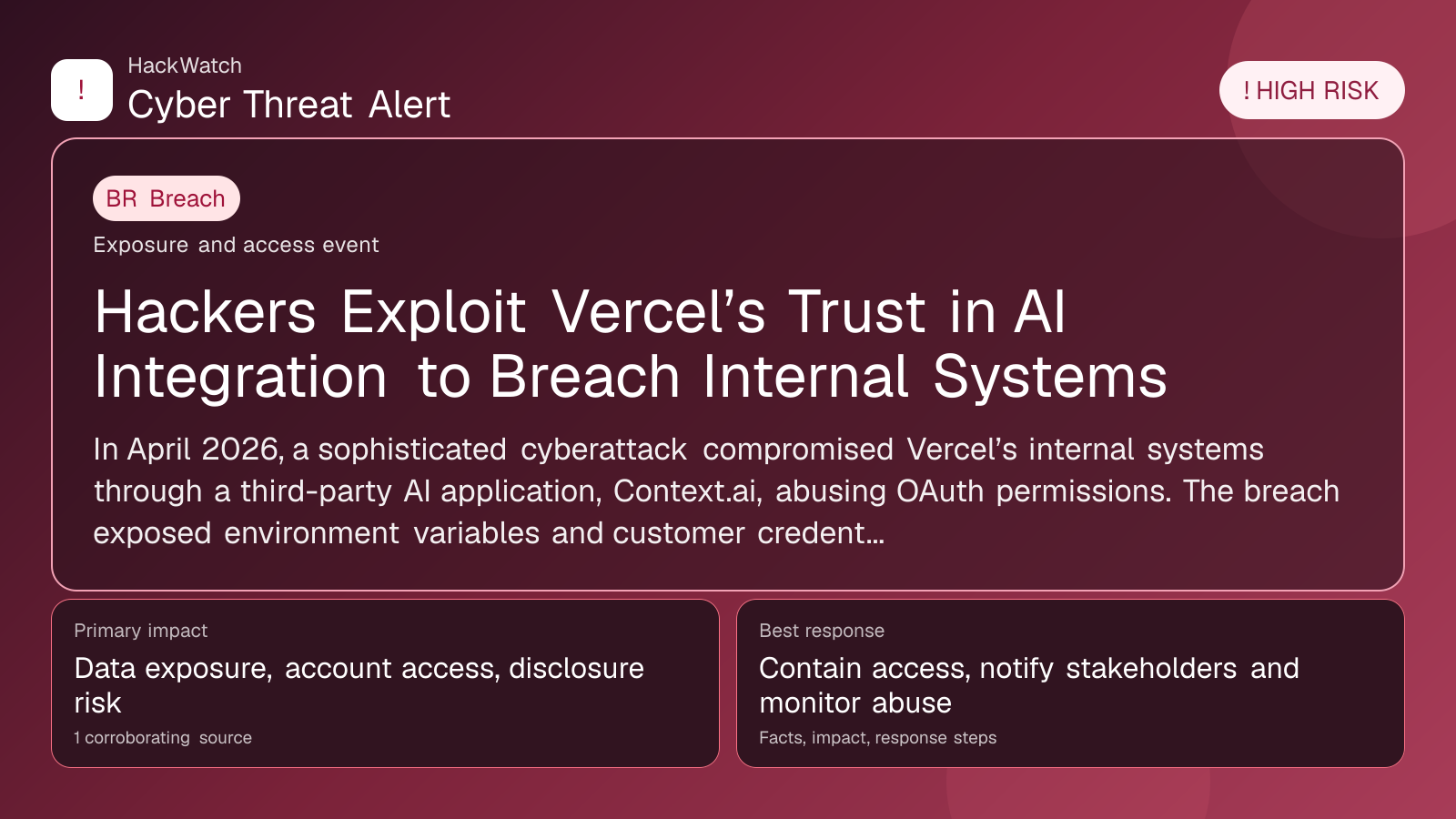
Hackers Exploit Vercel’s Trust in AI Integration to Breach Internal Systems
Breach coverage centered on exposed data, scope clarification and immediate containment priorities.

By: Artur Ślesik
Published: Apr 20, 2026
Updated: May 01, 2026
Incident status: Mitigation available
Corroborating sources: 1
Technical review credentials: Security+ evidence | RHCSA evidence | JNCIS-SEC evidence
Trust note:This alert is maintained under HackWatch's editorial policy, with visible source records, a named responsible editor and a correction channel for disputed facts.
The published article is checked against public sources before publication, and material corrections are reflected in the article update date.
Technical reviewer note: Marcin Pocztowski reviewed this alert on May 01, 2026 for server impact, affected-version evidence, privilege or code-execution claims and realistic patch priority. His remediation note follows the same discipline he would use around Juniper routers and production servers: verify scope, preserve useful logs, reduce exposed management access and only then apply the fix or compensating control supported by the 1 corroborating source.
Review our editorial policy or send corrections to [email protected].
Mitigation available. Mitigation guidance or a workaround is available, but defenders should still verify rollout status and exposure.
In April 2026, a sophisticated cyberattack compromised Vercel’s internal systems through a third-party AI application, Context.ai, abusing OAuth permissions. The breach exposed environment variables and customer credentials, prompting urgent security measures. Threat actors, possibly linked to the ShinyHunters group, attempted to sell stolen data on the dark web.
# Hackers Exploit Vercel’s Trust in AI Integration to Breach Internal Systems
What happened
In April 2026, Vercel, a leading frontend cloud platform known for Next.js and Turbo.js, disclosed a significant security breach stemming from a compromised third-party AI application, Context.ai. Attackers exploited OAuth permissions granted to this AI integration to gain unauthorized access to Vercel’s internal Google Workspace accounts. This access allowed them to retrieve environment variables that were not marked as "sensitive," exposing a limited subset of Vercel customers to potential credential compromise.
The breach was first hinted at by a threat actor claiming to be part of the notorious Shinyhunters hacking collective, who attempted to sell stolen data including access keys, source code, and private databases on dark web forums. Vercel confirmed the breach publicly after these claims surfaced, emphasizing their ongoing investigation and mitigation efforts.
Confirmed facts
- The initial attack vector was OAuth abuse via Context.ai, a third-party AI application used by a Vercel employee.
- Attackers gained access to the employee’s Google Workspace account and subsequently Vercel internal systems.
- Environment variables not marked as "sensitive" were accessed; however, sensitive variables remain protected and show no evidence of compromise.
- A limited subset of Vercel customers had their credentials exposed due to this breach.
- Vercel has contacted affected customers to rotate credentials and recommended security best practices.
- Threat actors, possibly impersonating Shinyhunters, posted stolen data for sale on BreachForums and Telegram channels.
- Vercel engaged cybersecurity firm Mandiant and law enforcement to investigate the incident.
- The exact method of compromise—whether Context.ai’s infrastructure was breached or OAuth tokens were stolen—remains under investigation.
Who is affected
- Vercel employees whose Google Workspace accounts were accessible via Context.ai OAuth tokens.
- A limited subset of Vercel customers whose credentials and environment variables were exposed.
- Potentially, users of projects hosted on Vercel that rely on environment variables not marked as sensitive.
If you have not been contacted by Vercel, there is currently no evidence your credentials or personal data were compromised.
What to do now
- Check for communication from Vercel: If you are a Vercel customer, verify whether you have received notifications regarding credential exposure.
- Rotate credentials immediately: Change all environment variables, API keys, tokens, and database credentials, especially those not marked as sensitive.
- Review activity logs: Audit recent deployment logs and access records for suspicious activity or unauthorized changes.
- Enable sensitive variable protections: Mark all critical secrets as "sensitive" within Vercel to ensure they are stored securely and inaccessible.
- Update deployment protection settings: Strengthen safeguards such as two-factor authentication (2FA) and IP restrictions on deployment pipelines.
- Monitor for phishing or suspicious communications: Attackers may attempt follow-up social engineering using stolen information.
How to secure yourself
- Use OAuth cautiously: Limit OAuth app permissions and regularly review authorized applications in your Google Workspace and other integrated services.
- Implement strict secret management: Always mark sensitive environment variables appropriately and rotate keys frequently.
- Adopt zero-trust principles: Minimize trust granted to third-party integrations and enforce least privilege access.
- Enable multi-factor authentication (MFA): Protect all accounts with MFA to reduce the risk of account takeover.
- Monitor logs proactively: Set up alerts for unusual account activity or deployment anomalies.
- Educate teams on supply chain risks: Third-party app compromises are increasingly common attack vectors.
FAQ
How did the attackers gain access to Vercel’s systems?
They exploited OAuth permissions granted to the third-party AI app Context.ai, which was authorized by a Vercel employee, allowing them to access Google Workspace accounts and internal environment variables.
What kind of data was exposed in the breach?
Non-sensitive environment variables, some customer credentials, access keys, source code, and private databases were exposed. Sensitive variables marked as such were not accessed.
Am I affected if I use Vercel but have not been contacted?
If you have not received communication from Vercel, there is currently no evidence your credentials or data were compromised.
What steps should Vercel customers take immediately?
Rotate all environment variables and credentials, review deployment logs for suspicious activity, enable sensitive variable protections, and update deployment security settings.
Could this breach lead to further attacks?
Yes, exposed credentials and keys can be used for follow-up attacks such as unauthorized deployments, data exfiltration, or phishing campaigns.
What is OAuth abuse and why is it dangerous?
OAuth abuse occurs when attackers exploit authorized tokens or permissions granted to third-party apps to gain unauthorized access to systems, bypassing traditional authentication.
How can I protect my organization from similar breaches?
Limit third-party app permissions, enforce least privilege access, use MFA, monitor logs, and educate staff on supply chain risks.
Has Vercel improved its security since the breach?
Yes, Vercel has enhanced sensitive variable protections, deployment safeguards, and is collaborating with cybersecurity firms and law enforcement to prevent future incidents.
Why this matters
This breach exemplifies the increasing risks posed by third-party AI integrations and OAuth token abuse in cloud environments. As organizations rapidly adopt AI-enhanced workflows, attackers are targeting trust relationships to escalate privileges and access sensitive data. The Vercel incident serves as a critical warning for developers, cloud platform users, and security teams to reassess their OAuth governance and secret management practices.
Failure to act promptly can lead to severe consequences including source code theft, data leaks, supply chain attacks, and reputational damage. The attempted sale of stolen Vercel data on dark web marketplaces also highlights the monetization of such breaches, fueling further cybercrime.
Sources and corroboration
This article is based on multiple corroborated reports, primarily from CSO Online’s detailed coverage dated April 20, 2026, and verified public disclosures by Vercel. Additional intelligence was gathered from dark web monitoring and cybersecurity firm advisories involved in the investigation.
- [CSO Online: Hackers exploit Vercel’s trust in AI integration](https://www.csoonline.com/article/4160853/hackers-exploit-vercels-trust-in-ai-integration.html)
- Vercel official security post (publicly referenced)
- Dark web threat actor postings on BreachForums and Telegram
- Mandiant and law enforcement collaboration statements
---
Stay vigilant and prioritize securing your cloud environments against emerging AI integration threats.
Sources used for this article
csoonline.com