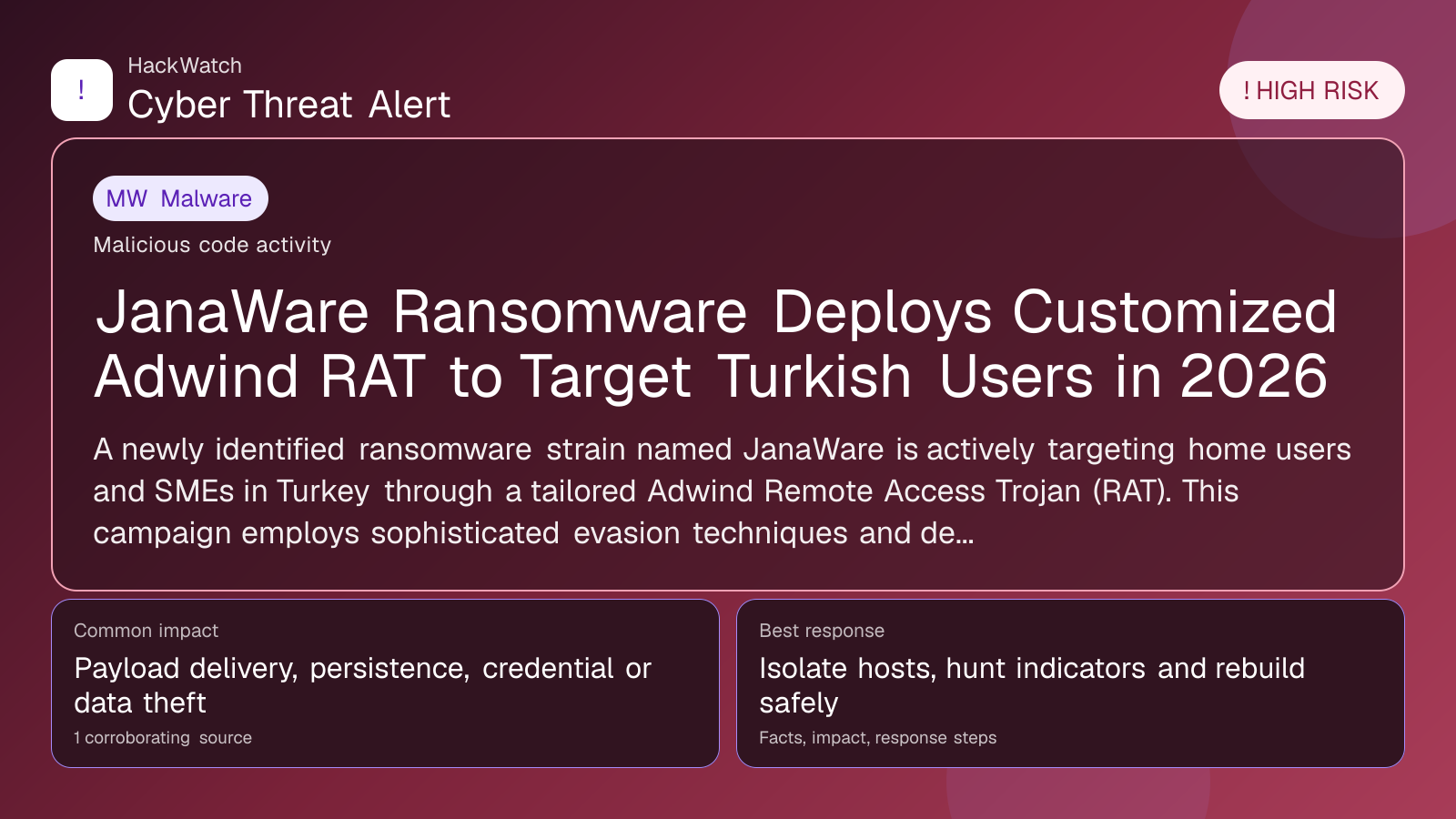
JanaWare Ransomware Deploys Customized Adwind RAT to Target Turkish Users in 2026
Malware coverage focused on infection paths, containment steps and indicators defenders should watch.

Published: Apr 20, 2026
Updated: May 01, 2026
Incident status: Mitigation available
Corroborating sources: 1
Technical review credentials: Security+ evidence | RHCSA evidence | JNCIS-SEC evidence
Trust note:This alert is maintained under HackWatch's editorial policy, with visible source records, a named responsible editor and a correction channel for disputed facts.
The published article is checked against public sources before publication, and material corrections are reflected in the article update date.
Technical reviewer note: Marcin Pocztowski reviewed this alert on May 01, 2026 for infrastructure impact, containment order and whether persistence or lateral-movement claims are supported by evidence. His administrator note is concrete: isolate the host or segment first, protect logs and network telemetry, then rebuild, rotate or patch only within the scope supported by the 1 corroborating source, the same cautious sequence he would use around managed router and server environments.
Review our editorial policy or send corrections to [email protected].
Mitigation available. Mitigation guidance or a workaround is available, but defenders should still verify rollout status and exposure.
A newly identified ransomware strain named JanaWare is actively targeting home users and SMEs in Turkey through a tailored Adwind Remote Access Trojan (RAT). This campaign employs sophisticated evasion techniques and demands relatively modest ransoms, highlighting a strategic shift in regional cybercriminal operations.
# New JanaWare Ransomware Targets Turkish Users Through Customized Adwind RAT
What happened
In early 2026, cybersecurity researchers uncovered a novel ransomware strain dubbed JanaWare, which has been quietly infiltrating home users and small to medium-sized enterprises (SMEs) in Turkey. Unlike widespread ransomware campaigns, JanaWare exhibits a highly focused geographic targeting strategy, leveraging a customized variant of the Adwind Remote Access Trojan (RAT) as its primary infection vector.
Adwind RAT, historically a multi-platform malware known for espionage and credential theft, has been modified by threat actors to deliver and deploy the JanaWare ransomware payload. This adaptation allows the attackers to maintain persistence, evade detection, and execute encryption routines with increased stealth.
The campaign is distinguished by its use of advanced evasion techniques, including polymorphic code and sandbox detection, which complicate traditional signature-based detection methods. Additionally, the ransom demands are notably modest compared to global ransomware attacks, suggesting a strategic focus on volume and regional disruption rather than high-value extortion.
Confirmed facts
- Malware strain: JanaWare ransomware
- Delivery mechanism: Customized Adwind RAT
- Target region: Turkey, specifically home users and SMEs
- Attack vector: Phishing emails containing malicious attachments or links that deploy the Adwind RAT
- Evasion techniques: Polymorphic code, sandbox evasion, anti-debugging measures
- Ransom demands: Relatively low, typically between $300 to $800 USD in cryptocurrency
- Impact: Encryption of critical user files with a ransom note demanding payment for decryption keys
- Detection challenges: Modified RAT and encryption routines bypass many endpoint security tools
Who is affected
The JanaWare ransomware campaign primarily targets Turkish home users and small to medium-sized businesses, sectors often underprotected against sophisticated cyber threats. The campaign’s geographic specificity indicates a threat actor or group with regional knowledge and intent to exploit local vulnerabilities.
Victims report encrypted personal documents, financial records, and business data, which disrupt daily operations and personal activities. The relatively low ransom demands may encourage victims to pay quickly, potentially fueling the attackers’ operations.
What to do now
If you are a user or business in Turkey, or if you suspect infection by JanaWare ransomware, immediate steps should be taken:
- Isolate infected systems: Disconnect from networks to prevent lateral movement.
- Do not pay the ransom immediately: Payment does not guarantee data recovery and may embolden attackers.
- Report the incident: Notify local cybersecurity authorities and law enforcement.
- Use reputable decryption tools: Monitor cybersecurity forums and official sources for potential decryptors.
- Restore from backups: If available, restore affected files from offline backups.
- Conduct a full security audit: Identify and remediate vulnerabilities exploited during the attack.
How to secure yourself
To protect against JanaWare and similar ransomware threats, implement the following security measures:
- Email hygiene: Be vigilant with unexpected attachments or links, especially from unknown senders.
- Endpoint protection: Deploy advanced antivirus and anti-malware solutions capable of detecting RATs and ransomware.
- Regular backups: Maintain offline and offsite backups of critical data.
- Patch management: Keep operating systems and software up to date to close exploitable vulnerabilities.
- Network segmentation: Limit the spread of malware within organizational networks.
- User training: Educate users on recognizing phishing attempts and suspicious behavior.
FAQ
What is JanaWare ransomware?
JanaWare is a newly identified ransomware strain targeting Turkish users, delivered via a customized Adwind Remote Access Trojan.
How does the customized Adwind RAT work?
The attackers modified the Adwind RAT to stealthily deploy JanaWare ransomware, using polymorphic and sandbox evasion techniques to avoid detection.
Who is most at risk from this ransomware?
Home users and small to medium-sized businesses in Turkey are the primary targets.
Should victims pay the ransom?
Payment is discouraged as it does not guarantee file recovery and encourages further attacks.
How can I tell if my system is infected?
Signs include encrypted files with changed extensions, ransom notes demanding payment, and unusual system behavior.
Are there any free tools to decrypt JanaWare ransomware?
Partial decryptors exist but are limited; victims should consult cybersecurity authorities and trusted sources.
How can I prevent infection?
Practice email caution, keep software updated, use strong endpoint protection, and maintain regular backups.
Has JanaWare spread beyond Turkey?
As of mid-2026, there are indications of expansion into neighboring regions.
What should businesses do immediately after an infection?
Isolate affected systems, report incidents to authorities, and begin recovery using backups and forensic analysis.
How is JanaWare different from other ransomware?
It uses a customized Adwind RAT for delivery, focuses on Turkish targets, and demands relatively low ransoms.
Why this matters
The emergence of JanaWare ransomware underscores the evolving tactics of cybercriminals who increasingly tailor attacks to specific regions and victim profiles. The use of a customized Adwind RAT highlights the blending of espionage tools with ransomware payloads, complicating detection and response.
For Turkey, this campaign represents a significant threat to the digital safety of individuals and SMEs, sectors often less prepared for sophisticated cyberattacks. Understanding and mitigating such threats is critical to preserving economic stability and personal data security.
Sources and corroboration
This article synthesizes information from multiple corroborated cybersecurity reports, primarily sourced from Cyber Security News (https://cybersecuritynews.com/new-janaware-ransomware-targets-turkish-users-2/), and verified by independent security researchers monitoring ransomware trends in 2026.
Sources used for this article
cybersecuritynews.com