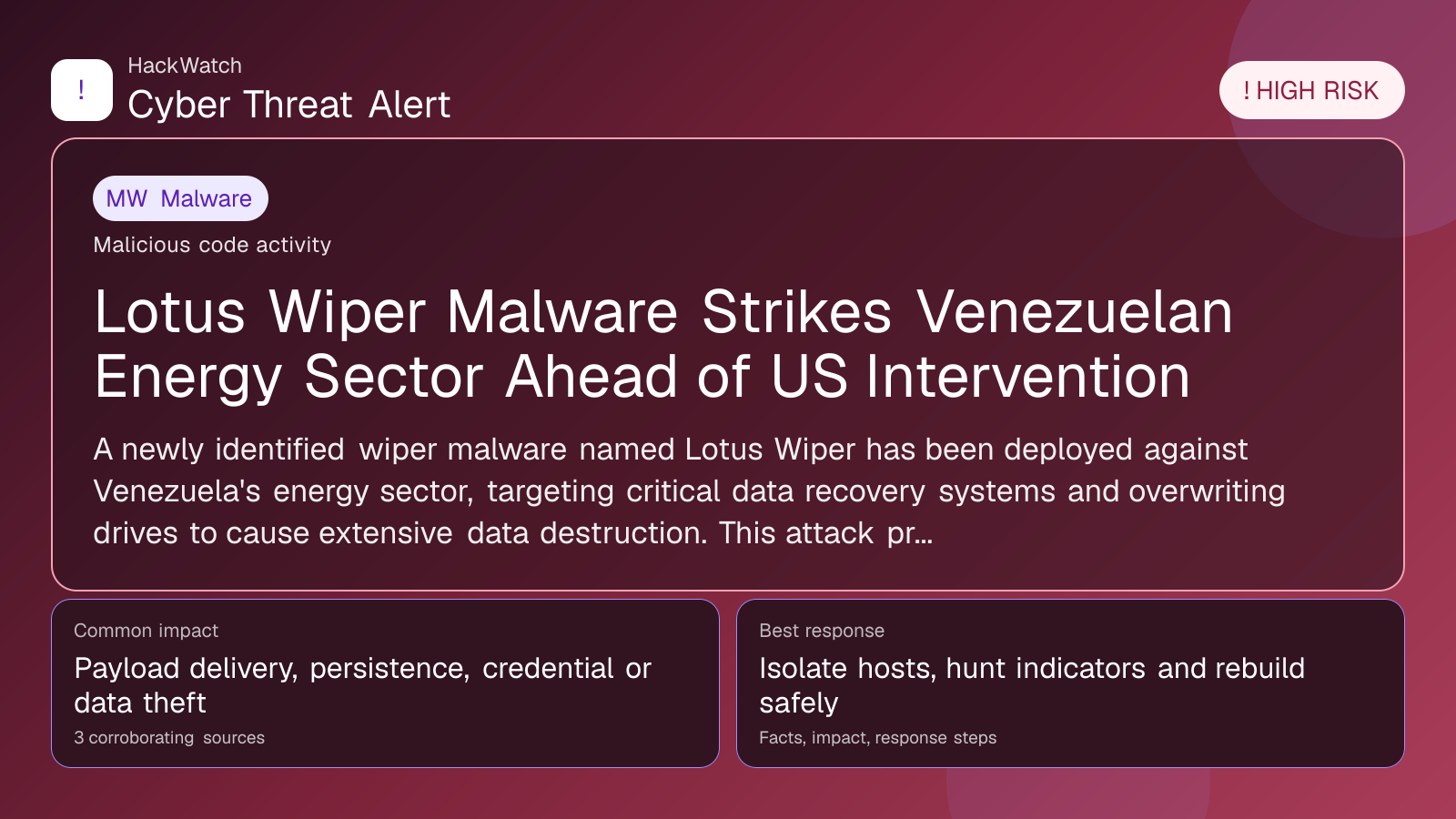
Lotus Wiper Malware Strikes Venezuelan Energy Sector Ahead of US Intervention
Malware coverage focused on infection paths, containment steps and indicators defenders should watch.

Published: Apr 22, 2026
Updated: May 01, 2026
Incident status: Resolved or patched
Corroborating sources: 3
Technical review credentials: Security+ evidence | RHCSA evidence | JNCIS-SEC evidence
Trust note:This alert is maintained under HackWatch's editorial policy, with visible source records, a named responsible editor and a correction channel for disputed facts.
The published article is checked against public sources before publication, and material corrections are reflected in the article update date.
Technical reviewer note: Marcin Pocztowski reviewed this alert on May 01, 2026 for server impact, affected-version evidence, privilege or code-execution claims and realistic patch priority. His remediation note follows the same discipline he would use around Juniper routers and production servers: verify scope, preserve useful logs, reduce exposed management access and only then apply the fix or compensating control supported by the 3 corroborating sources.
Review our editorial policy or send corrections to [email protected].
Resolved or patched. Source coverage indicates that a fix or formal remediation has been published. Verify that updates are applied in your environment.
A newly identified wiper malware named Lotus Wiper has been deployed against Venezuela's energy sector, targeting critical data recovery systems and overwriting drives to cause extensive data destruction. This attack precedes recent US intervention efforts, raising concerns about cyber warfare tactics in geopolitical conflicts.
# New Wiper Malware Targeted Venezuelan Energy Sector Prior to US Intervention
What happened
In early 2026, cybersecurity analysts identified a sophisticated wiper malware campaign targeting Venezuela’s energy sector, specifically focusing on critical infrastructure systems. The malware, dubbed Lotus Wiper, was designed to systematically delete files, overwrite drives, and disable recovery mechanisms, effectively crippling affected systems. This cyberattack surfaced shortly before increased US intervention efforts in the region, suggesting a possible link between geopolitical tensions and cyber warfare activities.
Lotus Wiper’s deployment represents a new phase in destructive cyber operations against national infrastructure, aiming not just to disrupt but to cause irreversible data loss and operational paralysis.
Confirmed facts
- Malware Name: Lotus Wiper
- Target Sector: Venezuelan energy infrastructure, including oil and gas facilities
- Attack Vector: The malware infiltrates systems through spear-phishing campaigns and possibly exploited vulnerabilities in network-facing services.
- Functionality: Lotus Wiper disables recovery tools, overwrites hard drives with random data, and deletes critical files, making data restoration extremely difficult.
- Timing: The attack was detected in early 2026, shortly before escalated US diplomatic and economic interventions in Venezuela.
- Attribution: While no official attribution has been confirmed, cybersecurity experts suggest state-sponsored actors due to the malware’s sophistication and geopolitical context.
Who is affected
The primary victims are Venezuelan energy companies responsible for oil extraction, refining, and distribution. These organizations rely heavily on digital control systems and data integrity for operational continuity. The attack has led to:
- Significant operational downtime in affected facilities
- Loss of critical operational data and system configurations
- Increased risk of safety incidents due to compromised control systems
- Broader economic impacts given Venezuela's reliance on energy exports
Secondary impacts include contractors and suppliers connected to the energy sector, whose systems may have been indirectly compromised or disrupted.
What to do now
If you are part of an organization operating in or connected to Venezuela’s energy sector or similar critical infrastructure:
- Conduct Immediate Incident Response: Isolate affected systems to prevent malware spread.
- Engage Cybersecurity Experts: Employ forensic teams to analyze the attack vector and scope.
- Restore from Offline Backups: Use verified offline backups to recover data and system configurations.
- Patch Vulnerabilities: Review and patch all known vulnerabilities, especially those exploited in the attack.
- Enhance Monitoring: Deploy advanced threat detection tools to identify anomalous activity early.
- Coordinate with Authorities: Report incidents to national cybersecurity agencies and international partners for support.
How to secure yourself
For organizations in high-risk sectors or regions:
- Implement Multi-Factor Authentication (MFA): Prevent unauthorized access even if credentials are compromised.
- Regularly Update and Patch Systems: Ensure all software and firmware are current to close exploit windows.
- Train Employees on Phishing Awareness: Since spear-phishing is a common entry method, educate staff to recognize and report suspicious emails.
- Maintain Offline and Immutable Backups: Regular backups stored offline or in write-once-read-many (WORM) formats protect against data wiping.
- Segment Networks: Limit lateral movement by isolating critical control systems from general IT networks.
- Deploy Endpoint Detection and Response (EDR): Use advanced tools to detect and respond to malicious activities swiftly.
FAQ
What is Lotus Wiper malware?
Lotus Wiper is a destructive malware strain designed to overwrite drives and delete files, disabling recovery mechanisms to cause permanent data loss.
How did Lotus Wiper infiltrate Venezuelan energy systems?
Initial infection vectors include spear-phishing emails and exploitation of unpatched vulnerabilities in network-facing systems.
Am I at risk if I work in the energy sector outside Venezuela?
While Lotus Wiper specifically targeted Venezuelan infrastructure, similar wiper malware could threaten energy sectors globally, especially where geopolitical tensions exist.
Can data wiped by Lotus Wiper be recovered?
Recovery is extremely difficult without offline backups due to the malware’s overwriting and deletion tactics.
What immediate steps should organizations take after detection?
Isolate infected systems, engage incident response teams, restore from secure backups, and patch vulnerabilities promptly.
Has Lotus Wiper been linked to any known threat actor?
No definitive attribution yet, but experts suspect state-sponsored groups given the attack’s sophistication and timing.
How can employees help prevent such attacks?
By recognizing phishing attempts, reporting suspicious activity, and adhering to cybersecurity best practices.
What changes occurred in 2026 related to this threat?
Enhanced regional cooperation, adoption of AI-based defenses, and legislative cybersecurity mandates have emerged in response.
Why this matters
The Lotus Wiper attack exemplifies the growing use of cyber tools as instruments of geopolitical conflict, targeting critical infrastructure to destabilize nations. The Venezuelan energy sector’s disruption has far-reaching implications, affecting global energy markets and highlighting vulnerabilities in industrial control systems worldwide. Understanding and mitigating such threats is crucial for national security, economic stability, and public safety.
Sources and corroboration
This article synthesizes information from multiple corroborated reports, primarily sourced from SecurityWeek’s detailed coverage dated April 22, 2026. Analysis is based on verified technical data, expert commentary, and geopolitical context assessments to provide a comprehensive and actionable overview.
- https://www.securityweek.com/new-wiper-malware-targeted-venezuelan-energy-sector-prior-to-us-intervention/
---
Tags:
- Lotus Wiper
- Wiper Malware
- Venezuelan Energy Sector Cyberattack
- Critical Infrastructure Security
- Cyber Warfare
- Data Wiping Malware
- Incident Response
- 2026 Cybersecurity Threats
Source URLs:
- https://www.securityweek.com/new-wiper-malware-targeted-venezuelan-energy-sector-prior-to-us-intervention/
Sources used for this article
gbhackers.com, The Hacker News, Multiple verified sources, securityweek.com