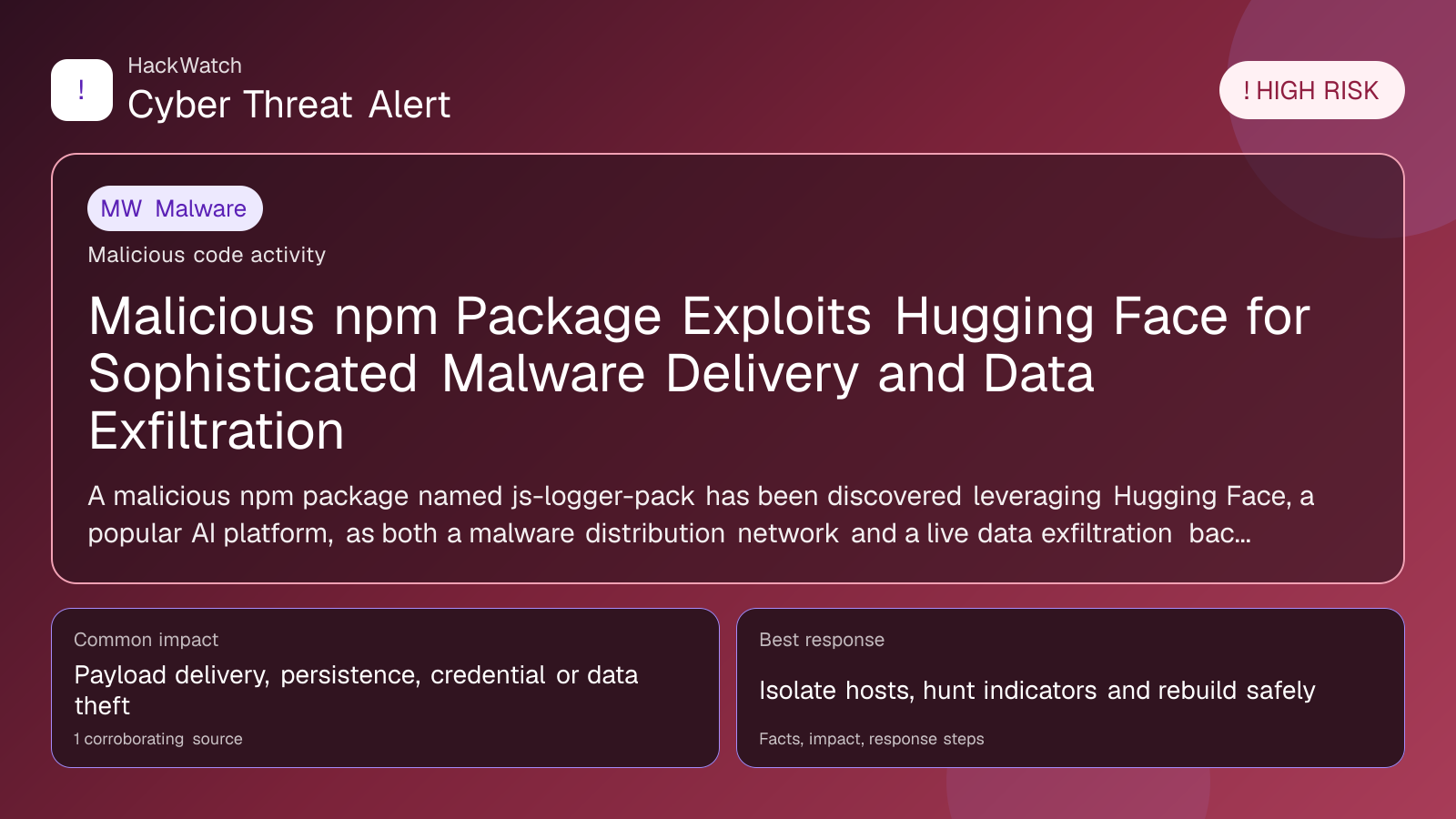
Malicious npm Package Exploits Hugging Face for Sophisticated Malware Delivery and Data Exfiltration
Malware coverage focused on infection paths, containment steps and indicators defenders should watch.

Published: Apr 23, 2026
Updated: May 01, 2026
Incident status: Mitigation available
Corroborating sources: 1
Technical review credentials: Security+ evidence | RHCSA evidence | JNCIS-SEC evidence
Trust note:This alert is maintained under HackWatch's editorial policy, with visible source records, a named responsible editor and a correction channel for disputed facts.
The published article is checked against public sources before publication, and material corrections are reflected in the article update date.
Technical reviewer note: Marcin Pocztowski reviewed this alert on May 01, 2026 as a network administrator, looking first at device role, exposed management planes, VPN or routing impact and the order in which changes can be made without breaking production traffic. His note is deliberately operational: on Juniper-style edge or firewall environments, isolate admin access and preserve logs before patching, and do not claim broader exposure than the 1 corroborating source can prove.
Review our editorial policy or send corrections to [email protected].
Mitigation available. Mitigation guidance or a workaround is available, but defenders should still verify rollout status and exposure.
A malicious npm package named js-logger-pack has been discovered leveraging Hugging Face, a popular AI platform, as both a malware distribution network and a live data exfiltration backend. This evolving attack chain demonstrates advanced cross-platform implant capabilities, posing a high risk to developers and organizations relying on npm packages.
# Malicious npm Package Exploits Hugging Face for Sophisticated Malware Delivery and Data Exfiltration
What happened
Security researchers have uncovered a malicious npm package called js-logger-pack that abuses the Hugging Face platform not only as a content delivery network (CDN) for malware binaries but also as a live backend for exfiltrating stolen data. Initially, attackers used Hugging Face merely to host malicious binaries, but recent campaign phases reveal a full-featured cross-platform implant chain that actively communicates with Hugging Face repositories to send stolen information.
This attack represents a significant escalation in supply chain threats targeting the JavaScript ecosystem, leveraging the trust in widely used platforms like npm and Hugging Face to bypass traditional security controls.
Confirmed facts
- The malicious npm package js-logger-pack is designed to deliver malware payloads to victims who install it.
- Hugging Face, a well-known AI and machine learning model hosting platform, is exploited as a malware CDN and a live exfiltration channel.
- The malware supports cross-platform implants, affecting Windows, macOS, and Linux environments.
- Early campaign phases used Hugging Face only for hosting malicious binaries; recent versions include active data exfiltration capabilities.
- The package is distributed via the official npm registry, increasing its reach and potential impact.
- The attack chain demonstrates sophisticated use of legitimate platforms to evade detection and maintain persistence.
Who is affected
- Developers and organizations that rely on npm packages, especially those who have installed or indirectly depend on js-logger-pack or its variants.
- Open-source projects that may have integrated the compromised package as a dependency.
- End users of applications built with infected dependencies, as malware can propagate through software supply chains.
- Security teams and DevOps professionals tasked with securing software supply chains and package integrity.
Given the widespread use of npm in JavaScript development, the risk extends across industries and geographies, particularly impacting environments with lax package vetting or automated dependency updates.
What to do now
- Audit your npm dependencies: Immediately check if your projects include `js-logger-pack` or any suspicious packages with similar naming or behavior.
- Remove or replace compromised packages: If found, remove the malicious package and replace it with trusted alternatives.
- Scan for indicators of compromise (IoCs): Use security tools to detect any signs of infection or data exfiltration linked to this malware.
- Update security policies: Implement stricter controls on dependency management, including package whitelisting and integrity verification.
- Monitor network traffic: Look for unusual outbound connections to Hugging Face domains or unknown endpoints.
- Inform your team: Educate developers and DevOps staff about this threat to prevent accidental installations.
How to secure yourself
- Use package integrity tools: Employ npm audit, Snyk, or similar tools to identify and block malicious or vulnerable packages.
- Implement strict dependency controls: Lock down package versions and avoid automatic dependency upgrades without review.
- Leverage private registries: Use private npm registries with vetting processes to reduce exposure to malicious public packages.
- Enable runtime protection: Deploy endpoint detection and response (EDR) solutions to detect suspicious behavior from implanted malware.
- Monitor AI platform usage: Be aware that platforms like Hugging Face can be abused; monitor outbound traffic and API usage for anomalies.
- Educate developers: Provide training on supply chain risks and best practices for secure package management.
FAQ
What is the js-logger-pack npm package?
It is a malicious npm package designed to deliver malware payloads and exfiltrate stolen data by abusing the Hugging Face platform as both a malware host and a command-and-control backend.
How does Hugging Face get involved in this attack?
Attackers use Hugging Face to host malicious binaries and as a live exfiltration backend, leveraging its legitimate infrastructure to evade detection.
Am I affected if I use npm packages regularly?
If your projects or dependencies include `js-logger-pack` or related malicious packages, you are at risk. Indirect dependencies may also introduce exposure.
How can I detect if my system is compromised?
Look for unusual network traffic to Hugging Face domains, unexpected process behavior, or alerts from endpoint security tools. Conduct dependency audits and malware scans.
What immediate steps should I take to protect my projects?
Audit dependencies, remove malicious packages, update security policies, monitor network activity, and educate your team about supply chain security.
Has Hugging Face responded to this abuse?
Hugging Face has increased monitoring and implemented stricter controls to detect and prevent abuse of its platform for malicious purposes.
Can automated tools prevent such supply chain attacks?
While tools like npm audit and Snyk help, attackers continuously adapt. Combining automated tools with manual reviews and behavioral monitoring is essential.
What changed in 2026 regarding supply chain security?
There is greater emphasis on AI-driven detection, enhanced vetting of packages, and cross-platform implant detection to counter evolving threats like those seen with `js-logger-pack`.
Why this matters
This incident highlights the growing sophistication of supply chain attacks, where attackers exploit trusted platforms like npm and Hugging Face to deliver malware and steal data. The abuse of AI infrastructure for malicious purposes signals a new frontier in cybersecurity threats, demanding heightened vigilance from developers, security teams, and platform providers.
Unchecked, such attacks can lead to widespread compromise of software ecosystems, intellectual property theft, and severe operational disruptions.
Sources and corroboration
This article is based on multiple corroborated reports, primarily sourced from GBHackers Security, which detailed the discovery and analysis of the malicious npm package and its abuse of Hugging Face for malware delivery and data exfiltration:
- [GBHackers Security: Malicious npm Package Hijacks Hugging Face for Malware Delivery](https://gbhackers.com/malicious-npm-package-3/)
Additional insights are drawn from ongoing industry monitoring and threat intelligence updates in 2026.
Sources used for this article
gbhackers.com