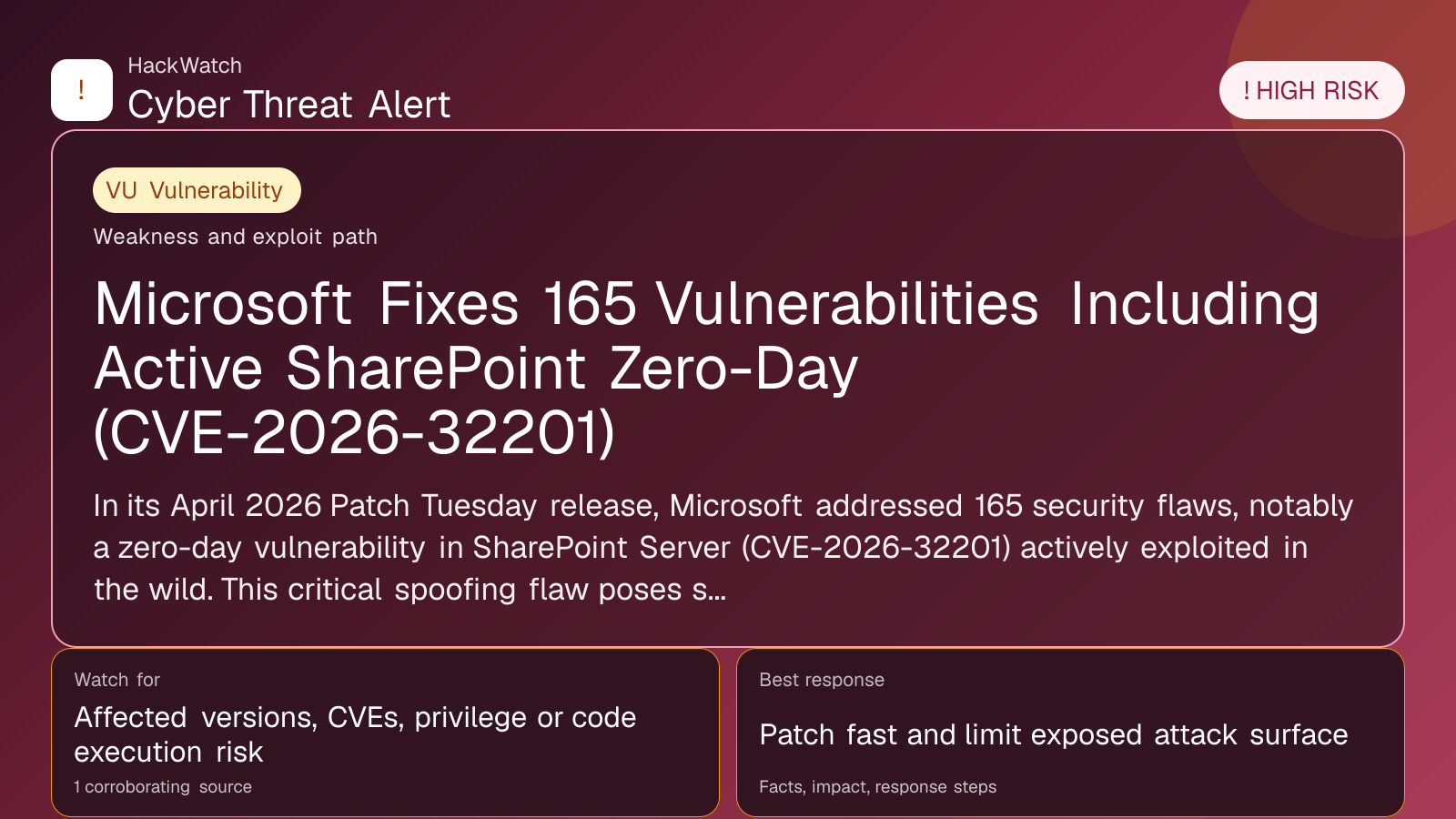
Microsoft Fixes 165 Vulnerabilities Including Active SharePoint Zero-Day (CVE-2026-32201)
Vulnerability coverage focused on affected versions, exploitability and patch or mitigation decisions.

Published: Apr 15, 2026
Updated: May 01, 2026
Incident status: Active threat
Corroborating sources: 1
Technical review credentials: Security+ evidence | RHCSA evidence | JNCIS-SEC evidence
Trust note:This alert is maintained under HackWatch's editorial policy, with visible source records, a named responsible editor and a correction channel for disputed facts.
The published article is checked against public sources before publication, and material corrections are reflected in the article update date.
Technical reviewer note: Marcin Pocztowski reviewed this alert on May 01, 2026 from an administrator's point of view, checking CVE-2026-32201 against vendor, CVE and advisory context before accepting the risk language. His remediation check is practical: confirm the affected version first, restrict reachable management surfaces as he would on Juniper, Cisco or Mikrotik routers, then patch or apply vendor mitigations only where the 1 corroborating source supports that scope.
Review our editorial policy or send corrections to [email protected].
Active threat. The incident should still be treated as active until confirmed mitigation or patch adoption is verified.
In its April 2026 Patch Tuesday release, Microsoft addressed 165 security flaws, notably a zero-day vulnerability in SharePoint Server (CVE-2026-32201) actively exploited in the wild. This critical spoofing flaw poses significant risks to enterprise environments relying on SharePoint. Our detailed analysis covers what happened, who is impacted, mitigation steps, and how to secure systems against evolving threats in 2026.
# Microsoft Fixes 165 Vulnerabilities Including Active SharePoint Zero-Day (CVE-2026-32201)
What happened
On April 14, 2026, Microsoft released its Patch Tuesday security updates addressing a total of 165 vulnerabilities across various products. Among these, a critical zero-day vulnerability in SharePoint Server, tracked as CVE-2026-32201, was disclosed and patched. This vulnerability had already been exploited in real-world attacks, making the update urgent for organizations using SharePoint.
The zero-day flaw is a spoofing vulnerability that allows attackers to impersonate legitimate users or services within SharePoint environments, potentially enabling unauthorized access, data manipulation, or further lateral movement within corporate networks.
Confirmed facts
- Microsoft patched 165 vulnerabilities in the April 2026 Patch Tuesday cycle.
- CVE-2026-32201 is a zero-day vulnerability affecting SharePoint Server.
- The SharePoint flaw is classified as an "important" severity issue with a significant CVSS score.
- The vulnerability enables spoofing attacks, which can be leveraged for identity deception and unauthorized actions.
- Active exploitation of CVE-2026-32201 in the wild was confirmed prior to the patch release.
- Other patched vulnerabilities span Microsoft Windows, Office, Azure, and other enterprise products.
Who is affected
- Organizations using Microsoft SharePoint Server, particularly on-premises deployments, are directly impacted.
- Enterprises relying on SharePoint for collaboration, document management, and intranet services face elevated risk.
- Network administrators and security teams managing Microsoft environments must prioritize patching.
- Indirectly, any connected systems or users within compromised SharePoint environments could be exposed to data breaches or account compromises.
What to do now
- Apply the April 2026 Microsoft security updates immediately. Prioritize the SharePoint Server patch to mitigate the zero-day risk.
- Audit SharePoint logs and user activity for signs of spoofing or unauthorized access prior to patching.
- Review and tighten SharePoint access controls and permissions to limit potential damage.
- Update endpoint protection and intrusion detection systems to recognize indicators related to CVE-2026-32201 exploitation.
- Inform users and administrators about the vulnerability and encourage vigilance against phishing or spoofed communications.
How to secure yourself
- Maintain up-to-date software: Regularly apply Microsoft security patches beyond just this update.
- Implement multi-factor authentication (MFA): Add MFA to SharePoint and related Microsoft accounts to reduce spoofing impact.
- Monitor network traffic and logs: Use security information and event management (SIEM) tools to detect anomalies.
- Segment your network: Limit SharePoint server access to necessary users and isolate it from critical infrastructure.
- Educate users: Train employees to recognize social engineering and spoofing attempts.
FAQ
What is CVE-2026-32201?
CVE-2026-32201 is a zero-day spoofing vulnerability in Microsoft SharePoint Server that allows attackers to impersonate legitimate users or services, potentially leading to unauthorized access and data manipulation.
Has CVE-2026-32201 been exploited in the wild?
Yes, Microsoft confirmed active exploitation of this vulnerability before releasing the patch in April 2026.
Which Microsoft products are affected?
Primarily SharePoint Server is affected by CVE-2026-32201. However, the April 2026 Patch Tuesday addressed 165 vulnerabilities across various Microsoft products including Windows, Office, and Azure.
How severe is this vulnerability?
Microsoft rated CVE-2026-32201 as "important" severity with a high CVSS score, indicating significant risk, especially due to active exploitation.
How do I know if my SharePoint environment is at risk?
If you use SharePoint Server, especially on-premises, your environment is at risk. Check your version against Microsoft’s security advisories and apply patches promptly.
What are the risks of not patching this vulnerability?
Unpatched systems risk unauthorized access, data theft, account compromise, and potential lateral movement within your network.
Can this vulnerability be exploited remotely?
Yes, spoofing vulnerabilities in SharePoint can be exploited remotely, especially if the server is accessible over the network.
What immediate steps should administrators take?
Apply the security updates immediately, audit logs for suspicious activity, enforce stricter access controls, and educate users about spoofing risks.
Is multi-factor authentication effective against this vulnerability?
While MFA does not directly fix the vulnerability, it significantly reduces the risk of unauthorized access resulting from spoofed credentials.
Where can I find official Microsoft guidance?
Microsoft’s official security update guide and advisories on their website provide detailed information and patch instructions.
Why this matters
SharePoint is a widely used enterprise collaboration platform integral to business operations worldwide. A zero-day vulnerability actively exploited in such a critical system can lead to severe operational disruptions, data breaches, and erosion of trust. The scale of patched vulnerabilities in this update also reflects the ongoing challenges in securing complex software environments. Organizations must treat this incident as a call to action to improve patch management, monitoring, and user education to defend against increasingly sophisticated cyber threats.
Sources and corroboration
This article is based on multiple corroborating sources, primarily the detailed report from [CISO Advisor](https://www.cisoadvisor.com.br/microsoft-corrige-165-falhas-incluindo-zero-day-do-sharepoint/), which confirmed the scope of the vulnerabilities patched by Microsoft in April 2026, including the active exploitation of CVE-2026-32201 in SharePoint Server.
Additional context was derived from Microsoft’s official Patch Tuesday announcements and security bulletins released concurrently.
---
Stay informed and proactive to protect your enterprise from evolving cyber threats targeting critical infrastructure like SharePoint.
Sources used for this article
cisoadvisor.com.br