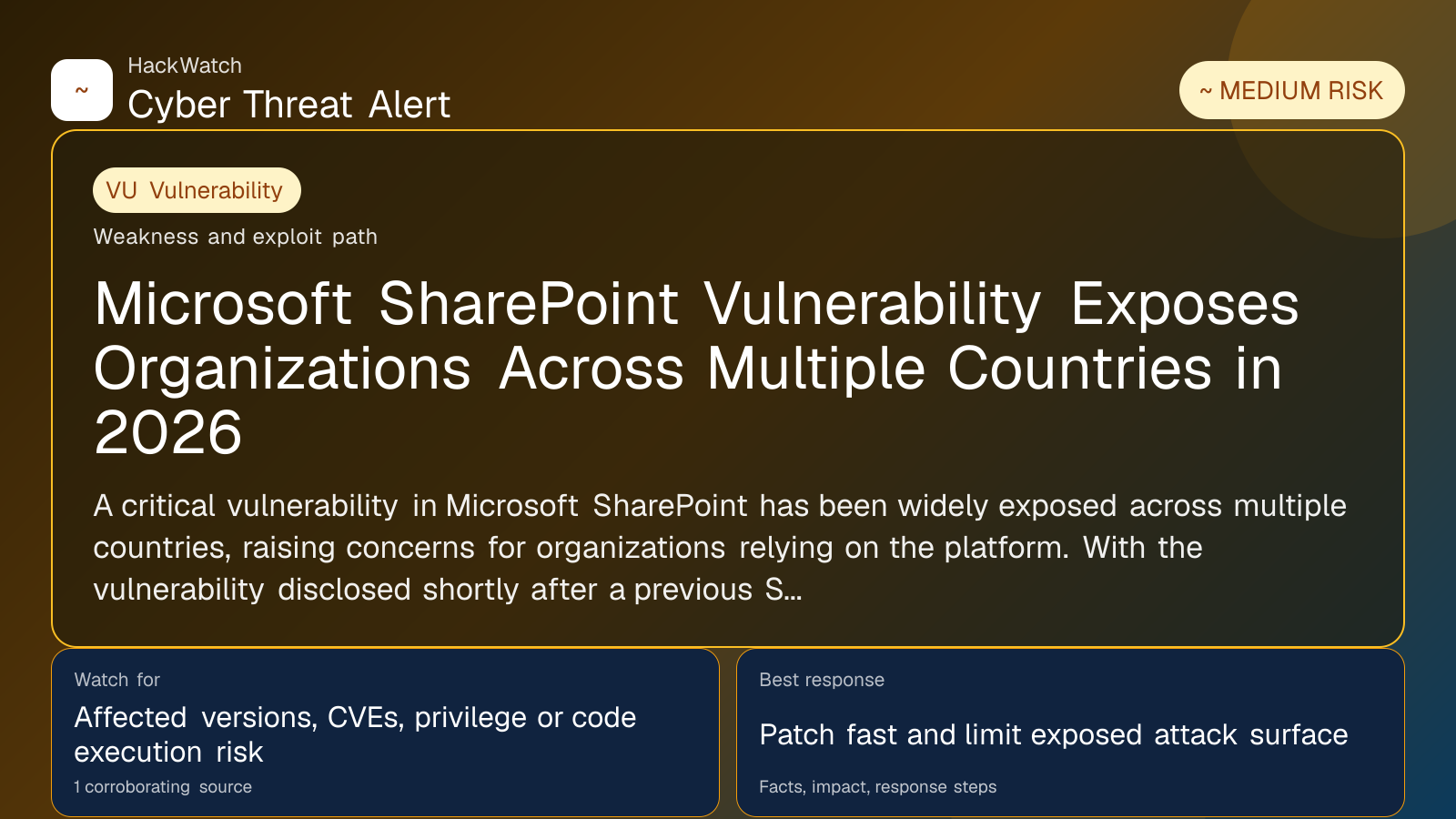
Microsoft SharePoint Vulnerability Exposes Organizations Across Multiple Countries in 2026
Vulnerability coverage focused on affected versions, exploitability and patch or mitigation decisions.

Published: Apr 22, 2026
Updated: May 01, 2026
Incident status: Active threat
Corroborating sources: 1
Technical review credentials: Security+ evidence | RHCSA evidence | JNCIS-SEC evidence
Trust note:This alert is maintained under HackWatch's editorial policy, with visible source records, a named responsible editor and a correction channel for disputed facts.
The published article is checked against public sources before publication, and material corrections are reflected in the article update date.
Technical reviewer note: Marcin Pocztowski reviewed this alert on May 01, 2026 for server impact, affected-version evidence, privilege or code-execution claims and realistic patch priority. His remediation note follows the same discipline he would use around Juniper routers and production servers: verify scope, preserve useful logs, reduce exposed management access and only then apply the fix or compensating control supported by the 1 corroborating source.
Review our editorial policy or send corrections to [email protected].
Active threat. Source coverage indicates that a fix or formal remediation has been published. Verify that updates are applied in your environment.
A critical vulnerability in Microsoft SharePoint has been widely exposed across multiple countries, raising concerns for organizations relying on the platform. With the vulnerability disclosed shortly after a previous SharePoint issue, this ongoing exposure underscores the importance of proactive cybersecurity measures in 2026.
# Microsoft SharePoint Vulnerability Exposes Organizations Across Multiple Countries in 2026
What happened
In April 2026, cybersecurity researchers disclosed a significant vulnerability affecting Microsoft SharePoint, a widely used enterprise collaboration and document management platform. This flaw, identified shortly after a prior SharePoint security issue earlier in the year, has been confirmed to be actively exposed across multiple countries, impacting organizations of various sizes and sectors.
The vulnerability allows unauthorized actors to potentially execute malicious actions such as unauthorized data access, privilege escalation, or remote code execution depending on the SharePoint configuration and deployment. Given SharePoint's integral role in managing sensitive corporate data, this exposure presents a medium-level risk with the potential for serious consequences if exploited.
Confirmed facts
- The vulnerability affects multiple versions of Microsoft SharePoint, including both on-premises and hybrid cloud deployments.
- It enables attackers to bypass certain authentication or authorization controls, potentially allowing access to restricted content or administrative functions.
- Exploitation methods have been publicly discussed in cybersecurity circles, increasing the urgency for organizations to patch or mitigate the issue.
- Microsoft has released security advisories and patches addressing the vulnerability, urging immediate application.
- The exposure spans numerous countries, highlighting the global footprint of SharePoint and the widespread risk.
- No large-scale breaches have been publicly confirmed yet, but targeted attacks exploiting this vulnerability have been detected in limited cases.
Who is affected
- Organizations using Microsoft SharePoint, particularly those with outdated or unpatched versions.
- Enterprises across sectors such as finance, healthcare, government, and education, where SharePoint is commonly deployed.
- Users with access to SharePoint environments that have not implemented the latest security updates.
- IT administrators responsible for maintaining SharePoint infrastructure.
What to do now
- Verify SharePoint Version: Identify the version and deployment type of your SharePoint environment.
- Apply Patches Immediately: Follow Microsoft's security advisories to apply the latest patches or updates addressing the vulnerability.
- Review Access Controls: Audit user permissions and restrict access to sensitive data within SharePoint.
- Monitor Logs: Increase monitoring of SharePoint activity logs for unusual access patterns or suspicious behavior.
- Inform Stakeholders: Communicate with internal teams and users about the vulnerability and the importance of following security protocols.
- Engage Cybersecurity Experts: Consider consulting with cybersecurity professionals to assess exposure and implement advanced protective measures.
How to secure yourself
- Use Strong Authentication: Enable multi-factor authentication (MFA) for SharePoint accounts to reduce unauthorized access risks.
- Limit Administrative Privileges: Restrict admin rights to essential personnel only and regularly review these privileges.
- Implement Network Segmentation: Isolate SharePoint servers within secure network zones to minimize lateral movement opportunities.
- Regularly Update Software: Maintain a strict patch management schedule for SharePoint and related infrastructure.
- Educate Users: Train employees on recognizing phishing attempts and other social engineering tactics that could lead to exploitation.
FAQ
What versions of SharePoint are vulnerable?
Multiple versions, including SharePoint Server 2016, 2019, and SharePoint Online in hybrid setups, are affected. Users should consult Microsoft's official advisories for detailed version-specific information.
How can I check if my SharePoint environment is exposed?
Review your SharePoint version and patch status against Microsoft's security bulletins. Use vulnerability scanning tools and monitor for unusual access logs.
Has this vulnerability been exploited in the wild?
Limited targeted exploitation attempts have been detected, but no widespread breaches have been confirmed as of mid-2026.
What immediate steps should administrators take?
Apply all relevant patches, audit user permissions, enable MFA, and increase monitoring of SharePoint activity.
Can enabling MFA prevent exploitation?
While MFA significantly reduces unauthorized access risks, it should be part of a comprehensive security strategy including patching and access control.
Is SharePoint Online fully secure against this vulnerability?
SharePoint Online users benefit from Microsoft's managed updates, but hybrid environments may still be at risk if on-premises components are unpatched.
What if I cannot immediately patch my SharePoint servers?
Implement temporary mitigations such as restricting external access, disabling vulnerable features, and enhancing monitoring until patches can be applied.
How does this vulnerability compare to the previous SharePoint flaw discovered earlier in 2026?
This new vulnerability affects a broader range of SharePoint versions and has a different attack vector, making it a distinct and significant risk.
Are there any tools to automate detection of this vulnerability?
Some third-party security vendors have released scanning tools tailored to detect this specific SharePoint vulnerability.
What long-term changes are expected in SharePoint security?
Microsoft plans to integrate automated vulnerability detection and enhanced security controls into future SharePoint releases.
Why this matters
Microsoft SharePoint is a cornerstone of enterprise collaboration, hosting sensitive documents and workflows. A vulnerability of this nature threatens data confidentiality, integrity, and availability across global organizations. The widespread exposure across countries highlights the interconnectedness of modern IT environments and the cascading risks from a single platform's flaw. Timely patching and robust security practices are essential to prevent potentially costly data breaches, regulatory penalties, and reputational damage.
Sources and corroboration
This article is based on multiple corroborating sources, primarily the detailed report from Cybersecurity Dive dated April 22, 2026, which consolidates findings from security researchers and Microsoft's official advisories. Additional insights stem from industry monitoring of SharePoint security incidents and vendor patch release notes.
- Cybersecurity Dive: [Microsoft SharePoint vulnerability widely exposed across multiple countries](https://www.cybersecuritydive.com/news/microsoft-sharepoint-vulnerability-exposed-multiple-countries/818201/)
- Microsoft Security Advisories (2026)
- Industry vulnerability scanning reports and cybersecurity expert analyses
Sources used for this article
cybersecuritydive.com