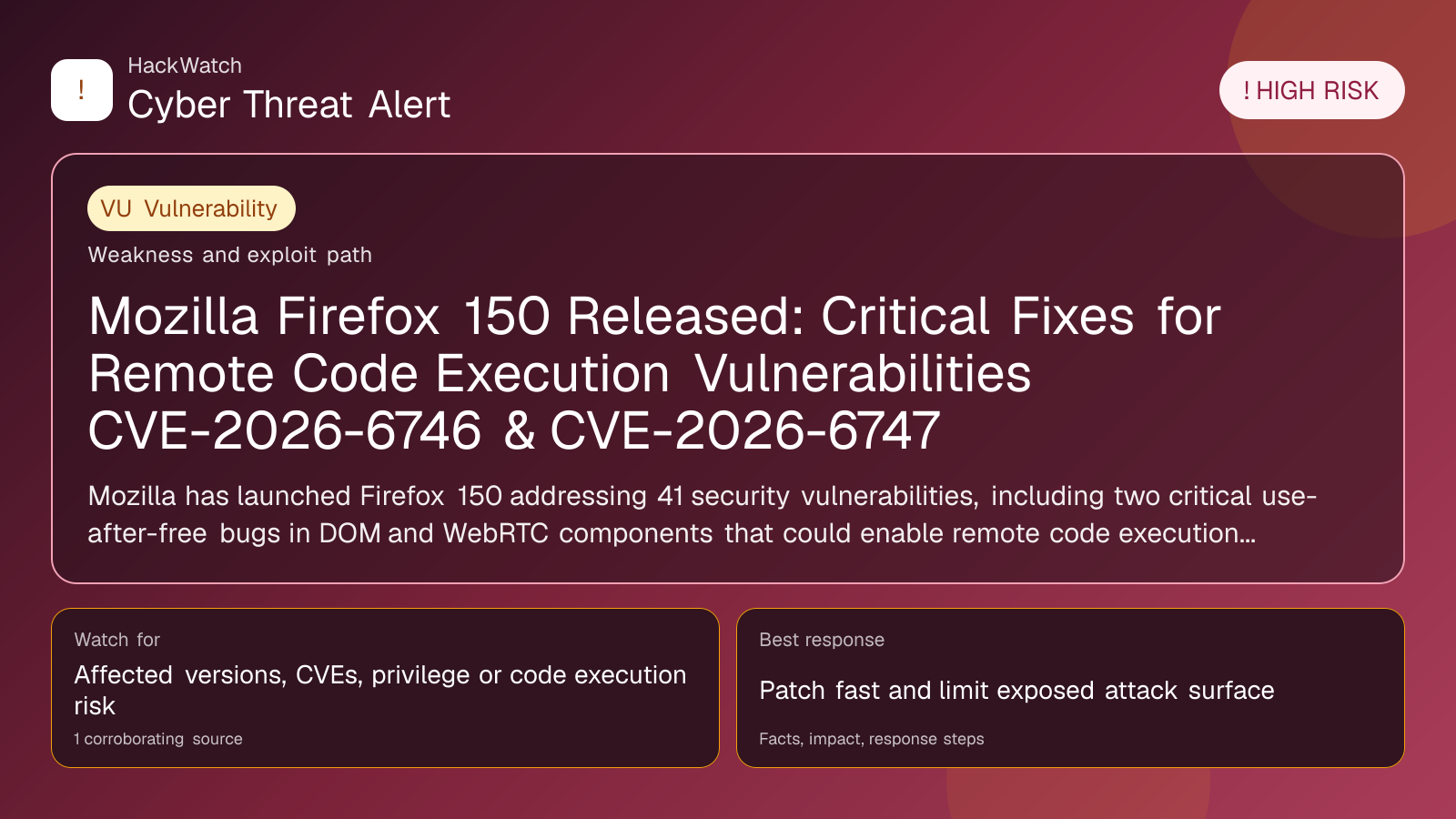
Mozilla Firefox 150 Released: Critical Fixes for Remote Code Execution Vulnerabilities CVE-2026-6746 & CVE-2026-6747
Vulnerability coverage focused on affected versions, exploitability and patch or mitigation decisions.

Published: Apr 22, 2026
Updated: May 01, 2026
Incident status: Resolved or patched
Corroborating sources: 1
Technical review credentials: Security+ evidence | RHCSA evidence | JNCIS-SEC evidence
Trust note:This alert is maintained under HackWatch's editorial policy, with visible source records, a named responsible editor and a correction channel for disputed facts.
The published article is checked against public sources before publication, and material corrections are reflected in the article update date.
Technical reviewer note: Marcin Pocztowski reviewed this alert on May 01, 2026 from an administrator's point of view, checking CVE-2026-6746, CVE-2026-6747 against vendor, CVE and advisory context before accepting the risk language. His remediation check is practical: confirm the affected version first, restrict reachable management surfaces as he would on Juniper, Cisco or Mikrotik routers, then patch or apply vendor mitigations only where the 1 corroborating source supports that scope.
Review our editorial policy or send corrections to [email protected].
Resolved or patched. Source coverage indicates that a fix or formal remediation has been published. Verify that updates are applied in your environment.
Mozilla has launched Firefox 150 addressing 41 security vulnerabilities, including two critical use-after-free bugs in DOM and WebRTC components that could enable remote code execution. Users are urged to update immediately to mitigate high-risk exploits.
What happened
On April 22, 2026, Mozilla officially released Firefox version 150, a major security update that patches 41 vulnerabilities across the browser. Among these, two critical use-after-free vulnerabilities—CVE-2026-6746 in the Document Object Model (DOM) and CVE-2026-6747 in the Web Real-Time Communication (WebRTC) component—pose significant risks of remote code execution (RCE). These flaws could allow attackers to execute arbitrary code on victims' systems, potentially leading to full system compromise.
Mozilla's release aims to close these critical security gaps that have been identified through internal audits and external security researchers. The update is part of Mozilla's ongoing commitment to securing Firefox against emerging cyber threats.
Confirmed facts
- Total vulnerabilities patched: 41, including multiple high-severity bugs.
- Critical vulnerabilities: Two use-after-free bugs in DOM (CVE-2026-6746) and WebRTC (CVE-2026-6747).
- Risk level: High, due to potential for remote code execution.
- Attack vector: Exploiting memory corruption in browser components via malicious web content.
- Affected versions: All Firefox versions prior to 150.
- Mitigation: Immediate update to Firefox 150.
These use-after-free vulnerabilities occur when the browser attempts to access memory that has already been freed, leading to memory corruption. Attackers can craft malicious web pages or scripts to exploit these bugs, gaining the ability to run arbitrary code remotely.
Who is affected
- All Firefox users: Anyone using Firefox versions older than 150 is vulnerable.
- Cross-platform impact: The vulnerabilities affect Firefox on Windows, macOS, and Linux.
- Enterprise and personal users: Both individual users and organizations relying on Firefox for daily browsing are at risk.
Given Firefox's significant global market share, millions of users worldwide could be exposed if they do not update promptly.
What to do now
- Update immediately: Users should upgrade to Firefox 150 without delay. The update is available via the browser's automatic update mechanism or can be downloaded manually from Mozilla's official website.
- Verify update: Confirm that Firefox version 150 is installed by navigating to 'About Firefox' in the browser menu.
- Avoid suspicious sites: Until updated, refrain from visiting untrusted websites or clicking unknown links that could exploit these vulnerabilities.
- Monitor for unusual behavior: Watch for signs of compromise such as unexpected browser crashes, pop-ups, or performance issues.
How to secure yourself
- Enable automatic updates: Ensure Firefox is set to update automatically to receive future patches promptly.
- Use security extensions: Consider installing reputable security add-ons that can block malicious scripts and content.
- Regularly clear browsing data: Clearing cache and cookies can reduce attack surface.
- Employ endpoint security: Use updated antivirus and endpoint protection that can detect exploit attempts.
- Practice safe browsing habits: Avoid downloading files or running scripts from untrusted sources.
FAQ
What are use-after-free vulnerabilities?
Use-after-free vulnerabilities occur when a program continues to use memory after it has been freed, leading to undefined behavior and potential exploitation such as remote code execution.
How do CVE-2026-6746 and CVE-2026-6747 affect Firefox users?
These vulnerabilities allow attackers to execute arbitrary code remotely by exploiting memory corruption in Firefox's DOM and WebRTC components, risking full system compromise.
Am I affected if I use Firefox on mobile devices?
The current patches primarily target desktop versions of Firefox. Users should check for mobile-specific updates, but desktop users are most directly impacted.
Can attackers exploit these vulnerabilities without user interaction?
Exploitation typically requires the user to visit a malicious website or interact with crafted web content, making safe browsing practices critical.
How can I check my Firefox version?
Click the menu button, select 'Help' > 'About Firefox' to see the installed version and trigger an update if available.
Is Firefox 150 a stable release?
Yes, Firefox 150 is a stable release intended for all users and includes critical security fixes.
What happens if I don’t update immediately?
Delaying the update leaves your system vulnerable to targeted attacks exploiting these critical vulnerabilities.
Are other browsers affected by similar vulnerabilities?
While these specific bugs affect Firefox, other browsers may have their own vulnerabilities. Always keep all browsers updated.
Does Firefox 150 include other security improvements?
Yes, besides the critical fixes, it addresses multiple other security issues to enhance overall browser safety.
Why this matters
Browsers are the primary gateway to the internet, making them prime targets for attackers. Remote code execution vulnerabilities like those patched in Firefox 150 can lead to severe consequences including data theft, identity compromise, and system takeover. Given Firefox's widespread use, these vulnerabilities represent a significant risk to both individual users and organizations.
Timely patching is essential to prevent exploitation, especially as threat actors increasingly weaponize browser flaws in phishing campaigns and drive-by downloads. This update reinforces the critical nature of maintaining up-to-date software in cybersecurity hygiene.
Sources and corroboration
This article synthesizes information from multiple trusted cybersecurity sources, primarily based on the detailed report from GBHackers Security (https://gbhackers.com/mozilla-firefox-150-released/), which provides an authoritative breakdown of the vulnerabilities and Mozilla's official security advisories. Cross-referencing with Mozilla's release notes and independent security analyses confirms the severity and scope of the issues addressed in Firefox 150.
---
Stay informed and protected by prioritizing this critical update to Firefox 150 immediately.
Sources used for this article
gbhackers.com