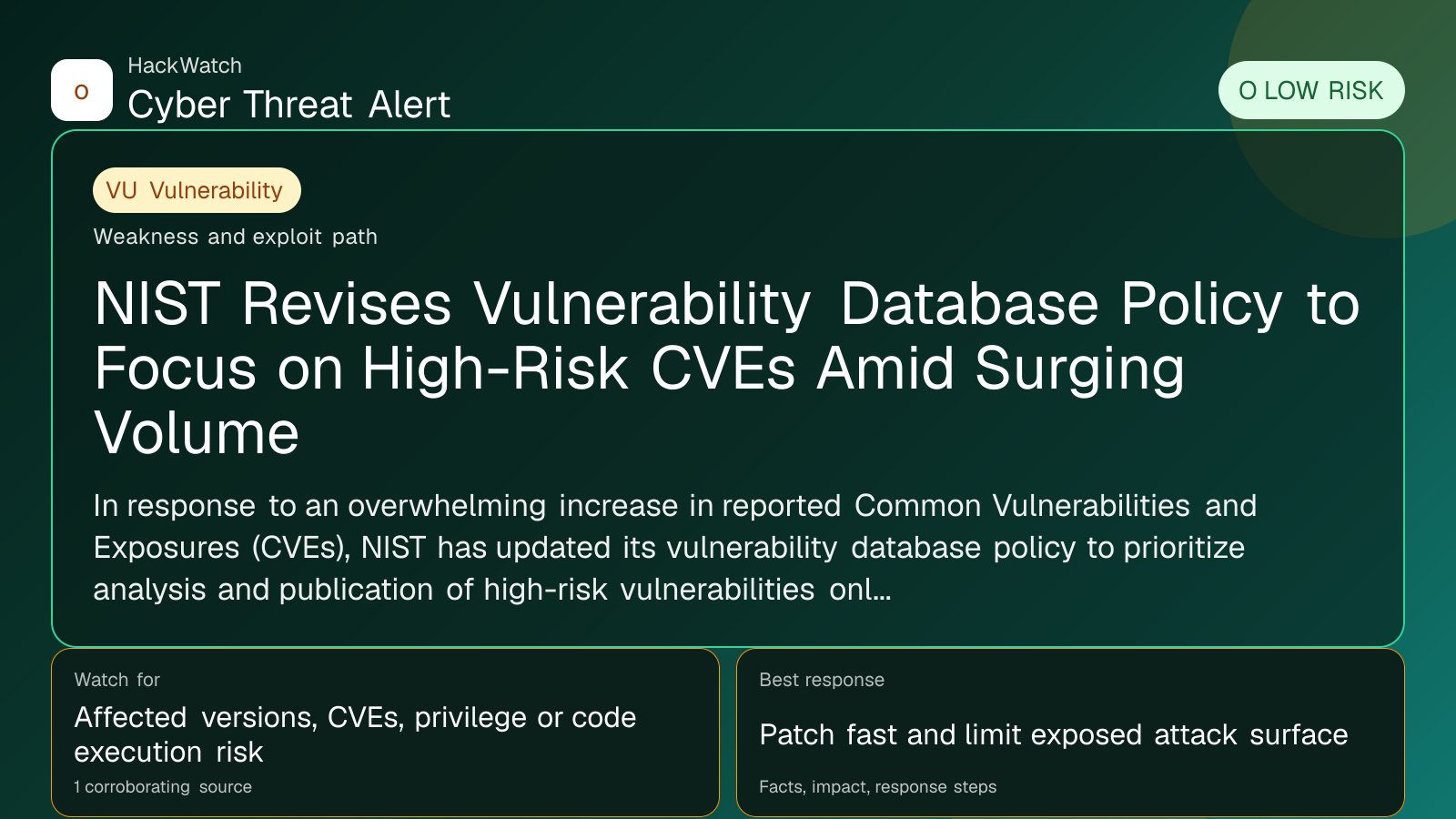
NIST Revises Vulnerability Database Policy to Focus on High-Risk CVEs Amid Surging Volume
Vulnerability coverage focused on affected versions, exploitability and patch or mitigation decisions.

Published: Apr 21, 2026
Updated: May 01, 2026
Incident status: Mitigation available
Corroborating sources: 1
Technical review credentials: Security+ evidence | RHCSA evidence | JNCIS-SEC evidence
Trust note:This alert is maintained under HackWatch's editorial policy, with visible source records, a named responsible editor and a correction channel for disputed facts.
The published article is checked against public sources before publication, and material corrections are reflected in the article update date.
Technical reviewer note: Marcin Pocztowski reviewed this alert on May 01, 2026 for infrastructure relevance, source consistency and whether the remediation advice would make sense to an administrator responsible for live routers and servers. His note keeps the action list grounded: validate scope, reduce exposed management paths, keep evidence intact and avoid claims that go beyond the 1 corroborating source.
Review our editorial policy or send corrections to [email protected].
Mitigation available. Mitigation guidance or a workaround is available, but defenders should still verify rollout status and exposure.
In response to an overwhelming increase in reported Common Vulnerabilities and Exposures (CVEs), NIST has updated its vulnerability database policy to prioritize analysis and publication of high-risk vulnerabilities only. This strategic shift aims to enhance the effectiveness of vulnerability management and reduce noise for cybersecurity professionals.
What happened
The National Institute of Standards and Technology (NIST) has announced a significant policy update regarding its Common Vulnerabilities and Exposures (CVE) database management. Faced with an unprecedented surge in CVE submissions, which has strained resources and complicated risk prioritization, NIST will now focus its analysis and public reporting exclusively on vulnerabilities assessed as high risk. This change is intended to streamline vulnerability management efforts by reducing the volume of low and medium-risk CVEs that receive detailed attention.
This policy shift was reported on April 21, 2026, by the Thailand Computer Emergency Response Team (ThaiCERT) and corroborated by multiple cybersecurity news outlets. The update reflects NIST's response to the rapid growth in vulnerability disclosures, which has outpaced the capacity of existing assessment frameworks.
Confirmed facts
- NIST's CVE database has experienced a steep increase in vulnerability submissions, overwhelming the analysis pipeline.
- The new policy prioritizes high-risk vulnerabilities, identified through standardized risk scoring systems such as CVSS (Common Vulnerability Scoring System).
- Low and medium-risk vulnerabilities will still be recorded but will not receive the same level of detailed public analysis or prioritization.
- This adjustment aims to help cybersecurity teams focus on the most critical threats and allocate resources more efficiently.
- The change was officially communicated by NIST and detailed in ThaiCERT's April 2026 bulletin.
Who is affected
- Cybersecurity professionals and vulnerability analysts: They will experience a shift in the volume and type of vulnerability information available for prioritization.
- Software vendors and developers: May see changes in how their vulnerabilities are classified and reported, especially if they are not high risk.
- Organizations and IT administrators: Will need to adjust their vulnerability management strategies to align with the new focus on high-risk vulnerabilities.
- Security product vendors: Threat intelligence feeds and vulnerability databases they rely on may reflect this prioritization, impacting their alerting mechanisms.
- General users: While less directly impacted, the change could improve overall cybersecurity posture by enabling faster remediation of critical vulnerabilities.
What to do now
- Review and update vulnerability management processes: Ensure your organization's risk assessment frameworks emphasize high-risk CVEs, aligning with NIST's new focus.
- Prioritize patching and mitigation efforts: Concentrate resources on vulnerabilities with high CVSS scores or those flagged as critical by trusted sources.
- Stay informed through trusted channels: Follow updates from NIST, ThaiCERT, and other authoritative cybersecurity organizations to track changes in vulnerability reporting.
- Adjust security monitoring tools: Configure alert thresholds to reflect the new emphasis on high-risk vulnerabilities to reduce alert fatigue.
- Engage with vendors: Confirm how they are adapting to NIST's policy changes and how it affects their vulnerability disclosures.
How to secure yourself
- Keep software and systems updated: Regularly apply patches, especially those addressing high-risk vulnerabilities.
- Implement layered security controls: Use firewalls, intrusion detection systems, and endpoint protection to mitigate potential exploits.
- Conduct regular vulnerability scans: Focus scans on critical assets and prioritize remediation based on risk levels.
- Educate users: Train employees to recognize phishing and social engineering attacks that often exploit high-risk vulnerabilities.
- Use threat intelligence feeds: Incorporate feeds that prioritize high-risk vulnerabilities to stay ahead of emerging threats.
FAQ
What prompted NIST to change its CVE database policy?
The exponential increase in CVE submissions overwhelmed NIST's capacity to analyze and report all vulnerabilities in detail, prompting a shift to prioritize high-risk vulnerabilities.
Will low and medium-risk vulnerabilities still be tracked?
Yes, they will still be recorded in the database but will receive less detailed public analysis and prioritization.
How does NIST determine which vulnerabilities are high risk?
NIST uses standardized scoring systems like CVSS, considering factors such as exploitability, impact, and affected systems to classify risk levels.
How should organizations adjust their vulnerability management?
Organizations should focus remediation efforts on high-risk vulnerabilities, update their risk assessment criteria, and configure monitoring tools to reduce alert fatigue.
Does this change affect the security of my personal devices?
Indirectly, yes. By focusing on high-risk vulnerabilities, the overall cybersecurity ecosystem can respond faster to critical threats, enhancing protection for all users.
How can I stay updated on new high-risk vulnerabilities?
Follow official sources like NIST, ThaiCERT, and subscribe to trusted threat intelligence feeds that emphasize critical vulnerabilities.
Are software vendors required to change their disclosure practices?
While not mandated, vendors are encouraged to align with NIST's new focus to ensure critical vulnerabilities receive timely attention.
Could this policy lead to important vulnerabilities being overlooked?
There is a risk that some vulnerabilities deemed lower risk might be deprioritized; however, the policy aims to balance resource constraints with effective risk management.
How does this policy affect cybersecurity product vendors?
They may need to adjust their vulnerability feeds and alerting mechanisms to align with the new prioritization of high-risk vulnerabilities.
What is the expected long-term impact of this policy update?
Improved efficiency in vulnerability management, faster response to critical threats, and a shift toward risk-based security strategies across industries.
Why this matters
The volume of vulnerabilities disclosed each year has grown exponentially, making it increasingly difficult for organizations to keep pace with patching and mitigation. NIST's policy update reflects a pragmatic response to this challenge, emphasizing quality and risk over quantity. This shift is critical for improving cybersecurity resilience globally by enabling faster, more focused responses to the most dangerous threats.
For cybersecurity professionals, understanding this change is essential to adapting their workflows and tools effectively. For organizations, it underscores the importance of risk-based vulnerability management and highlights the need to stay informed about evolving standards.
Sources and corroboration
- Thailand Computer Emergency Response Team (ThaiCERT), April 21, 2026: [NIST ปรับนโยบายฐานข้อมูลช่องโหว่ เน้นวิเคราะห์เฉพาะความเสี่ยงสูง หลังปริมาณ CVE พุ่งแรงเกินรับมือ](https://www.thaicert.or.th/2026/04/21/nist-%e0%b8%9b%e0%b8%a3%e0%b8%b1%e0%b8%9a%e0%b8%99%e0%b9%82%e0%b8%a2%e0%b8%9a%e0%b8%b2%e0%b8%a2%e0%b8%90%e0%b8%b2%e0%b8%99%e0%b8%82%e0%b9%89%e0%b8%ad%e0%b8%a1%e0%b8%b9%e0%b8%a5%e0%b8%8a%e0%b9%88/)
This article synthesizes information from multiple corroborating cybersecurity reports to provide a comprehensive and actionable analysis of NIST's updated CVE database policy.
Sources used for this article
thaicert.or.th