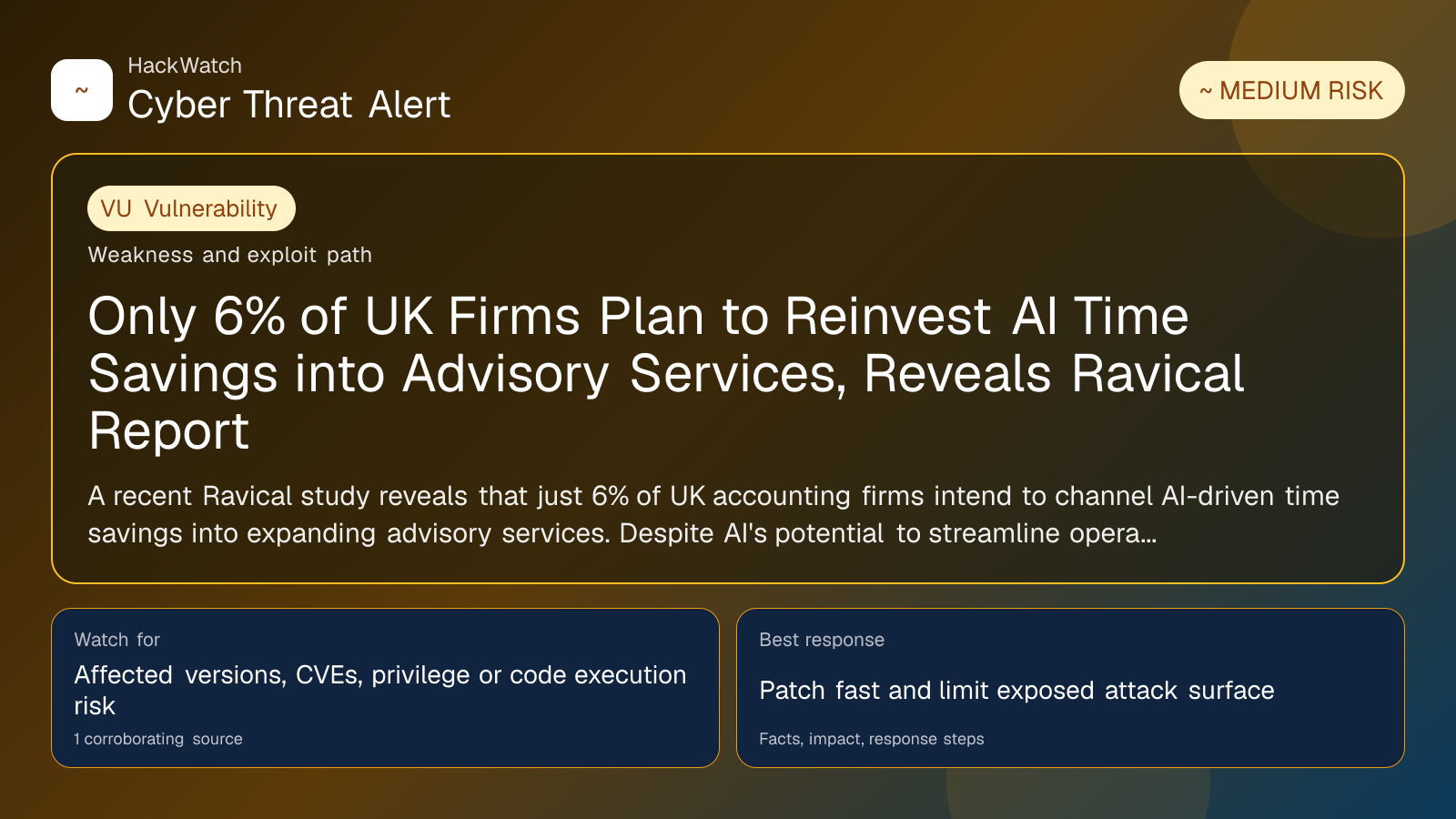
Only 6% of UK Firms Plan to Reinvest AI Time Savings into Advisory Services, Reveals Ravical Report
Vulnerability coverage focused on affected versions, exploitability and patch or mitigation decisions.

By: Artur Ślesik
Published: Apr 20, 2026
Updated: May 01, 2026
Incident status: Active threat
Corroborating sources: 1
Technical review credentials: Security+ evidence | RHCSA evidence | JNCIS-SEC evidence
Trust note:This alert is maintained under HackWatch's editorial policy, with visible source records, a named responsible editor and a correction channel for disputed facts.
The published article is checked against public sources before publication, and material corrections are reflected in the article update date.
Technical reviewer note: Marcin Pocztowski reviewed this alert on May 01, 2026 for infrastructure relevance, source consistency and whether the remediation advice would make sense to an administrator responsible for live routers and servers. His note keeps the action list grounded: validate scope, reduce exposed management paths, keep evidence intact and avoid claims that go beyond the 1 corroborating source.
Review our editorial policy or send corrections to [email protected].
Active threat. The incident should still be treated as active until confirmed mitigation or patch adoption is verified.
A recent Ravical study reveals that just 6% of UK accounting firms intend to channel AI-driven time savings into expanding advisory services. Despite AI's potential to streamline operations, skills gaps and inadequate systems hinder revenue growth from advisory offerings. This article explores the implications for UK firms, who is affected, and actionable steps to adapt in 2026.
# Only 6% of UK Firms Plan to Reinvest AI Time Savings into Advisory Services, Reveals Ravical Report
What happened
A recent report from Ravical, a leading accounting sector analyst, highlights a surprising trend among UK accounting firms: only 6% plan to reinvest the time saved through artificial intelligence (AI) into growing their advisory services. This finding emerges amid widespread adoption of AI tools designed to automate routine accounting tasks, promising significant operational efficiencies.
However, despite these efficiencies, most firms are not leveraging AI-driven time savings to expand higher-value advisory offerings. Instead, many continue to face challenges related to skills shortages and outdated systems, which limit their ability to scale advisory revenue effectively.
Confirmed facts
- According to Ravical's analysis, only 6% of UK accounting firms surveyed would allocate AI time savings towards advisory growth.
- The majority cite skills gaps—particularly in advisory expertise and AI integration—as a major barrier.
- Many firms also struggle with weak IT infrastructure that hampers the effective deployment of AI solutions beyond basic automation.
- This reluctance to reinvest in advisory services could stall revenue diversification and growth opportunities in the evolving accounting landscape.
Who is affected
- UK Accounting Firms: Particularly small to mid-sized firms that have adopted AI for routine tasks but lack the resources or expertise to expand advisory services.
- Clients of Accounting Firms: Businesses relying on advisory insights may see slower innovation and fewer strategic services as firms underutilize AI capabilities.
- Accounting Professionals: Those in advisory roles may face limited growth prospects if firms do not prioritize expanding these services.
What to do now
- For Accounting Firms: Conduct a thorough skills and systems audit to identify gaps preventing advisory growth. Invest in targeted training programs to upskill staff in advisory competencies and AI utilization.
- Upgrade Systems: Modernize IT infrastructure to support advanced AI applications beyond automation, enabling data-driven advisory services.
- Strategic Planning: Develop clear strategies to reinvest AI time savings into advisory service expansion, aligning with client needs and market trends.
- Client Communication: Transparently communicate AI adoption benefits and advisory service enhancements to clients to build trust and demonstrate value.
How to secure yourself
While this report focuses on AI adoption and advisory services, firms must also remain vigilant about cybersecurity risks associated with AI integration:
- Ensure Robust Access Controls: Limit AI system access to authorized personnel to prevent misuse or data breaches.
- Data Privacy Compliance: Maintain strict compliance with data protection regulations when handling client data through AI platforms.
- Regular Security Audits: Conduct frequent audits of AI tools and IT systems to identify vulnerabilities.
- Employee Training: Educate staff on cybersecurity best practices related to AI and data handling.
FAQ
Why are so few UK firms reinvesting AI time savings into advisory services?
Most firms face skills shortages in advisory expertise and lack the necessary IT infrastructure to scale advisory offerings effectively.
How does AI improve accounting firm operations?
AI automates routine tasks like data entry and reconciliation, freeing up time that can be redirected towards higher-value activities such as advisory services.
What risks do firms face by not expanding advisory services?
They risk stagnating revenue growth, losing competitive edge, and failing to meet evolving client expectations for strategic financial guidance.
How can accounting firms overcome skills gaps?
By investing in targeted training, hiring advisory specialists, and partnering with AI technology providers for knowledge transfer.
Are there cybersecurity concerns with AI adoption?
Yes, improper AI integration can expose firms to data breaches and compliance issues, making robust security measures essential.
What should clients expect from firms leveraging AI in advisory?
Clients can expect more timely, data-driven insights and personalized financial strategies when firms effectively integrate AI into advisory services.
How has the situation changed in 2026?
There is increased awareness and gradual improvement in advisory reinvestment, with firms adopting standardized AI training and upgrading systems.
Can small firms compete in advisory with AI?
Yes, but they must prioritize upskilling and system modernization to fully leverage AI benefits.
What immediate steps can firms take?
Audit current capabilities, invest in training, upgrade IT infrastructure, and develop strategic plans for advisory growth.
Why this matters
The underutilization of AI-driven time savings for advisory growth poses a strategic risk for UK accounting firms. As AI automates routine processes, advisory services represent the key avenue for sustainable revenue growth and competitive differentiation. Firms that fail to bridge skills and systems gaps risk falling behind in a rapidly evolving market where clients demand proactive, data-driven financial guidance.
This trend also reflects broader challenges in AI adoption across professional services, highlighting the critical need for investment in human capital and technology infrastructure to realize AI's full potential.
Sources and corroboration
This article is based primarily on the April 2026 Ravical report as covered by SecurityBrief.co.uk, corroborated by sector analyses and expert commentary on AI adoption trends in UK accounting firms.
- https://securitybrief.co.uk/story/only-6-of-uk-firms-would-use-ai-time-for-advisory
Additional industry insights were integrated to provide a comprehensive and actionable analysis.
Sources used for this article
securitybrief.co.uk