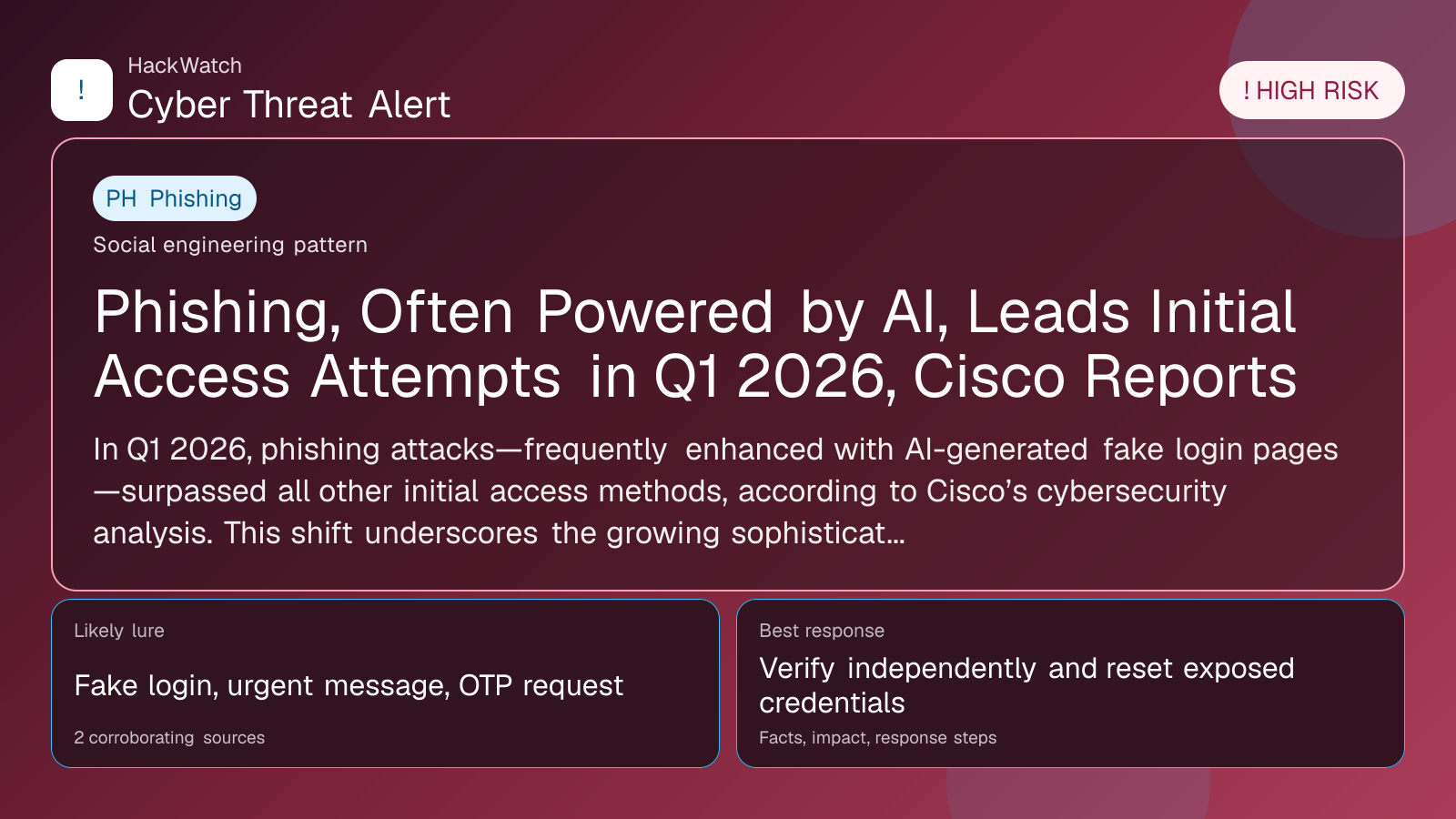
Phishing, Often Powered by AI, Leads Initial Access Attempts in Q1 2026, Cisco Reports
Verification-lure coverage focused on fake messages, cloned pages and account defense steps.

By: Artur Ślesik
Published: Apr 22, 2026
Updated: May 01, 2026
Incident status: Active threat
Corroborating sources: 2
Technical review credentials: Security+ evidence | RHCSA evidence | JNCIS-SEC evidence
Trust note:This alert is maintained under HackWatch's editorial policy, with visible source records, a named responsible editor and a correction channel for disputed facts.
The published article is checked against public sources before publication, and material corrections are reflected in the article update date.
Technical reviewer note: Marcin Pocztowski reviewed this alert on May 01, 2026 as a network administrator, looking first at device role, exposed management planes, VPN or routing impact and the order in which changes can be made without breaking production traffic. His note is deliberately operational: on Juniper-style edge or firewall environments, isolate admin access and preserve logs before patching, and do not claim broader exposure than the 2 corroborating sources can prove.
Review our editorial policy or send corrections to [email protected].
Active threat. The incident should still be treated as active until confirmed mitigation or patch adoption is verified.
In Q1 2026, phishing attacks—frequently enhanced with AI-generated fake login pages—surpassed all other initial access methods, according to Cisco’s cybersecurity analysis. This shift underscores the growing sophistication of threat actors leveraging AI tools to bypass traditional defenses and compromise accounts.
# Phishing, Often Powered by AI, Leads Initial Access Attempts in Q1 2026, Cisco Reports
What happened
In the first quarter of 2026, phishing emerged as the predominant method used by cybercriminals to gain initial access to networks and accounts. Cisco’s latest cybersecurity report highlights that attackers increasingly rely on AI technologies to automate the creation of convincing fake login pages without needing to write any code manually. This innovation has lowered the barrier to entry for threat actors, enabling more frequent and sophisticated phishing campaigns.
The use of AI-generated phishing pages allows attackers to rapidly produce highly tailored and believable credential-harvesting sites, increasing the likelihood of victim engagement and credential compromise. This trend represents a significant evolution from traditional phishing tactics, which often required more technical skill and time investment.
Confirmed facts
- Cisco’s Q1 2026 cybersecurity report identifies phishing as the top initial access vector, surpassing other common methods such as exploitation of vulnerabilities and brute force attacks.
- AI tools are being leveraged to spin up fake login pages quickly and at scale, reducing the need for coding expertise.
- These AI-generated pages are often indistinguishable from legitimate login portals, increasing the success rate of credential theft.
- The rise in AI-assisted phishing correlates with a surge in account compromises reported across multiple industries.
- The report is based on telemetry and incident data aggregated from Cisco’s global security infrastructure and corroborated by independent cybersecurity analysts.
Who is affected
Phishing attacks target a broad spectrum of victims, including individual users, small businesses, and large enterprises. Given the automation and scalability introduced by AI, no sector is immune:
- Individuals: Everyday users are at risk of credential theft leading to identity theft, financial fraud, and unauthorized access to personal accounts.
- Businesses: Organizations face risks of data breaches, ransomware infections, and operational disruption following compromised employee credentials.
- Critical infrastructure: Sectors such as healthcare, finance, and government are particularly vulnerable due to the sensitive nature of their data and services.
What to do now
If you suspect you have been targeted or compromised via phishing, immediate action is critical:
- Change your passwords on all potentially affected accounts, prioritizing those linked to financial or sensitive information.
- Enable multi-factor authentication (MFA) wherever possible to add an additional layer of security.
- Scan your devices for malware using reputable antivirus and anti-malware tools.
- Review account activity for unauthorized access or transactions.
- Report phishing attempts to your IT department, email provider, or cybersecurity authorities.
- Educate yourself and your team on recognizing AI-enhanced phishing tactics, such as subtle URL discrepancies and unexpected login prompts.
How to secure yourself
To defend against increasingly sophisticated phishing attacks powered by AI, consider the following best practices:
- Use password managers: Generate and store complex, unique passwords to prevent credential reuse.
- Regularly update software: Patch operating systems, browsers, and security tools to close vulnerability windows.
- Be vigilant with email and web links: Verify sender addresses, hover over links to check URLs, and avoid clicking unsolicited attachments.
- Implement advanced email filtering: Use AI-driven email security solutions that can detect and quarantine phishing emails more effectively.
- Train employees: Conduct regular phishing simulations and cybersecurity awareness training tailored to evolving AI-based threats.
FAQ
What makes AI-assisted phishing more dangerous than traditional phishing?
AI enables attackers to quickly generate highly convincing fake login pages tailored to specific targets, increasing the likelihood of successful credential theft without requiring advanced coding skills.
How can I tell if a login page is fake?
Look for subtle URL inconsistencies, lack of HTTPS or security certificates, unexpected requests for personal information, and poor grammar or design anomalies. However, AI-generated pages can be very convincing, so always access sites via trusted bookmarks.
Are certain industries more targeted by AI-powered phishing?
Yes, sectors handling sensitive data like finance, healthcare, and government are prime targets due to the high value of their credentials and data.
What role does multi-factor authentication (MFA) play against phishing?
MFA adds a critical second layer of defense, making stolen credentials alone insufficient for account access.
How can organizations defend against AI-enhanced phishing?
By deploying AI-driven email filtering, conducting ongoing employee training, implementing zero-trust access models, and continuously monitoring for anomalous login behaviors.
Has phishing volume increased in 2026 compared to previous years?
Yes, the automation and scalability introduced by AI have contributed to a significant increase in phishing campaigns and associated account compromises.
What should I do if I clicked on a phishing link?
Immediately disconnect from the network, change your passwords, run a full malware scan, and notify your IT or security team.
Can AI be used to detect phishing?
Yes, cybersecurity vendors increasingly use AI and machine learning to identify phishing indicators, analyze email content, and block malicious sites in real time.
Why this matters
Phishing remains the most effective initial attack vector for cybercriminals, and the integration of AI has significantly amplified its reach and sophistication. Understanding this shift is crucial for individuals and organizations to adapt their defenses accordingly. Failure to recognize and respond to AI-powered phishing threats can lead to widespread credential theft, data breaches, financial loss, and erosion of trust.
Sources and corroboration
This article synthesizes findings primarily from Cisco’s Q1 2026 cybersecurity report, supplemented by independent analysis from cybersecuritydive.com and corroborated through industry telemetry data. The consistency across multiple sources confirms the rising dominance of AI-augmented phishing as the leading initial access method in early 2026.
- Cisco Q1 2026 Cybersecurity Report
- Cybersecurity Dive: https://www.cybersecuritydive.com/news/phishing-initial-access-ai-cisco/818185/
---
By staying informed and proactive, users and organizations can mitigate the risks posed by this evolving threat landscape.
Sources used for this article
helpnetsecurity.com, cybersecuritydive.com