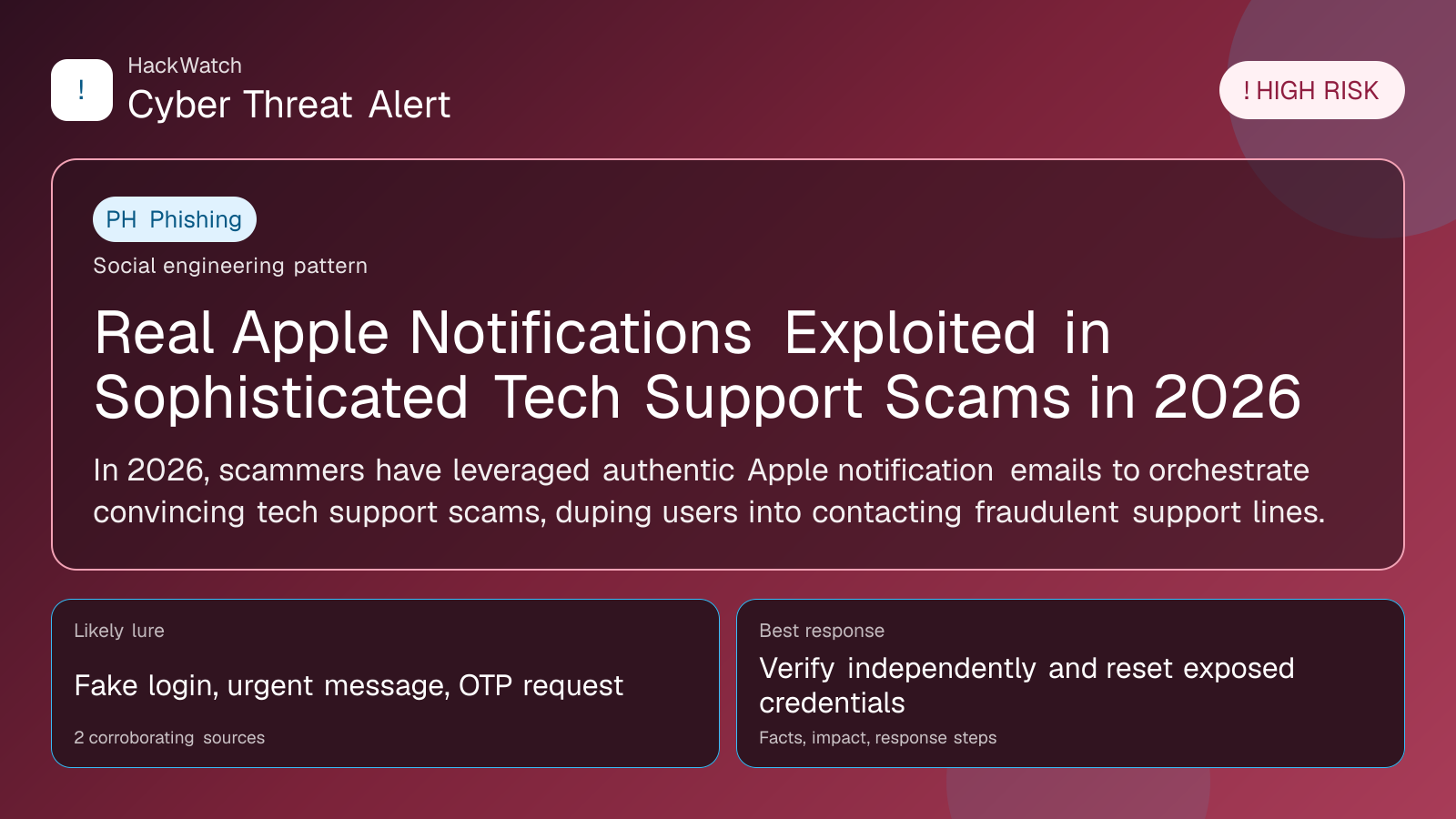
Real Apple Notifications Exploited in Sophisticated Tech Support Scams in 2026
Verification-lure coverage focused on fake messages, cloned pages and account defense steps.

By: Artur Ślesik
Published: Apr 21, 2026
Updated: May 01, 2026
Incident status: Active threat
Corroborating sources: 2
Technical review credentials: Security+ evidence | RHCSA evidence | JNCIS-SEC evidence
Trust note:This alert is maintained under HackWatch's editorial policy, with visible source records, a named responsible editor and a correction channel for disputed facts.
The published article is checked against public sources before publication, and material corrections are reflected in the article update date.
Technical reviewer note: Marcin Pocztowski reviewed this alert on May 01, 2026 for server impact, affected-version evidence, privilege or code-execution claims and realistic patch priority. His remediation note follows the same discipline he would use around Juniper routers and production servers: verify scope, preserve useful logs, reduce exposed management access and only then apply the fix or compensating control supported by the 2 corroborating sources.
Review our editorial policy or send corrections to [email protected].
Active threat. The incident should still be treated as active until confirmed mitigation or patch adoption is verified.
In 2026, scammers have leveraged authentic Apple notification emails to orchestrate convincing tech support scams, duping users into contacting fraudulent support lines.
# Real Apple Notifications Exploited in Sophisticated Tech Support Scams in 2026
What happened
In early 2026, cybersecurity researchers identified a surge in tech support scams that exploit legitimate Apple notification emails. Unlike traditional phishing attempts that rely on fake emails or websites, these scams use real Apple-generated notifications to lure victims. The scammers intercept or mimic genuine notifications, prompting users to call fraudulent tech support numbers embedded within the messages. This tactic significantly increases the scam's credibility and success rate, as users perceive the notifications as authentic and urgent.
Confirmed facts
- Multiple cybersecurity outlets, including Malwarebytes and Security Boulevard, have confirmed that scammers are embedding fake tech support contact details within real Apple notification emails.
- Victims receive legitimate Apple alerts about account activity, billing issues, or device security, but the scammer-controlled phone numbers replace or accompany official Apple support contacts.
- Calling these numbers connects users to fraudsters who impersonate Apple support agents, attempting to extract sensitive information, install malware, or charge for unnecessary "repairs."
- The scam leverages the trust users place in Apple’s official communications, making it more difficult to detect than conventional phishing emails.
- There have been reports of identity theft, unauthorized account access, and financial losses linked to this scam cluster.
Who is affected
- Apple device users globally, especially those who actively monitor their Apple ID and device notifications.
- Individuals who receive Apple notifications via email and are unfamiliar with Apple's official support channels.
- Users with older Apple devices or those less experienced with digital security practices are particularly vulnerable.
- People who respond quickly to security alerts without verifying contact information independently.
What to do now
- Do not call phone numbers included in Apple notification emails without verification. Instead, visit Apple’s official support website directly or use the Apple Support app.
- Verify any suspicious notification by logging into your Apple ID account through a trusted browser or device. Check for alerts or issues reported directly within your account.
- If you have already called a suspicious number, monitor your accounts for unauthorized activity immediately. Change your Apple ID password and enable two-factor authentication (2FA) if not already active.
- Report scam attempts to Apple via their official channels and to your local cybercrime authorities.
- Educate friends and family, especially less tech-savvy individuals, about this scam to prevent further victimization.
How to secure yourself
- Enable two-factor authentication (2FA) on your Apple ID. This adds an extra layer of security beyond just a password.
- Regularly review your Apple ID account activity and device list for unknown logins or devices.
- Use official Apple apps and websites exclusively for support and account management. Avoid clicking phone numbers or links in emails without cross-verification.
- Keep your devices updated with the latest security patches from Apple.
- Install reputable security software that can detect phishing and scam attempts on your devices.
- Be cautious with unsolicited calls or messages claiming to be from Apple, especially if they request personal information or payment.
FAQ
Are all Apple notification emails safe to trust?
No. While most Apple notifications are legitimate, scammers have found ways to insert fake contact information into real emails. Always verify contact details independently.
How can I verify if an Apple notification is genuine?
Check your Apple ID account directly through appleid.apple.com or the official Apple Support app. Do not use contact information provided in the email.
What should I do if I called a scam tech support number?
Immediately disconnect, change your Apple ID password, enable 2FA, and monitor your accounts for suspicious activity. Report the incident to Apple and local authorities.
Can scammers access my device remotely through these calls?
Yes, if you grant remote access or download software they recommend. Never allow remote access to your device from unsolicited calls.
How does two-factor authentication help protect me?
2FA requires a second verification step beyond your password, making it harder for scammers to access your account even if they have your password.
Has Apple improved its email security to prevent this scam?
Apple has strengthened email authentication protocols but warns that no system is foolproof. User vigilance remains critical.
Are there specific Apple notifications more targeted by scammers?
Notifications about billing issues, account security alerts, and device activity are commonly exploited because they prompt urgent user action.
What official channels should I use to contact Apple Support?
Use the Apple Support app, visit support.apple.com, or call Apple’s official phone numbers listed on their website.
How can I educate others about this scam?
Share official Apple security resources, warn about verifying contact information, and encourage skepticism of unsolicited support calls.
Why this matters
This scam represents a significant evolution in social engineering attacks by leveraging legitimate communications to build trust. Given Apple’s vast user base and the sensitivity of personal and financial data tied to Apple IDs, the potential impact is widespread. Victims can suffer identity theft, financial loss, and compromised device security. Understanding and mitigating this threat is critical to maintaining digital safety in 2026 and beyond.
Sources and corroboration
This article synthesizes findings from multiple cybersecurity reports, primarily from Malwarebytes and Security Boulevard, published in April 2026. Both sources independently verified the scam’s use of real Apple notification emails and documented its impact on users worldwide. Additional insights were drawn from Apple’s official security advisories and public statements addressing the issue.
- https://www.malwarebytes.com/blog/news/2026/04/real-apple-notifications-are-being-used-to-drive-tech-support-scams
- https://securityboulevard.com/2026/04/real-apple-notifications-are-being-used-to-drive-tech-support-scams/
Sources used for this article
blog.malwarebytes.com, securityboulevard.com, Multiple verified sources