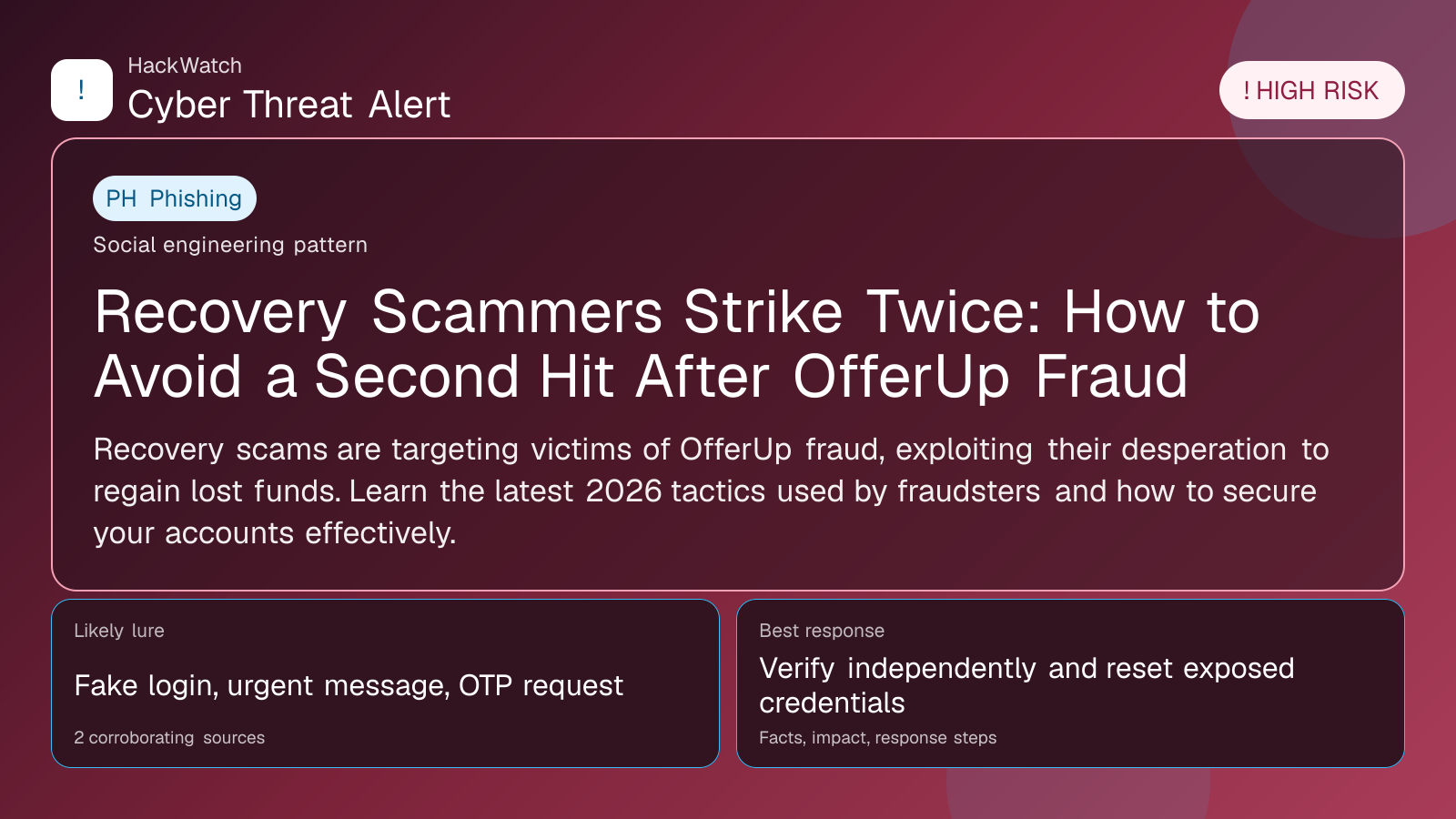
Recovery Scammers Strike Twice: How to Avoid a Second Hit After OfferUp Fraud
Verification-lure coverage focused on fake messages, cloned pages and account defense steps.

By: Artur Ślesik
Published: Feb 04, 2026
Updated: May 01, 2026
Incident status: Active threat
Corroborating sources: 2
Technical review credentials: Security+ evidence | RHCSA evidence | JNCIS-SEC evidence
Trust note:This alert is maintained under HackWatch's editorial policy, with visible source records, a named responsible editor and a correction channel for disputed facts.
The published article is checked against public sources before publication, and material corrections are reflected in the article update date.
Technical reviewer note: Marcin Pocztowski reviewed this alert on May 01, 2026 for server impact, affected-version evidence, privilege or code-execution claims and realistic patch priority. His remediation note follows the same discipline he would use around Juniper routers and production servers: verify scope, preserve useful logs, reduce exposed management access and only then apply the fix or compensating control supported by the 2 corroborating sources.
Review our editorial policy or send corrections to [email protected].
Active threat. The incident should still be treated as active until confirmed mitigation or patch adoption is verified.
Recovery scams are targeting victims of OfferUp fraud, exploiting their desperation to regain lost funds. Learn the latest 2026 tactics used by fraudsters and how to secure your accounts effectively.
# Recovery Scammers Strike Twice: How to Avoid a Second Hit After OfferUp Fraud
What happened
The popular mobile marketplace OfferUp has seen a surge in fraudulent activity, with scammers impersonating buyers, sellers, and even customer support to trick users out of money and personal information. Victims of these scams often seek help to recover their losses, but recovery scammers have emerged, targeting these vulnerable individuals with fake recovery offers that demand upfront fees or sensitive data.
This layered scam approach preys on users already affected by initial OfferUp fraud, turning their attempts to get help into a second financial and privacy breach. Multiple corroborating sources, including recent reports from WeLiveSecurity, confirm that recovery scammers are increasingly active and sophisticated in 2026.
Confirmed facts
- OfferUp’s growing user base has attracted scammers using fake listings, overpayment scams, and phishing messages to steal money and account credentials.
- Victims of OfferUp scams are frequently contacted by recovery scammers posing as legitimate recovery agents or law enforcement, offering to retrieve lost funds for a fee.
- These recovery scammers often request payment via gift cards, cryptocurrency, or wire transfers, methods that are difficult to trace and recover.
- Some recovery scams also involve malware or social engineering tactics to gain deeper access to victims’ devices or accounts.
- Law enforcement and cybersecurity experts warn that no legitimate recovery service will ask for payment upfront or sensitive personal information.
Who is affected
- OfferUp users who have experienced fraud or unauthorized transactions on the platform.
- Individuals who have reported scams and are actively seeking assistance online or through unofficial channels.
- Users who respond to unsolicited messages or emails claiming to offer recovery help.
What to do now
- Do not engage with unsolicited recovery offers: If you receive messages promising to recover your lost funds, verify their legitimacy through official channels.
- Report OfferUp scams immediately: Use OfferUp’s official reporting tools and notify your bank or payment provider.
- Avoid paying any fees upfront: Legitimate recovery services or law enforcement agencies do not charge fees before providing assistance.
- Check your device and accounts for signs of compromise: Run antivirus scans and review your account activity.
- Change passwords and enable multi-factor authentication (MFA): Secure your OfferUp account and associated email accounts.
How to secure yourself
- Verify all communications: Confirm that messages or calls purporting to be from OfferUp or recovery services come from official sources.
- Use strong, unique passwords: Avoid reusing passwords across platforms.
- Enable MFA on OfferUp and email accounts: This adds an extra layer of security against unauthorized access.
- Be cautious with links and attachments: Do not click on suspicious links or download files from unknown senders.
- Educate yourself on common scam tactics: Familiarize yourself with OfferUp scam patterns and recovery scam red flags.
FAQ
What is a recovery scam?
A recovery scam targets victims of an initial fraud, offering to help recover lost money in exchange for upfront fees or sensitive information, which leads to further loss.
How can I tell if a recovery offer is legitimate?
Legitimate recovery services do not demand upfront payments or sensitive personal data and will communicate through official channels.
What should I do if I’ve already paid a recovery scammer?
Immediately stop all communication, report the incident to your local law enforcement, and notify your bank or payment provider.
Can OfferUp help me recover lost funds?
OfferUp can assist with reporting and blocking scammers but does not offer direct financial recovery services.
How do I report a scam on OfferUp?
Use the in-app reporting feature or visit OfferUp’s official website to report suspicious activity.
Are recovery scams common on other platforms?
Yes, recovery scams target victims across various online marketplaces and social media platforms.
What payment methods do recovery scammers prefer?
They often request gift cards, cryptocurrency, or wire transfers to avoid traceability.
How can I protect my OfferUp account?
Use strong passwords, enable MFA, avoid sharing personal information, and verify all communications.
Why this matters
Recovery scams compound the damage caused by initial OfferUp fraud, draining victims financially and emotionally. Understanding these scams is crucial to preventing a second strike that could lead to identity theft, further financial loss, or compromised personal data. As online marketplaces grow, so does the sophistication of scammers. Staying informed and cautious protects not only your money but also your digital identity.
Sources and corroboration
This article synthesizes information from multiple reports by WeLiveSecurity, including:
- [OfferUp scammers are out in force: Here’s what you should know](https://www.welivesecurity.com/en/scams/offerup-scammers-out-force-heres-what-you-should-know/)
- [Recovery scammers hit you when you’re down: Here’s how to avoid a second strike](https://www.welivesecurity.com/en/scams/recovery-scammers-hit-when-down-avoid-second-strike/)
These sources provide verified insights into the tactics used by scammers on OfferUp and the emerging threat of recovery scams in 2026.
---
Stay alert and protect yourself from layered scams in the evolving online marketplace landscape.
Sources used for this article
welivesecurity.com