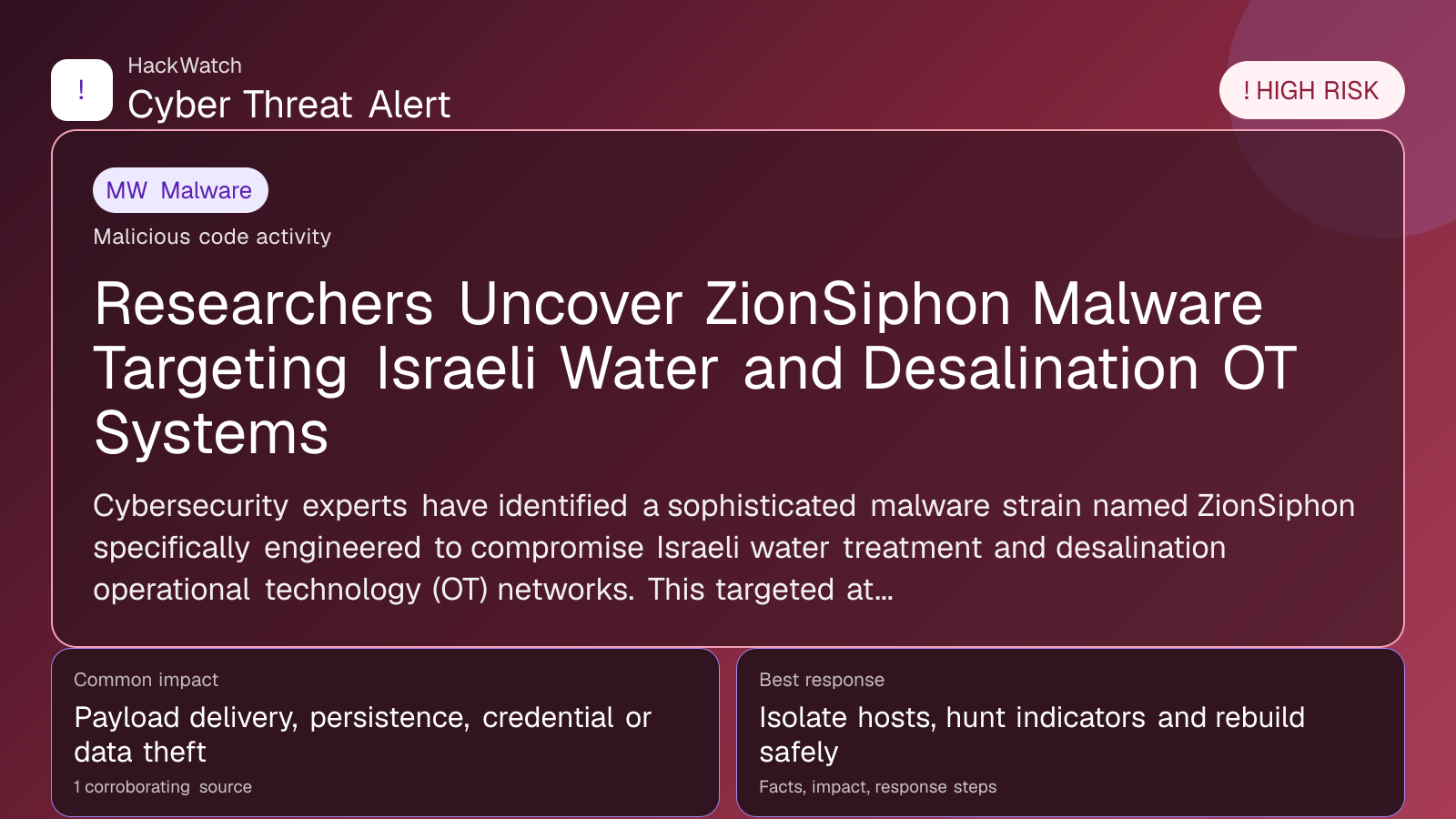
Researchers Uncover ZionSiphon Malware Targeting Israeli Water and Desalination OT Systems
Malware coverage focused on infection paths, containment steps and indicators defenders should watch.

Published: Apr 20, 2026
Updated: May 01, 2026
Incident status: Active threat
Corroborating sources: 1
Technical review credentials: Security+ evidence | RHCSA evidence | JNCIS-SEC evidence
Trust note:This alert is maintained under HackWatch's editorial policy, with visible source records, a named responsible editor and a correction channel for disputed facts.
The published article is checked against public sources before publication, and material corrections are reflected in the article update date.
Technical reviewer note: Marcin Pocztowski reviewed this alert on May 01, 2026 as a network administrator, looking first at device role, exposed management planes, VPN or routing impact and the order in which changes can be made without breaking production traffic. His note is deliberately operational: on Juniper-style edge or firewall environments, isolate admin access and preserve logs before patching, and do not claim broader exposure than the 1 corroborating source can prove.
Review our editorial policy or send corrections to [email protected].
Active threat. The incident should still be treated as active until confirmed mitigation or patch adoption is verified.
Cybersecurity experts have identified a sophisticated malware strain named ZionSiphon specifically engineered to compromise Israeli water treatment and desalination operational technology (OT) networks. This targeted attack underscores growing risks to critical infrastructure and calls for immediate protective measures.
# Researchers Uncover ZionSiphon Malware Targeting Israeli Water and Desalination OT Systems
What happened
In April 2026, cybersecurity researchers, led by Darktrace, revealed the discovery of a new malware strain dubbed ZionSiphon. This malware is uniquely designed to infiltrate and manipulate operational technology (OT) systems within Israeli water treatment and desalination facilities. ZionSiphon demonstrates advanced capabilities such as establishing persistence on infected machines, modifying local configuration files, and scanning local subnets for OT-relevant services, indicating a highly targeted attack on critical infrastructure.
The malware's emergence was reported by multiple cybersecurity outlets, with The Hacker News providing detailed technical analysis. The coordinated reporting confirms the malware's focus on disrupting water and desalination OT environments, which are vital for Israel’s water security.
Confirmed facts
- ZionSiphon malware was first detected by Darktrace researchers in early 2026.
- The malware targets OT systems specifically involved in water treatment and desalination processes in Israel.
- ZionSiphon can establish persistence on infected devices, allowing long-term access.
- It tampers with local configuration files, potentially disrupting normal operations or enabling further exploitation.
- The malware scans the local subnet to identify OT services, suggesting reconnaissance for lateral movement or targeted attacks.
- No public evidence yet indicates successful sabotage or data exfiltration, but the potential risk to critical infrastructure is high.
Who is affected
The primary victims of ZionSiphon are Israeli water treatment plants and desalination facilities that rely on OT systems to manage and control water purification and distribution. These systems are integral to Israel’s national water supply and public health.
Given the malware’s focus on OT networks, organizations operating similar infrastructure worldwide should also be vigilant, as this attack vector could be adapted or expanded by threat actors targeting other nations’ critical water infrastructure.
What to do now
- Immediate OT Network Assessment: Facilities should conduct thorough scans to detect any signs of ZionSiphon or related suspicious activity within their OT environments.
- Isolate Critical Systems: Segregate OT networks from corporate IT networks to limit malware propagation.
- Update and Patch Systems: Apply all relevant security patches to OT devices and supporting IT infrastructure.
- Monitor Network Traffic: Deploy advanced monitoring solutions to detect unusual scanning or configuration changes.
- Incident Response Preparedness: Develop or update incident response plans specifically addressing OT-targeted malware.
How to secure yourself
- Implement Network Segmentation: Strictly separate OT networks from external and less secure internal networks.
- Use Multi-Factor Authentication (MFA): Enforce MFA for all remote and privileged access to OT systems.
- Regularly Audit Configurations: Continuously verify that configuration files and system settings remain unaltered.
- Deploy Endpoint Detection and Response (EDR): Utilize EDR solutions capable of monitoring OT endpoints for anomalous behavior.
- Employee Training: Educate staff on phishing and social engineering tactics that could deliver malware payloads.
FAQ
What is ZionSiphon malware?
ZionSiphon is a newly identified malware strain targeting Israeli water treatment and desalination operational technology systems, designed to establish persistence, modify configurations, and scan for OT services.
How does ZionSiphon affect water treatment plants?
By tampering with OT configurations and scanning for services, ZionSiphon can disrupt normal operations, potentially leading to service interruptions or enabling further malicious activities.
Am I affected if I’m not in Israel?
While ZionSiphon currently targets Israeli infrastructure, similar OT environments worldwide could be at risk if threat actors adapt the malware or its techniques.
How can organizations detect ZionSiphon?
Detection involves monitoring for unusual network scanning, unauthorized configuration changes, and persistent malware signatures within OT systems.
What immediate steps should water facilities take?
Conduct comprehensive OT network audits, isolate critical systems, apply security patches, enhance monitoring, and prepare incident response plans.
Is there evidence of data theft or sabotage?
No confirmed reports of data exfiltration or operational sabotage have been made public, but the malware’s capabilities pose a significant threat.
How can employees help prevent such attacks?
By recognizing phishing attempts, following security protocols, and reporting suspicious activities promptly.
What changes in OT security have occurred in 2026?
There is increased emphasis on network segmentation, real-time monitoring, and collaboration between public and private sectors to defend critical infrastructure.
Can ZionSiphon spread to corporate IT networks?
While primarily targeting OT systems, if networks are not properly segmented, the malware could potentially spread to connected IT environments.
Why this matters
Water treatment and desalination systems are critical to public health and national security. The emergence of ZionSiphon highlights the increasing sophistication of cyber threats targeting OT environments, which traditionally have been less protected than IT networks. A successful attack could disrupt water supply, cause public safety hazards, and undermine trust in essential services.
Understanding and mitigating such threats is crucial not only for Israeli infrastructure but also globally, as adversaries may replicate these tactics against other nations’ critical systems.
Sources and corroboration
This article synthesizes information from multiple cybersecurity reports, primarily from Darktrace’s research and The Hacker News coverage dated April 20, 2026. The convergence of independent sources confirms the malware’s existence, capabilities, and targeted nature.
- [The Hacker News: Researchers Detect ZionSiphon Malware Targeting Israeli Water, Desalination OT Systems](https://thehackernews.com/2026/04/researchers-detect-zionsiphon-malware.html)
---
By staying informed and implementing robust OT security measures, organizations can defend against emerging threats like ZionSiphon and safeguard critical infrastructure from potentially devastating cyberattacks.
Sources used for this article
The Hacker News