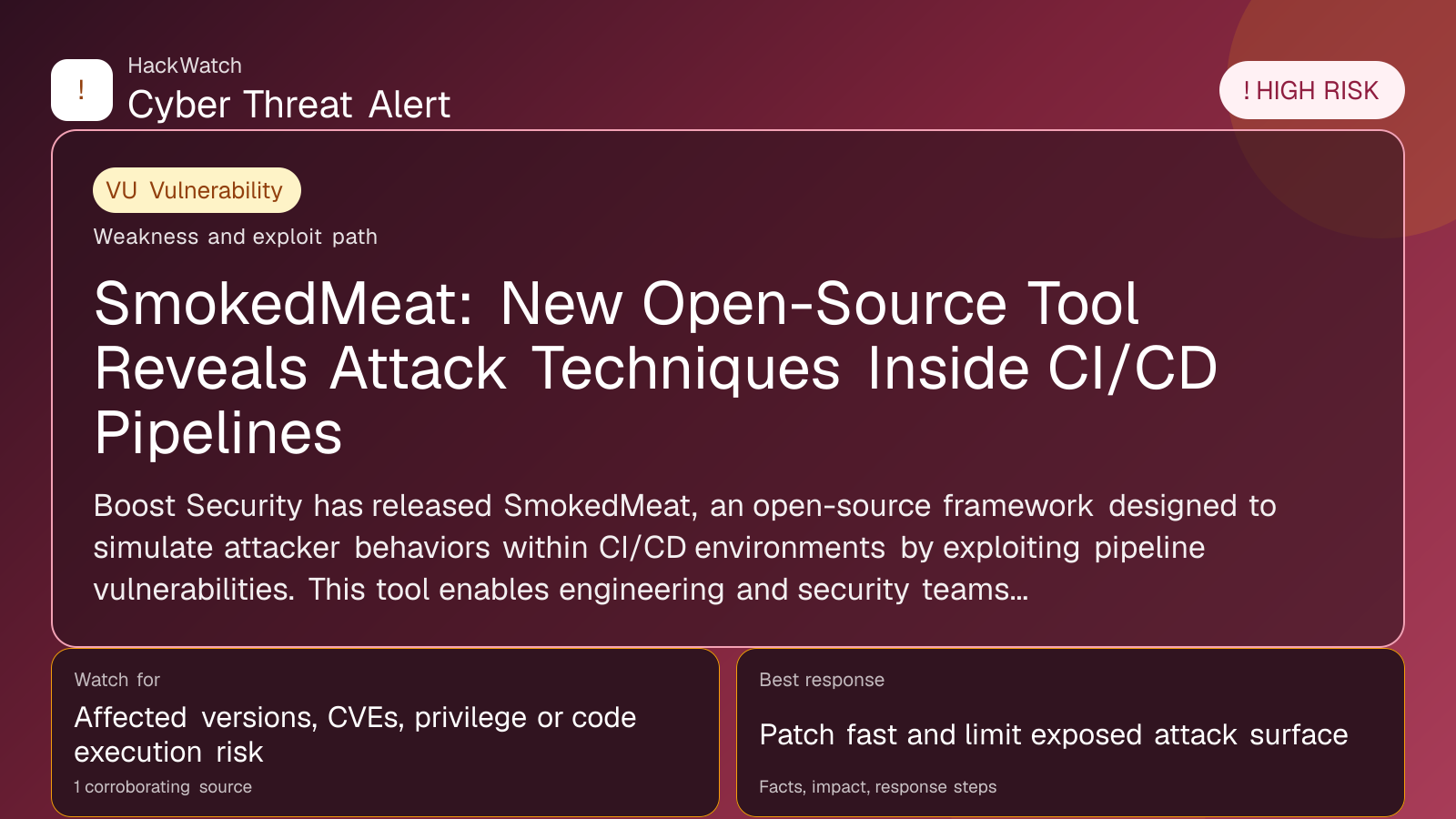
SmokedMeat: New Open-Source Tool Reveals Attack Techniques Inside CI/CD Pipelines
Vulnerability coverage focused on affected versions, exploitability and patch or mitigation decisions.

Published: Apr 20, 2026
Updated: Apr 24, 2026
Incident status: Resolved or patched
Corroborating sources: 1
Technical review credentials: Security+ evidence | RHCSA evidence | JNCIS-SEC evidence
Trust note:This alert is maintained under HackWatch's editorial policy, with visible source records, a named responsible editor and a correction channel for disputed facts.
The published article is checked against public sources before publication, and material corrections are reflected in the article update date.
Technical reviewer note: Marcin Pocztowski reviewed this alert on Apr 24, 2026 for server impact, affected-version evidence, privilege or code-execution claims and realistic patch priority. His remediation note follows the same discipline he would use around Juniper routers and production servers: verify scope, preserve useful logs, reduce exposed management access and only then apply the fix or compensating control supported by the 1 corroborating source.
Review our editorial policy or send corrections to [email protected].
Resolved or patched. Source coverage indicates that a fix or formal remediation has been published. Verify that updates are applied in your environment.
Boost Security has released SmokedMeat, an open-source framework designed to simulate attacker behaviors within CI/CD environments by exploiting pipeline vulnerabilities. This tool enables engineering and security teams to understand the full impact of compromised CI/CD infrastructure, including credential harvesting and cloud access escalation. The release highlights the critical need for securing CI/CD pipelines against increasingly sophisticated attacks.
What happened
Boost Security launched SmokedMeat, an open-source framework that demonstrates how attackers can exploit vulnerabilities within Continuous Integration/Continuous Deployment (CI/CD) pipelines. The tool takes a flagged vulnerability in a pipeline and executes a live attack simulation against the user’s own infrastructure. This enables teams to observe firsthand the potential damage an attacker could inflict by compromising their CI/CD environment.
Confirmed facts
- SmokedMeat operates by starting from a single vulnerability in a CI/CD pipeline.
- The tool deploys a payload that compromises the pipeline runner.
- Once the runner is compromised, SmokedMeat harvests credentials directly from process memory.
- Harvested credentials are then used to gain unauthorized cloud access.
- The framework exposes the full attack chain, showing how attackers move laterally and escalate privileges inside CI/CD infrastructure.
- SmokedMeat is open-source and freely available to help security and engineering teams simulate real-world attack scenarios within their environments.
Who is affected
Organizations using CI/CD pipelines for software development and deployment are at risk, especially those that have not fully secured their pipeline infrastructure. This includes:
- DevOps teams managing CI/CD runners and pipelines.
- Security teams responsible for cloud and pipeline security.
- Any company relying on automated build and deployment processes that could be targeted by attackers to gain persistent access.
What to do now
- Assess Your CI/CD Pipelines: Identify and patch known vulnerabilities in your pipeline configurations and runners.
- Run SmokedMeat: Use the tool within your environment to simulate attacks and understand your specific risks.
- Monitor Pipeline Activity: Implement continuous monitoring to detect unusual pipeline or runner behavior.
- Secure Credentials: Avoid storing credentials in pipeline environments and use ephemeral secrets management.
- Limit Cloud Access: Enforce least privilege principles for credentials accessible from CI/CD systems.
- Update and Harden Runners: Regularly update pipeline runners and restrict their permissions.
Why this matters
CI/CD pipelines are increasingly targeted by attackers because they provide a direct path to production environments and cloud resources. Compromising a pipeline can allow attackers to inject malicious code, steal sensitive data, or maintain persistent access. SmokedMeat’s release underscores the sophistication of modern attacks and the importance of proactive defense measures in DevOps workflows.
What defenders should verify
- Are pipeline runners running with minimal privileges?
- Are secrets and credentials adequately protected and rotated?
- Is there visibility into pipeline execution and access logs?
- Are known vulnerabilities in pipeline tools and dependencies patched?
- Does the organization have incident response plans specific to CI/CD compromises?
Prevention
- Implement strict access controls and role-based permissions for CI/CD components.
- Use ephemeral credentials and secret management solutions integrated with pipelines.
- Regularly scan pipeline configurations and infrastructure for vulnerabilities.
- Enable audit logging and anomaly detection for pipeline activities.
- Educate DevOps and security teams about pipeline-specific attack vectors.
- Incorporate tools like SmokedMeat to continuously test and validate pipeline security.
Sources and corroboration
This article is based on reporting from Help Net Security, which detailed the capabilities and purpose of SmokedMeat as an open-source tool designed to simulate attacker behavior within CI/CD pipelines. The information reflects confirmed technical details provided by Boost Security’s release announcement dated April 20, 2026.
[Original source: Help Net Security](https://www.helpnetsecurity.com/2026/04/20/smokedmeat-ci-cd-pipeline-attacks/)
Sources used for this article
helpnetsecurity.com