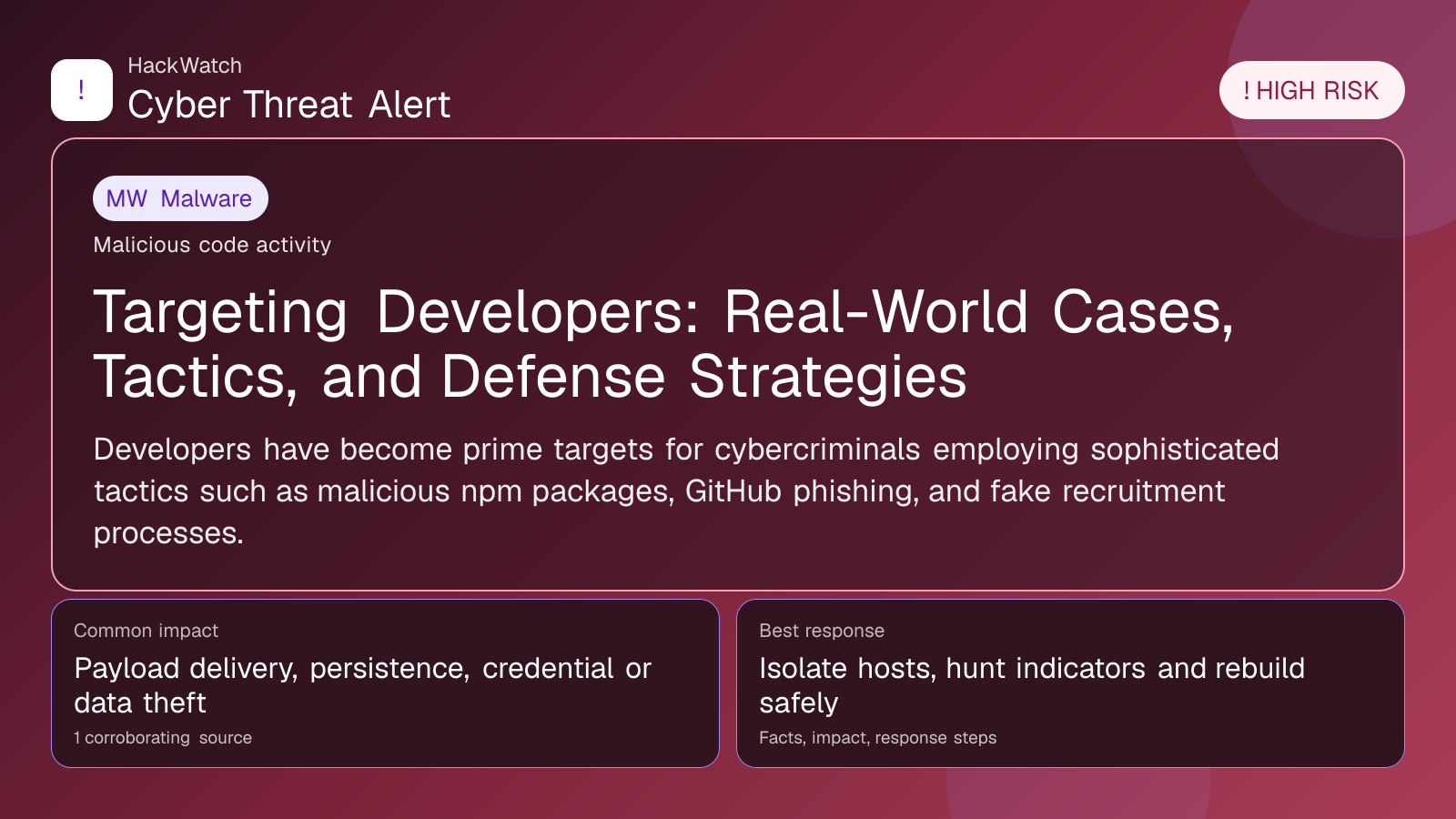
Targeting Developers: Real-World Cases, Tactics, and Defense Strategies
Malware coverage focused on infection paths, containment steps and indicators defenders should watch.

By: Artur Ślesik
Published: Apr 22, 2026
Updated: May 01, 2026
Incident status: Active threat
Corroborating sources: 1
Technical review credentials: Security+ evidence | RHCSA evidence | JNCIS-SEC evidence
Trust note:This alert is maintained under HackWatch's editorial policy, with visible source records, a named responsible editor and a correction channel for disputed facts.
The published article is checked against public sources before publication, and material corrections are reflected in the article update date.
Technical reviewer note: Marcin Pocztowski reviewed this alert on May 01, 2026 for infrastructure impact, containment order and whether persistence or lateral-movement claims are supported by evidence. His administrator note is concrete: isolate the host or segment first, protect logs and network telemetry, then rebuild, rotate or patch only within the scope supported by the 1 corroborating source, the same cautious sequence he would use around managed router and server environments.
Review our editorial policy or send corrections to [email protected].
Active threat. The incident should still be treated as active until confirmed mitigation or patch adoption is verified.
Developers have become prime targets for cybercriminals employing sophisticated tactics such as malicious npm packages, GitHub phishing, and fake recruitment processes.
# Targeting Developers: Real-World Cases, Tactics, and Defense Strategies
What happened
In recent years, cybercriminals have increasingly targeted software developers with tailored attacks exploiting their critical role in the software supply chain. According to multiple corroborated reports from Kaspersky, attackers have leveraged malicious npm packages, GitHub phishing campaigns, and deceptive recruitment tactics such as fake interviews and take-home assignments to compromise developer environments and gain access to sensitive codebases and infrastructure.
These attacks are sophisticated and multi-faceted, often combining social engineering with technical exploits. For example, malicious npm packages masquerading as legitimate dependencies have been found to exfiltrate credentials or inject backdoors. Similarly, phishing campaigns on GitHub have tricked developers into revealing OAuth tokens or login credentials, enabling attackers to infiltrate repositories.
Fake recruitment processes have also emerged as a novel vector. Attackers pose as recruiters or hiring managers, inviting developers to participate in take-home coding assignments embedded with malware or designed to harvest sensitive information.
Confirmed facts
- Malicious npm packages have been identified that execute unauthorized code during installation, compromising developer machines and environments.
- GitHub phishing campaigns have successfully harvested developer credentials and OAuth tokens, allowing attackers to access private repositories and inject malicious code.
- Fake interviews and take-home assignments have been used to distribute malware disguised as legitimate coding tasks.
- These tactics have been confirmed through multiple independent analyses and incident reports documented by Kaspersky and other cybersecurity entities.
- Attacks often lead to supply chain compromises, affecting not only individual developers but also the organizations relying on their code.
Who is affected
- Individual software developers, especially those working with open-source ecosystems like npm or GitHub.
- Development teams within enterprises that rely on third-party packages and external contributors.
- Organizations dependent on secure software supply chains, including tech companies, financial institutions, and critical infrastructure providers.
- Recruiters and HR teams inadvertently facilitating attacker access through compromised hiring processes.
What to do now
- Audit all dependencies in your projects, especially npm packages, for authenticity and recent security advisories.
- Enable multi-factor authentication (MFA) on all developer accounts, including GitHub and npm registries.
- Be vigilant against unsolicited recruitment offers or interview requests; verify recruiter identities through official company channels.
- Use security tools to scan take-home assignments for malicious code before execution.
- Regularly rotate and audit access tokens and credentials associated with development platforms.
- Educate development teams about social engineering tactics targeting developers.
How to secure yourself
- Implement strict dependency management policies, including the use of package integrity checks and lockfiles.
- Leverage security features provided by platforms like GitHub, such as security alerts and token scanning.
- Use isolated environments or containers when testing untrusted code or assignments.
- Integrate automated security scanning into CI/CD pipelines to detect suspicious code or dependencies early.
- Report suspicious recruitment or phishing attempts to platform administrators and cybersecurity teams.
- Maintain up-to-date endpoint security solutions tailored to developer tools and environments.
FAQ
How can I tell if I have been targeted by malicious npm packages?
Look for unexpected network activity during package installation, unusual code execution, or alerts from security tools. Regularly review package update histories and community reports for suspicious behavior.
What steps should I take if my GitHub account is compromised?
Immediately revoke all active tokens, change your password, enable MFA, review repository access logs, and notify your organization’s security team. Conduct a thorough audit of recent commits for unauthorized changes.
Are fake interview assignments common in developer recruitment scams?
Yes, attackers increasingly use fake coding assignments to distribute malware or steal sensitive information. Always verify the legitimacy of recruitment communications and scan any received code before running.
How do I secure my development environment against these threats?
Use isolated environments for testing, enforce strict access controls, keep software updated, and integrate automated security scans into your development lifecycle.
What changes were introduced in 2026 to combat developer-targeted attacks?
Mandatory MFA for package maintainers, AI-driven threat detection in developer platforms, enhanced vetting of packages, and improved user education initiatives have been implemented.
Can open-source contributors protect themselves from supply chain attacks?
Yes, by following best practices such as code reviews, dependency audits, and using security tools designed for open-source ecosystems.
How do phishing attacks on GitHub typically work?
Attackers send deceptive messages or create fake login pages to steal credentials or OAuth tokens, which they then use to access repositories and inject malicious code.
What role do recruiters play in these attacks?
Some attackers impersonate recruiters to gain trust and lure developers into executing malicious code under the guise of legitimate job tasks.
Is multi-factor authentication enough to protect developer accounts?
While MFA significantly improves security, it should be combined with other measures like token management, security awareness, and environment isolation for comprehensive protection.
Why this matters
Developers are the gatekeepers of software integrity. Compromising their accounts or environments can lead to widespread supply chain attacks, affecting millions of users downstream. Understanding the evolving tactics targeting developers and adopting robust defense strategies is critical to maintaining software security and trust in digital ecosystems.
Sources and corroboration
This article synthesizes findings and incident analyses from Kaspersky’s official blog post dated April 22, 2026, alongside corroborating reports from cybersecurity research and incident response teams specializing in developer-targeted threats.
- https://www.kaspersky.com/blog/why-hackers-target-developers/55630/
Sources used for this article
kaspersky.com