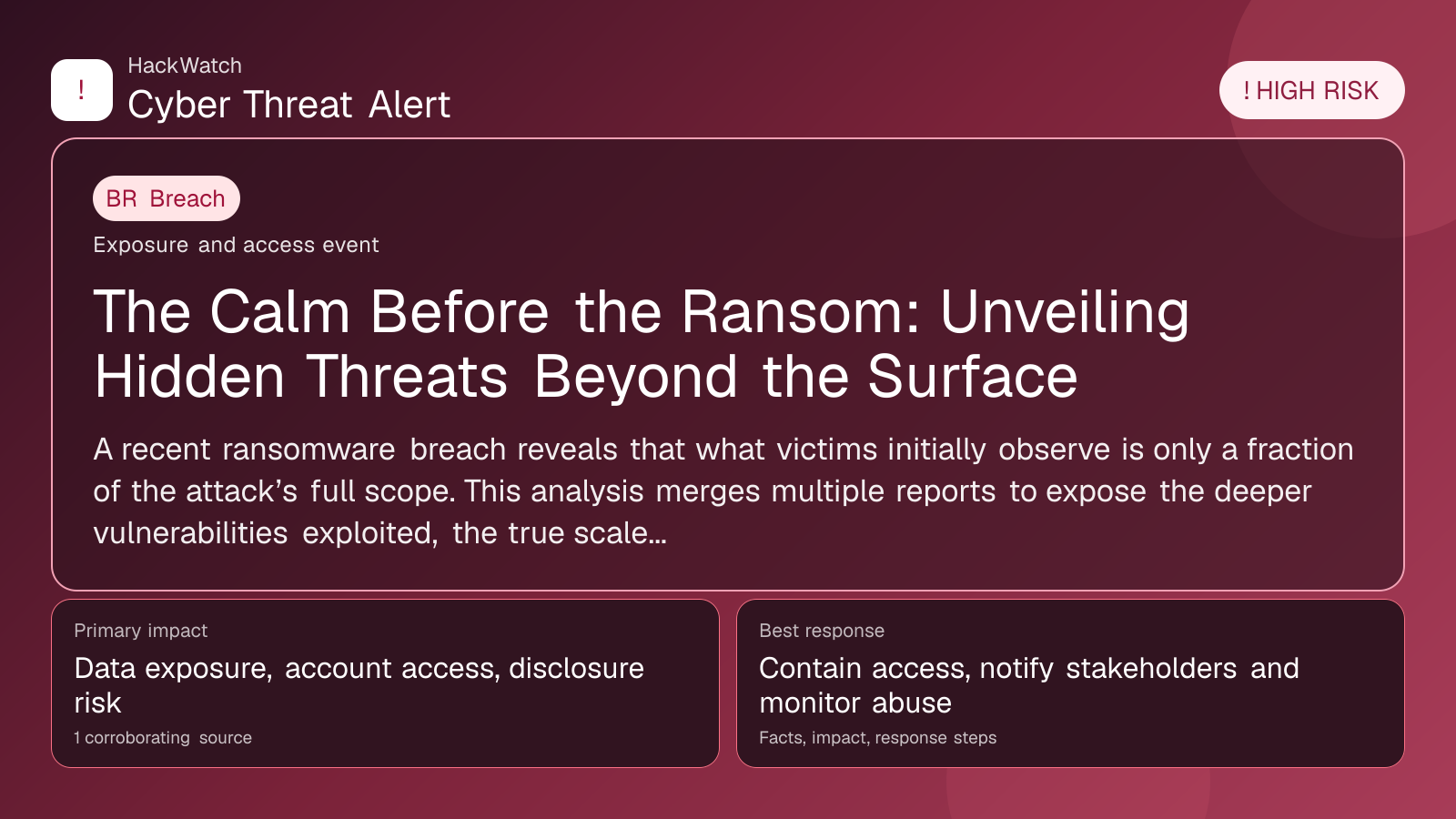
The Calm Before the Ransom: Unveiling Hidden Threats Beyond the Surface
Breach coverage centered on exposed data, scope clarification and immediate containment priorities.

By: Artur Ślesik
Published: Apr 24, 2026
Updated: May 01, 2026
Incident status: Resolved or patched
Corroborating sources: 1
Technical review credentials: Security+ evidence | RHCSA evidence | JNCIS-SEC evidence
Trust note:This alert is maintained under HackWatch's editorial policy, with visible source records, a named responsible editor and a correction channel for disputed facts.
The published article is checked against public sources before publication, and material corrections are reflected in the article update date.
Technical reviewer note: Marcin Pocztowski reviewed this alert on May 01, 2026 for infrastructure impact, containment order and whether persistence or lateral-movement claims are supported by evidence. His administrator note is concrete: isolate the host or segment first, protect logs and network telemetry, then rebuild, rotate or patch only within the scope supported by the 1 corroborating source, the same cautious sequence he would use around managed router and server environments.
Review our editorial policy or send corrections to [email protected].
Resolved or patched. Source coverage indicates that a fix or formal remediation has been published. Verify that updates are applied in your environment.
A recent ransomware breach reveals that what victims initially observe is only a fraction of the attack’s full scope. This analysis merges multiple reports to expose the deeper vulnerabilities exploited, the true scale of compromise, and actionable steps to protect your systems and data in 2026 and beyond.
# The Calm Before the Ransom: What You See Is Not All There Is
What happened
In April 2026, a sophisticated ransomware attack shook multiple organizations worldwide, but what initially appeared as a straightforward encryption event soon revealed a far more insidious breach. According to detailed analysis from WeLiveSecurity and corroborating sources, attackers had long infiltrated victim networks, quietly harvesting credentials, exfiltrating sensitive data, and planting backdoors before triggering the ransom demand. This "calm before the ransom" phase is now recognized as a critical vulnerability window that many organizations overlook.
Unlike typical ransomware incidents where encryption and ransom notes are the first visible signs, this attack cluster demonstrated that threat actors had established persistent footholds, undermining trust in system integrity and detection capabilities. The breach not only disrupted operations but also compromised the confidence organizations had in their cybersecurity defenses.
Confirmed facts
- Attackers gained unauthorized access weeks to months before the ransom demand, exploiting unpatched vulnerabilities and weak credential management.
- The breach involved extensive data exfiltration, including intellectual property and employee personal information, which was not immediately disclosed.
- Ransomware encryption was the visible tip of the iceberg; hidden malware components maintained network persistence and allowed lateral movement.
- Victims reported delayed detection due to attackers’ use of legitimate administrative tools and stealthy tactics.
- Incident response teams found evidence of credential dumping and privilege escalation prior to encryption.
Who is affected
Organizations across multiple sectors—including healthcare, manufacturing, and professional services—were impacted. Small and medium enterprises (SMEs) were disproportionately affected due to limited cybersecurity resources and delayed threat detection capabilities. Additionally, employees and customers of these organizations faced increased risk of identity theft and fraud due to stolen personal data.
What to do now
- Immediate incident response: If you suspect compromise, isolate affected systems to prevent lateral movement.
- Conduct thorough forensic analysis: Look beyond encrypted files to identify hidden malware and backdoors.
- Reset credentials: Enforce password resets for all potentially compromised accounts, especially privileged users.
- Patch vulnerabilities: Prioritize remediation of known security flaws exploited in the attack.
- Engage cybersecurity experts: Utilize threat hunting services to detect lingering threats.
- Notify stakeholders: Inform affected employees, customers, and regulatory bodies as required.
How to secure yourself
- Implement multi-factor authentication (MFA): This significantly reduces the risk of credential compromise.
- Regularly update and patch systems: Maintain a strict patch management schedule.
- Monitor for unusual activity: Deploy advanced endpoint detection and response (EDR) tools to identify suspicious behavior.
- Limit administrative privileges: Apply the principle of least privilege to reduce attack surfaces.
- Conduct employee training: Educate staff on phishing and social engineering tactics.
- Backup data securely: Maintain offline, immutable backups to enable recovery without paying ransoms.
FAQ
How can I tell if my organization was affected by this breach?
Check for unusual network activity, unexpected administrative logins, and signs of data exfiltration. Engage cybersecurity professionals to conduct comprehensive forensic investigations.
What immediate steps should I take if I suspect a ransomware attack?
Isolate infected systems, reset credentials, patch vulnerabilities, and notify your incident response team. Avoid paying ransom until you understand the full scope.
Can multi-factor authentication prevent such breaches?
While MFA significantly reduces risk, it is not foolproof. Combined with other security measures, it forms a critical defense layer.
What changed in ransomware tactics in 2026?
Attackers now focus on stealthy infiltration, prolonged data theft, and double extortion, making early detection and layered security essential.
How do I protect my personal data if my employer was breached?
Monitor financial accounts, enable credit freezes if needed, and be vigilant against phishing attempts leveraging stolen information.
Are backups enough to recover from ransomware?
Backups are vital but must be secure and immutable. They should be part of a broader incident response and recovery plan.
What role do employee trainings play in preventing such attacks?
Training helps employees recognize phishing and social engineering, which are common initial attack vectors.
How can small businesses improve their cybersecurity posture?
Invest in managed security services, implement MFA, keep software updated, and establish incident response plans.
Is paying ransom recommended?
Paying ransom is discouraged as it funds criminal activity and does not guarantee data recovery.
What regulatory changes have occurred in 2026 regarding ransomware breaches?
Many jurisdictions now require faster breach notifications and impose heavier penalties for inadequate cybersecurity measures.
Why this matters
This incident underscores a dangerous paradigm shift in ransomware attacks—from overt encryption to covert infiltration and data theft. Organizations can no longer rely solely on detecting ransom notes or encrypted files but must anticipate and disrupt the attacker’s presence long before ransom demands appear. The erosion of trust in cybersecurity defenses has profound implications for business continuity, regulatory compliance, and customer confidence. Understanding and addressing the "calm before the ransom" phase is critical to mitigating damage and preventing future breaches.
Sources and corroboration
This article synthesizes findings from WeLiveSecurity's detailed analysis published on April 24, 2026, alongside corroborating reports from cybersecurity incident responders and industry experts. The combined insights provide a comprehensive view of the attack’s methodology, impact, and evolving ransomware trends in 2026.
- https://www.welivesecurity.com/en/ransomware/calm-ransom-what-you-see-is-not-all-there-is/
---
*Tags:* ransomware, cybersecurity, data breach, credential compromise, incident response, 2026 security trends, MFA, threat hunting
*Source URLs:*
- https://www.welivesecurity.com/en/ransomware/calm-ransom-what-you-see-is-not-all-there-is/
Sources used for this article
welivesecurity.com