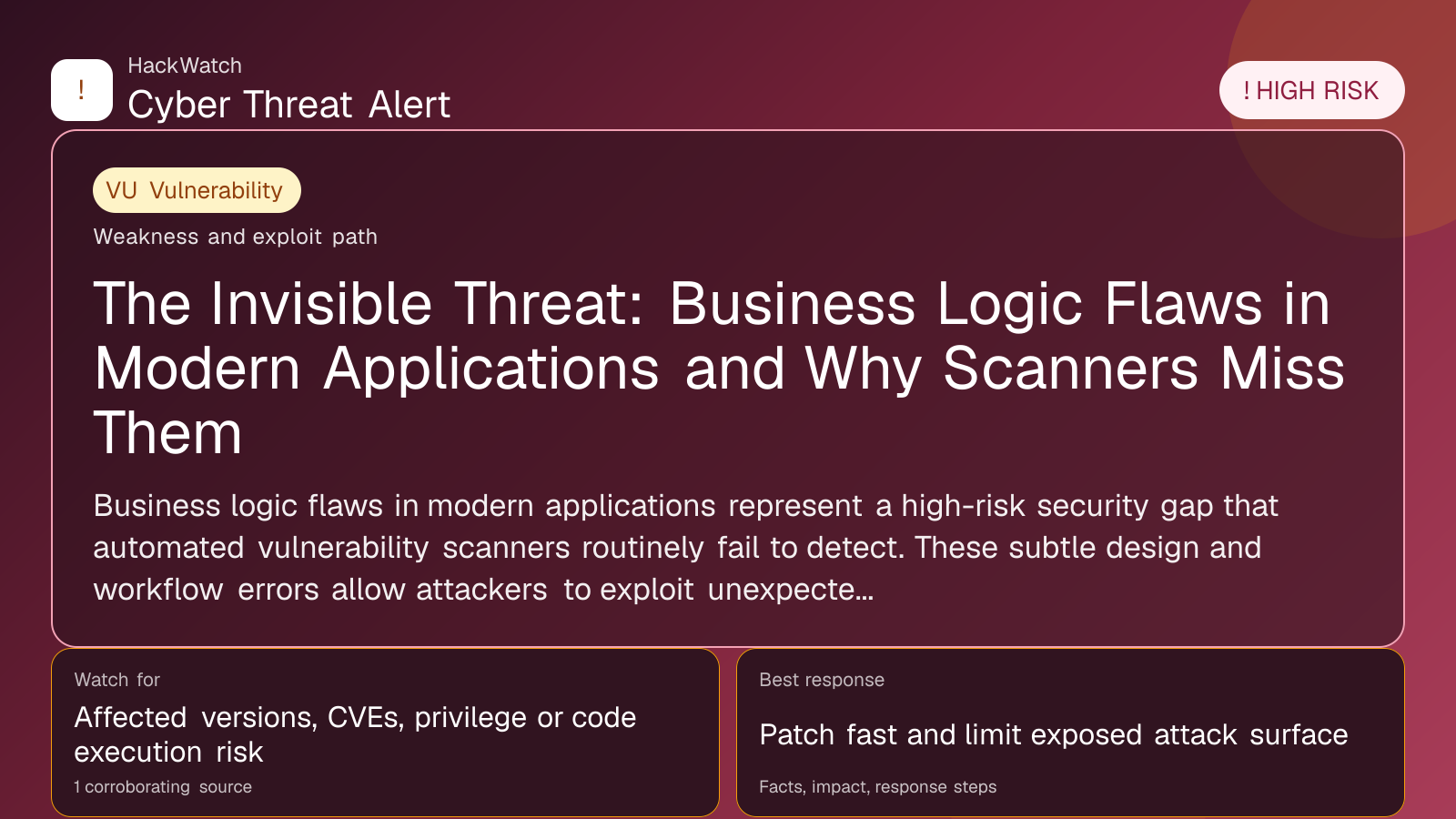
The Invisible Threat: Business Logic Flaws in Modern Applications and Why Scanners Miss Them
Vulnerability coverage focused on affected versions, exploitability and patch or mitigation decisions.

By: Artur Ślesik
Published: Apr 22, 2026
Updated: May 01, 2026
Incident status: Active threat
Corroborating sources: 1
Technical review credentials: Security+ evidence | RHCSA evidence | JNCIS-SEC evidence
Trust note:This alert is maintained under HackWatch's editorial policy, with visible source records, a named responsible editor and a correction channel for disputed facts.
The published article is checked against public sources before publication, and material corrections are reflected in the article update date.
Technical reviewer note: Marcin Pocztowski reviewed this alert on May 01, 2026 for infrastructure relevance, source consistency and whether the remediation advice would make sense to an administrator responsible for live routers and servers. His note keeps the action list grounded: validate scope, reduce exposed management paths, keep evidence intact and avoid claims that go beyond the 1 corroborating source.
Review our editorial policy or send corrections to [email protected].
Active threat. The incident should still be treated as active until confirmed mitigation or patch adoption is verified.
Business logic flaws in modern applications represent a high-risk security gap that automated vulnerability scanners routinely fail to detect. These subtle design and workflow errors allow attackers to exploit unexpected behaviors, leading to serious breaches despite clean scan reports.
What happened
In 2026, cybersecurity experts have increasingly identified business logic flaws as a critical and underappreciated threat vector in modern applications. Unlike common vulnerabilities such as SQL injection or cross-site scripting, business logic flaws arise from errors in the intended workflow or design of an application. These flaws allow attackers to manipulate the system by performing actions outside the expected sequences or exploiting overlooked edge cases.
Automated vulnerability scanners, which form the backbone of many organizations' security assessments, are largely ineffective at detecting these flaws. This invisibility has led to a rise in breaches where companies believed their applications were secure based on clean scan reports, only to be blindsided by attackers exploiting logic errors.
Confirmed facts
- Business logic flaws are not technical bugs but design and workflow mistakes inherent in the application's business rules.
- Automated scanners primarily detect known technical vulnerabilities and cannot interpret complex business workflows or context-specific logic.
- Attackers exploit these flaws by performing unexpected sequences of actions or abusing legitimate functions in unintended ways.
- Real-world incidents have shown significant data breaches and financial fraud stemming from business logic vulnerabilities.
- Security Boulevard's April 2026 report consolidates expert analysis highlighting this invisible threat and the limitations of current scanning tools.
Who is affected
- Enterprises and SMBs: Any organization relying on web or mobile applications with complex workflows is at risk.
- Financial services: Banking and payment platforms are prime targets due to the high value of transactions and complex business rules.
- E-commerce platforms: Logic flaws can enable price manipulation, unauthorized discounts, or inventory mismanagement.
- Healthcare and insurance: Sensitive data and claim processing workflows present opportunities for exploitation.
- End users: Customers suffer from identity theft, financial loss, and privacy breaches resulting from these flaws.
What to do now
- Conduct manual business logic reviews: Security teams must complement automated scans with expert-led assessments focusing on business workflows.
- Implement threat modeling: Map out application processes to identify potential logic abuse scenarios.
- Engage in red teaming and penetration testing: Use skilled testers to simulate attacks that exploit business logic.
- Adopt runtime application self-protection (RASP): Monitor application behavior in real-time to detect anomalous sequences.
- Prioritize security in the development lifecycle: Integrate logic flaw detection early in design and testing phases.
How to secure yourself
- For developers and organizations:
- Invest in training on business logic security.
- Use comprehensive security frameworks that include logic flaw detection.
- Regularly update and patch applications with a focus on workflow integrity.
- For users:
- Monitor account activity for unusual transactions or behavior.
- Use multi-factor authentication to reduce account compromise risk.
- Report suspicious application behavior promptly.
FAQ
What exactly are business logic flaws?
Business logic flaws are vulnerabilities that arise from errors or oversights in the design and intended workflows of an application, allowing attackers to manipulate processes in unintended ways.
Why do automated scanners miss business logic flaws?
Automated scanners focus on technical vulnerabilities and lack the contextual understanding of complex business processes required to detect logic errors.
Can business logic flaws lead to data breaches?
Yes, attackers can exploit these flaws to bypass controls, access sensitive data, or perform unauthorized transactions.
How can organizations detect business logic vulnerabilities?
Through manual code reviews, threat modeling, penetration testing, and deploying runtime monitoring tools that analyze application behavior.
Are business logic flaws common in all industries?
They are prevalent wherever applications have complex workflows, especially in finance, e-commerce, healthcare, and insurance sectors.
What role does AI play in detecting business logic flaws?
AI is increasingly used to analyze code and application behavior patterns to identify anomalies indicative of logic flaws, though it is not yet a complete solution.
How can users protect themselves from the impact of business logic flaws?
By monitoring their accounts for unusual activity, using strong authentication methods, and promptly reporting suspicious behavior.
Has regulation changed in 2026 regarding business logic flaws?
Yes, some regulatory frameworks now require organizations in critical sectors to assess and mitigate business logic vulnerabilities.
What is the difference between a business logic flaw and a traditional vulnerability?
Traditional vulnerabilities are technical bugs exploitable by code injection or protocol manipulation, while business logic flaws stem from incorrect or incomplete application workflows.
Are there any tools specialized in detecting business logic flaws?
Currently, specialized tools are emerging, often incorporating AI and behavioral analytics, but manual expert analysis remains essential.
Why this matters
Business logic flaws represent a stealthy yet high-impact security risk. Their ability to bypass automated defenses and exploit legitimate application functions makes them particularly dangerous. Organizations ignoring this threat expose themselves to financial loss, reputational damage, and regulatory penalties. Understanding and addressing business logic vulnerabilities is critical for robust cybersecurity in 2026 and beyond.
Sources and corroboration
This article synthesizes findings from Security Boulevard's April 22, 2026 report titled "The Invisible Threat: Business Logic Flaws in Modern Applications and Why Scanners Miss Them" and corroborates insights from industry experts and recent cybersecurity incident analyses.
- https://securityboulevard.com/2026/04/the-invisible-threat-business-logic-flaws-in-modern-applications-and-why-scanners-miss-them/
Sources used for this article
securityboulevard.com