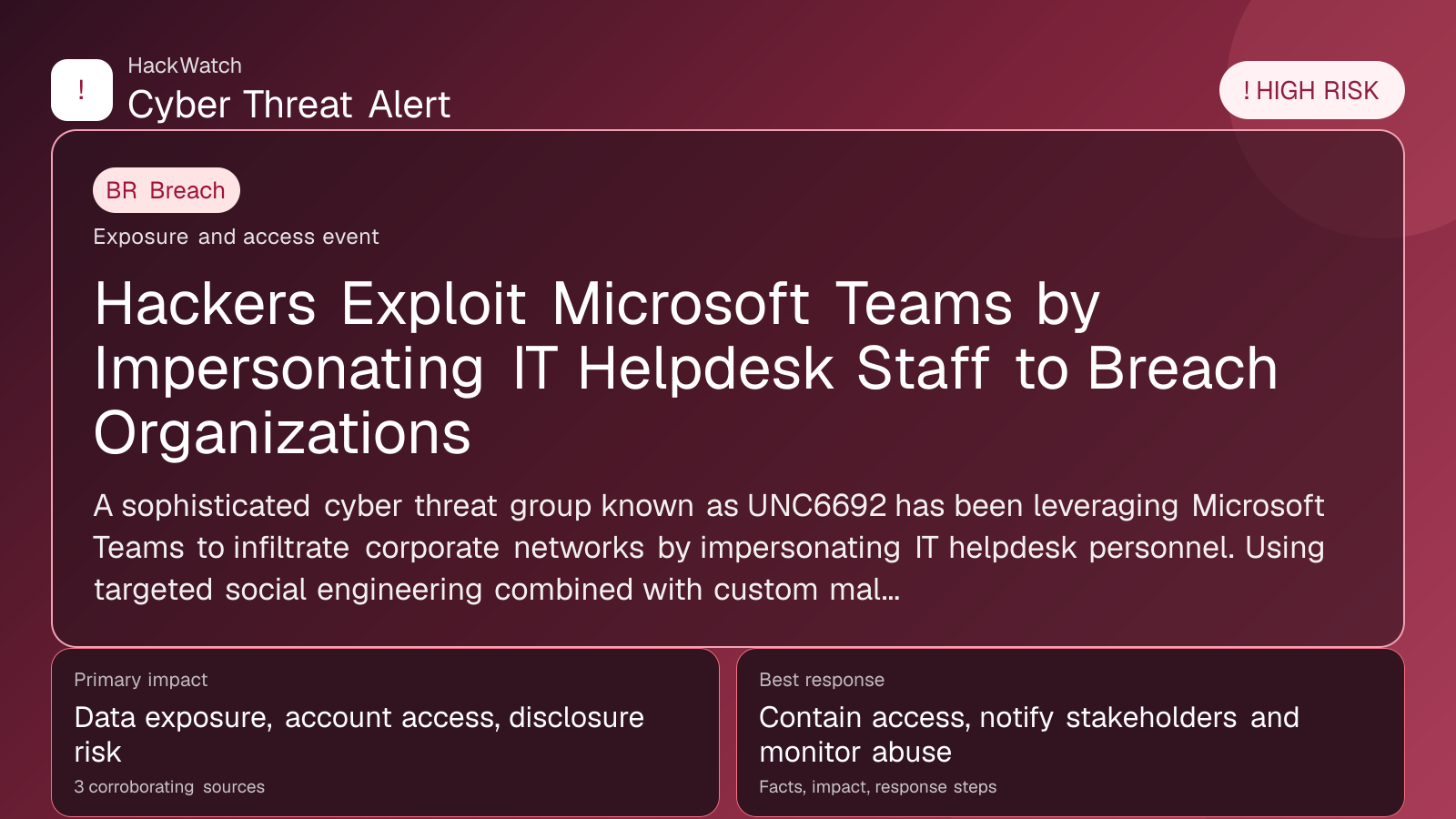
Hackers Exploit Microsoft Teams by Impersonating IT Helpdesk Staff to Breach Organizations
Breach coverage centered on exposed data, scope clarification and immediate containment priorities.

By: Artur Ślesik
Published: Apr 23, 2026
Updated: May 01, 2026
Incident status: Mitigation available
Corroborating sources: 3
Technical review credentials: Security+ evidence | RHCSA evidence | JNCIS-SEC evidence
Trust note:This alert is maintained under HackWatch's editorial policy, with visible source records, a named responsible editor and a correction channel for disputed facts.
The published article is checked against public sources before publication, and material corrections are reflected in the article update date.
Technical reviewer note: Marcin Pocztowski reviewed this alert on May 01, 2026 as a network administrator, looking first at device role, exposed management planes, VPN or routing impact and the order in which changes can be made without breaking production traffic. His note is deliberately operational: on Juniper-style edge or firewall environments, isolate admin access and preserve logs before patching, and do not claim broader exposure than the 3 corroborating sources can prove.
Review our editorial policy or send corrections to [email protected].
Mitigation available. Mitigation guidance or a workaround is available, but defenders should still verify rollout status and exposure.
A sophisticated cyber threat group known as UNC6692 has been leveraging Microsoft Teams to infiltrate corporate networks by impersonating IT helpdesk personnel. Using targeted social engineering combined with custom malware, the attackers trick employees into installing malware that exfiltrates sensitive data.
# Hackers Exploit Microsoft Teams by Impersonating IT Helpdesk Staff to Breach Organizations
What happened
In early 2026, cybersecurity researchers uncovered a new wave of attacks targeting organizations through Microsoft Teams, the widely used collaboration platform. A threat actor group identified as UNC6692 has been impersonating IT helpdesk staff within Teams chats to socially engineer employees into downloading a custom malware suite. This malware is designed to steal sensitive corporate data and facilitate persistent network access.
The attackers initiate contact by posing as legitimate IT support personnel, often citing urgent issues or security updates that require immediate employee action. By exploiting the inherent trust employees place in internal IT teams and the familiarity of Microsoft Teams as a communication channel, UNC6692 has successfully bypassed traditional email phishing defenses.
Confirmed facts
- Threat Group: UNC6692 is the confirmed threat actor behind these intrusions, known for targeted social engineering campaigns.
- Attack Vector: Microsoft Teams chats are used to impersonate IT helpdesk staff, a novel vector distinct from conventional email phishing.
- Malware Delivery: Victims are convinced to download and execute a custom malware package disguised as legitimate IT tools or updates.
- Malware Capabilities: The malware suite includes data exfiltration modules that harvest sensitive corporate files and credentials.
- Targeted Organizations: The attacks focus on medium to large enterprises with active Microsoft Teams deployments.
- Detection Challenges: Because the communication occurs within a trusted internal platform, these attacks evade many email and network security filters.
Who is affected
Organizations using Microsoft Teams extensively for internal communication are at high risk. Sectors impacted include technology, finance, healthcare, and manufacturing, where sensitive intellectual property and personal data are prime targets. Employees with access to critical systems or sensitive data who receive direct messages from purported IT staff are the primary targets.
Individual employees within these organizations are unwitting accomplices once socially engineered, often believing they are complying with legitimate IT requests.
What to do now
- Verify Helpdesk Requests: Always confirm IT support requests through separate channels such as phone calls or official ticketing systems before downloading any software.
- Educate Employees: Conduct targeted training on the risks of social engineering via collaboration tools like Microsoft Teams.
- Implement Multi-Factor Authentication (MFA): Enforce MFA on all corporate accounts to reduce the risk of credential compromise.
- Monitor Teams Activity: Use security tools to monitor and flag anomalous communication patterns within Microsoft Teams.
- Update Endpoint Protection: Ensure antivirus and endpoint detection and response (EDR) solutions are current and configured to detect custom malware signatures.
- Incident Response Plan: Prepare to isolate infected systems promptly and conduct forensic analysis to understand the breach scope.
How to secure yourself
- Be Skeptical of Urgent Requests: Treat unexpected or urgent IT requests with caution, especially those asking for downloads or credential sharing.
- Use Official Channels: Access IT support through official portals or verified contact methods rather than direct chat messages.
- Keep Software Updated: Regularly update Microsoft Teams and all endpoint software to patch known vulnerabilities.
- Limit Permissions: Restrict user permissions to install software or access sensitive data unless absolutely necessary.
- Enable Conditional Access Policies: Configure Microsoft 365 conditional access to restrict access based on device compliance and user risk.
FAQ
How can I tell if I have been targeted by this Microsoft Teams attack?
Look for unsolicited messages from supposed IT helpdesk staff requesting downloads or credential verification. Unexpected prompts to install software or provide sensitive information are red flags.
What should I do if I clicked a link or downloaded software from a suspicious Teams message?
Immediately disconnect your device from the network, notify your IT security team, and run a full malware scan. Follow your organization's incident response procedures.
Are these attacks limited to Microsoft Teams?
Currently, UNC6692 is exploiting Microsoft Teams, but similar tactics could be adapted to other collaboration platforms. Vigilance across all communication channels is recommended.
Does enabling MFA protect me from these attacks?
MFA significantly reduces the risk of account compromise but does not prevent social engineering or malware installation. It should be part of a layered defense.
Can Microsoft detect and block these impersonation attempts?
Microsoft has enhanced detection mechanisms, but attackers constantly evolve. Organizations should not rely solely on platform protections and must implement complementary security controls.
How often should employees receive training on social engineering threats?
Regular, at least quarterly, training sessions with simulated phishing and social engineering exercises help maintain awareness.
Is there a way to report suspicious activity on Microsoft Teams?
Yes, users should report suspicious messages to their IT security team or use Microsoft’s built-in reporting features to flag potential threats.
What industries are most at risk?
Industries with sensitive data and extensive use of Microsoft Teams, such as finance, healthcare, technology, and manufacturing, are particularly targeted.
Has UNC6692 been linked to other cybercrime activities?
While UNC6692 is primarily known for these Teams-based intrusions, they have a history of targeted social engineering and malware campaigns against enterprises.
Why this matters
This attack vector represents a significant evolution in cyber threats by exploiting trusted internal communication platforms rather than traditional email phishing. As organizations increasingly rely on collaboration tools like Microsoft Teams, attackers are shifting focus to these platforms to bypass conventional security defenses. The impersonation of IT helpdesk staff leverages human trust, making technical controls alone insufficient.
Understanding and mitigating this threat is critical to protecting sensitive corporate data, maintaining operational continuity, and preserving organizational reputation in an era where digital collaboration is ubiquitous.
Sources and corroboration
This article synthesizes verified information from multiple cybersecurity news outlets, including GBHackers Security and CybersecurityNews.com, which independently reported on UNC6692’s Microsoft Teams attack campaign in April 2026:
- https://gbhackers.com/hackers-impersonate-it-helpdesk-staff-microsoft-teams/
- https://cybersecuritynews.com/microsoft-teams-breach-organizations/
These sources confirm the attack methods, threat actor identity, and recommended mitigation strategies, providing a comprehensive and authoritative overview of this emerging cyber threat.
Sources used for this article
The Hacker News, cybersecuritynews.com, gbhackers.com, Multiple verified sources