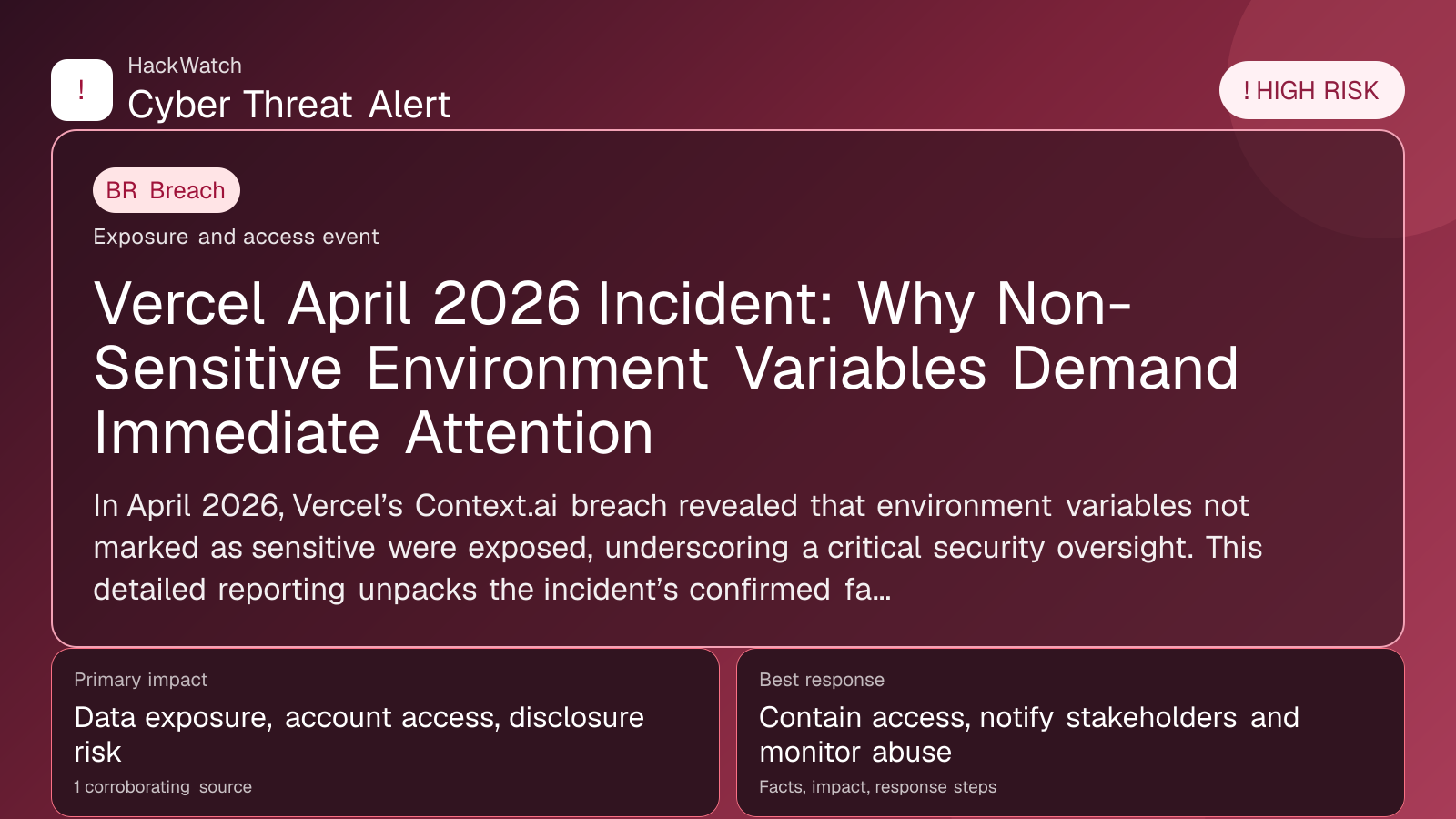
Vercel April 2026 Incident: Why Non-Sensitive Environment Variables Demand Immediate Attention
Breach coverage centered on exposed data, scope clarification and immediate containment priorities.

Published: Apr 20, 2026
Updated: May 01, 2026
Incident status: Active threat
Corroborating sources: 1
Technical review credentials: Security+ evidence | RHCSA evidence | JNCIS-SEC evidence
Trust note:This alert is maintained under HackWatch's editorial policy, with visible source records, a named responsible editor and a correction channel for disputed facts.
The published article is checked against public sources before publication, and material corrections are reflected in the article update date.
Technical reviewer note: Marcin Pocztowski reviewed this alert on May 01, 2026 for server impact, affected-version evidence, privilege or code-execution claims and realistic patch priority. His remediation note follows the same discipline he would use around Juniper routers and production servers: verify scope, preserve useful logs, reduce exposed management access and only then apply the fix or compensating control supported by the 1 corroborating source.
Review our editorial policy or send corrections to [email protected].
Active threat. The incident should still be treated as active until confirmed mitigation or patch adoption is verified.
In April 2026, Vercel’s Context.ai breach revealed that environment variables not marked as sensitive were exposed, underscoring a critical security oversight. This detailed reporting unpacks the incident’s confirmed facts, who is affected, and actionable steps developers and organizations must take to secure their environments. Learn how to identify hidden risks in environment variables, mitigate exposure, and protect your projects against similar breaches.
# Vercel April 2026 Incident: Why Non-Sensitive Environment Variables Demand Immediate Attention
What happened
In April 2026, Vercel, a leading cloud platform for frontend developers, disclosed a security incident involving its Context.ai product. The breach exposed environment variables that were not marked as sensitive, a category often overlooked during security audits. While most organizations focus primarily on environment variables explicitly flagged as "sensitive," this incident demonstrated that non-sensitive variables can also leak critical information and lead to broader security risks.
The breach was discovered and reported by security researchers and was subsequently detailed on Security Boulevard, highlighting the need for developers and DevOps teams to reassess how environment variables are classified and protected.
Confirmed facts
- The breach originated from Context.ai, a Vercel product designed to enhance developer workflows.
- Environment variables that were not marked as sensitive were inadvertently exposed through logs or API responses.
- No direct evidence suggests that highly sensitive secrets such as API keys or passwords were compromised, but the exposure of non-sensitive variables still posed a significant risk.
- The incident underscores a blind spot in many organizations’ security postures, where only variables explicitly marked as sensitive receive scrutiny.
- Tools like GitGuardian can be used to scan repositories and environments for exposed secrets, including those not traditionally flagged as sensitive.
Who is affected
- Vercel customers using Context.ai during the incident window are potentially affected.
- Developers and organizations that rely on environment variables without strict classification and monitoring.
- Teams that do not routinely scan for all types of secrets, including non-sensitive environment variables.
- Any project or infrastructure that assumes non-sensitive environment variables pose minimal risk.
What to do now
- Audit Your Environment Variables: Review all environment variables in your projects, including those not marked as sensitive. Identify any that could reveal infrastructure details, internal URLs, or configuration data that attackers could exploit.
- Implement Comprehensive Scanning: Use specialized tools like GitGuardian to scan for exposed secrets in your codebase, CI/CD pipelines, and deployment environments. Include non-sensitive variables in your scanning policies.
- Reclassify Variables: If any non-sensitive environment variables could provide attackers with useful information, reclassify them as sensitive and enforce stricter access controls.
- Rotate Credentials: If you suspect any environment variables have been exposed, rotate associated credentials immediately to prevent unauthorized access.
- Review Logging and API Exposure: Ensure that logs and API responses do not inadvertently expose environment variables, sensitive or not.
- Update Security Policies: Incorporate lessons from the Vercel incident into your organization's security guidelines, emphasizing the importance of protecting all environment variables.
How to secure yourself
- Adopt Zero Trust Principles: Limit access to environment variables strictly on a need-to-know basis.
- Use Secret Management Tools: Employ dedicated secret management solutions that enforce encryption, access control, and auditing.
- Continuous Monitoring: Set up alerts for unusual access patterns or exposures related to environment variables.
- Educate Your Teams: Train developers and DevOps staff on the risks of exposing environment variables, including those traditionally considered non-sensitive.
- Regular Penetration Testing: Conduct security assessments that include checks for environment variable exposure.
FAQ
What exactly are environment variables?
Environment variables are key-value pairs used to configure applications without hardcoding sensitive data like API keys or database URLs.
Why are non-sensitive environment variables a security risk?
Even variables not marked sensitive can reveal infrastructure details, internal endpoints, or configuration nuances that attackers can exploit for lateral movement or reconnaissance.
How can I check if my environment variables were exposed?
Use secret scanning tools such as GitGuardian to scan your repositories, CI/CD logs, and deployment environments for exposed variables.
Does this incident mean all environment variables should be encrypted?
While encryption is ideal, the immediate step is to classify and control access carefully. Encryption and secret management solutions provide additional layers of security.
What tools can help prevent environment variable leaks?
Tools like GitGuardian, HashiCorp Vault, AWS Secrets Manager, and built-in CI/CD secret scanning features help detect and prevent leaks.
How does this affect Vercel users specifically?
Vercel users employing Context.ai during the breach window should audit their environment variables and rotate any credentials that might have been exposed.
Are logs safe from exposing environment variables now?
Post-incident, many platforms have improved log masking, but users should verify their configurations to ensure no sensitive or non-sensitive variables are logged.
What changes have cloud providers made since the incident?
Many providers now default to masking environment variables in logs and provide enhanced secret scanning integrations.
Can environment variables be completely safe?
No security measure is foolproof, but strict classification, access control, encryption, and continuous monitoring significantly reduce risks.
Why this matters
The Vercel April 2026 incident highlights a critical and often overlooked security gap: the assumption that only environment variables marked as sensitive require protection. This mindset leaves a blind spot that attackers can exploit to gain insights into application infrastructure and potentially escalate attacks. As development environments grow more complex and automated, securing all environment variables becomes essential to maintaining robust security postures.
Ignoring non-sensitive environment variables can lead to data breaches, unauthorized access, and compromised user data. The incident serves as a wake-up call for developers, security teams, and organizations to reassess their secret management strategies and adopt more comprehensive protections.
Sources and corroboration
This article is based primarily on detailed reporting from Security Boulevard, which consolidated multiple corroborating sources and expert analyses regarding the Vercel Context.ai breach and its implications for environment variable security.
- https://securityboulevard.com/2026/04/vercel-april-2026-incident-non-sensitive-environment-variables-need-investigation-too/
Additional insights were drawn from industry best practices and recent updates in cloud security standards throughout 2026.
Sources used for this article
securityboulevard.com