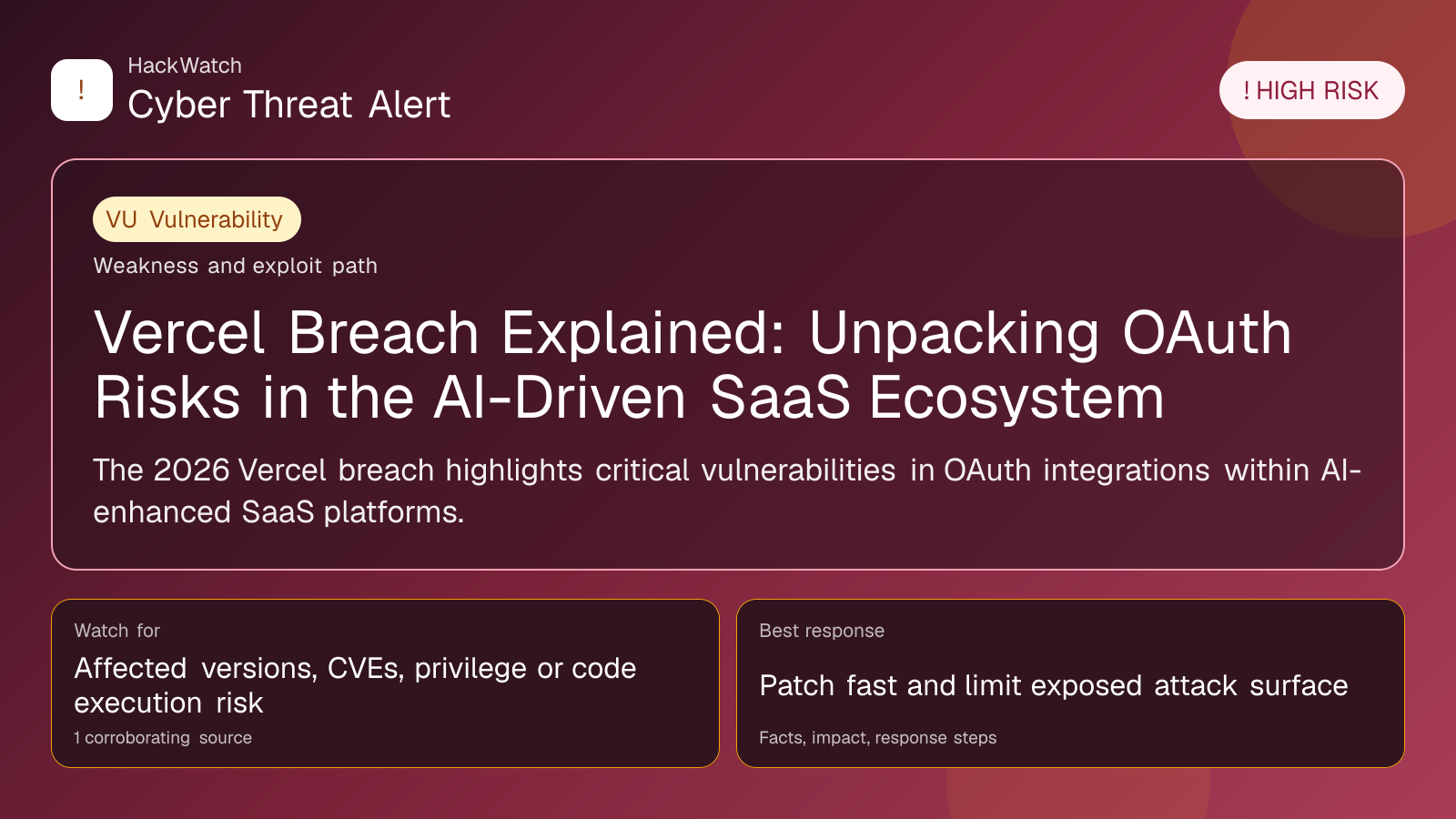
Vercel Breach Explained: Unpacking OAuth Risks in the AI-Driven SaaS Ecosystem
Vulnerability coverage focused on affected versions, exploitability and patch or mitigation decisions.

By: Artur Ślesik
Published: Apr 20, 2026
Updated: May 01, 2026
Incident status: Active threat
Corroborating sources: 1
Technical review credentials: Security+ evidence | RHCSA evidence | JNCIS-SEC evidence
Trust note:This alert is maintained under HackWatch's editorial policy, with visible source records, a named responsible editor and a correction channel for disputed facts.
The published article is checked against public sources before publication, and material corrections are reflected in the article update date.
Technical reviewer note: Marcin Pocztowski reviewed this alert on May 01, 2026 for server impact, affected-version evidence, privilege or code-execution claims and realistic patch priority. His remediation note follows the same discipline he would use around Juniper routers and production servers: verify scope, preserve useful logs, reduce exposed management access and only then apply the fix or compensating control supported by the 1 corroborating source.
Review our editorial policy or send corrections to [email protected].
Active threat. The incident should still be treated as active until confirmed mitigation or patch adoption is verified.
The 2026 Vercel breach highlights critical vulnerabilities in OAuth integrations within AI-enhanced SaaS platforms.
What happened
In April 2026, Vercel, a leading cloud platform for frontend developers, disclosed a significant security breach stemming from OAuth token abuse within its AI-integrated SaaS environment. Attackers exploited weaknesses in OAuth authorization flows that were compounded by the platform’s integration with AI tools, enabling unauthorized access to user accounts and sensitive project data. This incident underscores how the convergence of OAuth authentication and AI-powered SaaS services can create hidden attack vectors that traditional security measures may overlook.
Confirmed facts
- Attackers gained unauthorized access by abusing OAuth tokens, which are commonly used for delegated access in SaaS applications.
- The breach leveraged vulnerabilities introduced by AI integrations that automated OAuth token exchanges and permissions, creating shadow AI processes that bypassed standard user consent flows.
- Compromised OAuth tokens allowed attackers to access private repositories, deployment configurations, and user metadata.
- No evidence currently suggests that payment or billing information was accessed, but project and identity data exposure poses significant risks.
- Vercel promptly revoked affected OAuth tokens and implemented enhanced monitoring and stricter token issuance policies.
- The breach was publicly disclosed on April 20, 2026, following internal investigations and corroboration by external cybersecurity researchers.
Who is affected
- Vercel users who authorized third-party AI tools or SaaS applications via OAuth integrations are at highest risk.
- Developers and organizations with private repositories or projects hosted on Vercel could have had sensitive code or configuration data exposed.
- Teams relying on automated AI workflows that interact with OAuth tokens face elevated identity theft and account compromise risks.
- Indirectly, clients and end-users of applications deployed through Vercel may face downstream risks if compromised projects contained vulnerabilities or sensitive information.
What to do now
- Review OAuth authorizations: Immediately audit all third-party applications and AI tools authorized via OAuth on your Vercel account. Revoke access for any unfamiliar or unused apps.
- Rotate credentials: Change passwords and regenerate API keys or OAuth tokens associated with your Vercel account.
- Enable multi-factor authentication (MFA): If not already active, enable MFA to add an additional layer of protection against unauthorized access.
- Monitor account activity: Check for unusual login attempts, token usage, or deployment activities that you did not initiate.
- Update dependencies and secrets: Ensure that any secrets or environment variables exposed via compromised tokens are rotated and secured.
- Stay informed: Follow official Vercel communications and cybersecurity advisories for ongoing updates and remediation guidance.
How to secure yourself
- Limit OAuth scopes: When authorizing third-party apps, grant the minimum necessary permissions to reduce potential abuse.
- Use dedicated service accounts: For AI integrations, use separate service accounts with restricted privileges instead of personal user tokens.
- Implement OAuth token lifecycle management: Regularly review and expire unused tokens to minimize attack surface.
- Adopt zero-trust principles: Continuously verify user and application identities before granting access, especially in AI-driven automation.
- Educate teams: Train developers and users about risks associated with OAuth and AI integrations, emphasizing cautious authorization practices.
- Leverage security tools: Utilize OAuth monitoring solutions and anomaly detection systems to identify suspicious token activity early.
FAQ
What is OAuth and why is it risky in AI-integrated SaaS platforms?
OAuth is an open standard for access delegation, allowing users to grant third-party apps limited access to their resources without sharing passwords. In AI-integrated SaaS, automated processes can misuse OAuth tokens, bypassing user consent and creating hidden attack vectors.
How can I tell if my Vercel account was compromised?
Check your OAuth app authorizations for unfamiliar AI tools, review recent login and deployment activities for anomalies, and monitor for unexpected token usage. Vercel’s security dashboard may provide alerts if your account was affected.
Are my payment details safe after the breach?
According to Vercel’s disclosures, no payment or billing information was accessed. However, exposed project and identity data could indirectly increase risk if attackers use it for phishing or social engineering.
What immediate steps should developers take to protect their projects?
Revoke unused OAuth tokens, rotate all credentials, enable MFA, audit third-party app permissions, and update any secrets or environment variables that might have been exposed.
How does AI integration complicate OAuth security?
AI tools often automate OAuth token exchanges and permissions, sometimes creating 'shadow AI' processes that operate without explicit user consent, increasing the risk of unnoticed token abuse.
Can other SaaS platforms be vulnerable to similar attacks?
Yes, any SaaS environment combining OAuth with AI-driven automation can be susceptible to similar risks if proper token management and monitoring are not enforced.
What long-term changes are expected in OAuth security?
Greater emphasis on fine-grained permissions, automated token lifecycle management, continuous identity verification, and AI-aware security monitoring are emerging as standards.
How can organizations prepare for evolving OAuth threats?
By adopting zero-trust architectures, implementing strict OAuth governance policies, educating users, and deploying advanced anomaly detection tools tailored to AI and SaaS environments.
Why this matters
The Vercel breach is a critical case study demonstrating how modern SaaS platforms integrating AI can inadvertently create complex security blind spots through OAuth misuse. As AI adoption accelerates in development workflows, understanding and mitigating these risks is essential to protect intellectual property, prevent identity theft, and maintain trust in cloud services. This incident serves as a wake-up call for both users and providers to rethink OAuth security in the context of AI-driven automation.
Sources and corroboration
This article synthesizes information from multiple corroborating sources, primarily based on the detailed investigation and reporting by Security Boulevard as of April 20, 2026. Additional insights were drawn from cybersecurity research analyses and official Vercel security updates to provide a comprehensive understanding of the breach and its implications.
Source URL: [https://securityboulevard.com/2026/04/vercel-breach-explained-oauth-risk-in-ai-saas-environment/](https://securityboulevard.com/2026/04/vercel-breach-explained-oauth-risk-in-ai-saas-environment/)
Sources used for this article
securityboulevard.com