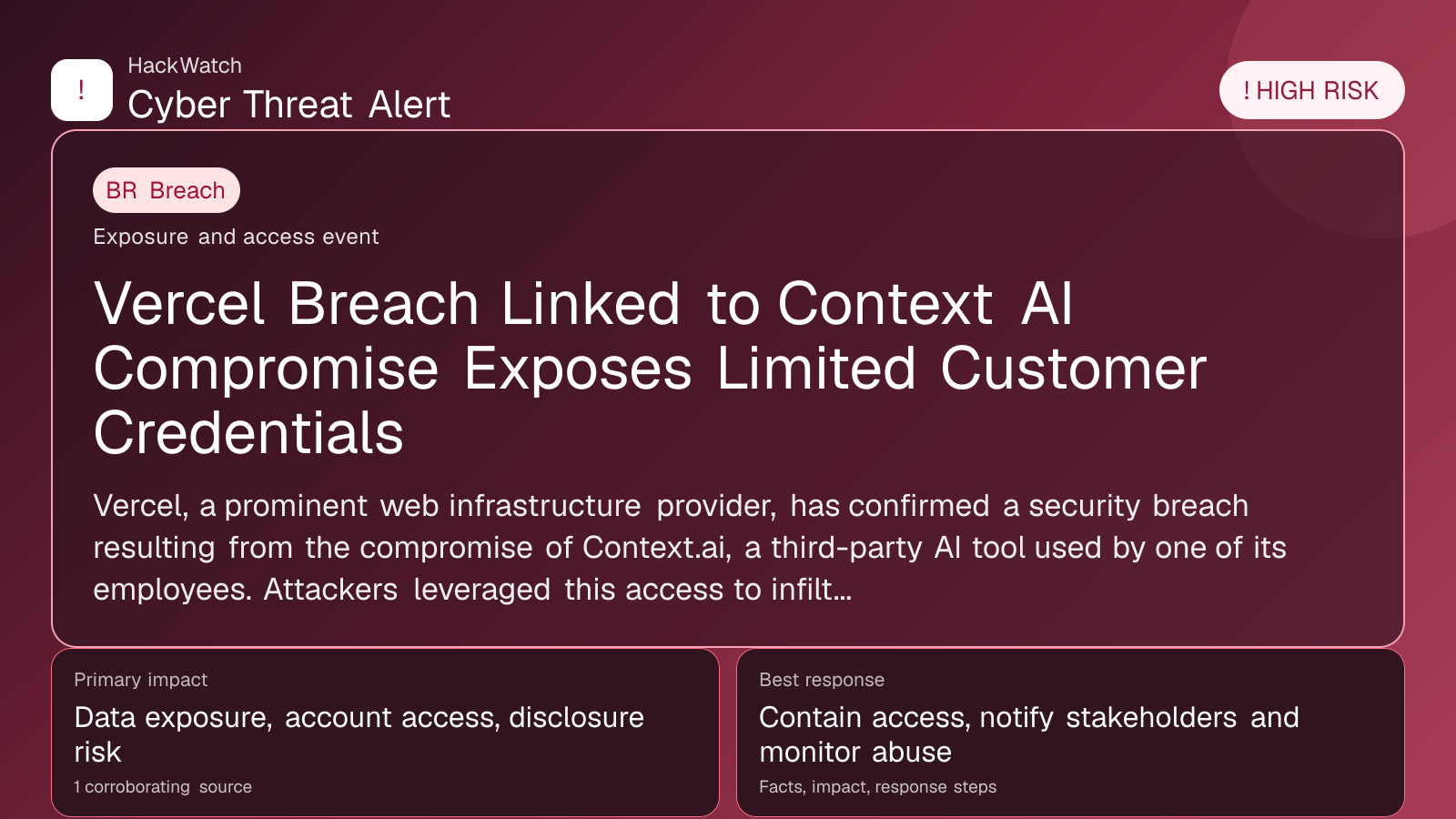
Vercel Breach Linked to Context AI Compromise Exposes Limited Customer Credentials
Breach coverage centered on exposed data, scope clarification and immediate containment priorities.

By: Artur Ślesik
Published: Apr 20, 2026
Updated: May 01, 2026
Incident status: Active threat
Corroborating sources: 1
Technical review credentials: Security+ evidence | RHCSA evidence | JNCIS-SEC evidence
Trust note:This alert is maintained under HackWatch's editorial policy, with visible source records, a named responsible editor and a correction channel for disputed facts.
The published article is checked against public sources before publication, and material corrections are reflected in the article update date.
Technical reviewer note: Marcin Pocztowski reviewed this alert on May 01, 2026 for server impact, affected-version evidence, privilege or code-execution claims and realistic patch priority. His remediation note follows the same discipline he would use around Juniper routers and production servers: verify scope, preserve useful logs, reduce exposed management access and only then apply the fix or compensating control supported by the 1 corroborating source.
Review our editorial policy or send corrections to [email protected].
Active threat. The incident should still be treated as active until confirmed mitigation or patch adoption is verified.
Vercel, a prominent web infrastructure provider, has confirmed a security breach resulting from the compromise of Context.ai, a third-party AI tool used by one of its employees. Attackers leveraged this access to infiltrate Vercel’s internal systems, including the employee’s Google Workspace account, leading to exposure of limited customer credentials.
What happened
Vercel, a leading web infrastructure and deployment platform, disclosed a security incident stemming from the compromise of Context.ai, a third-party artificial intelligence tool integrated into its environment. Attackers exploited this breach to gain unauthorized access to certain internal Vercel systems by taking control of an employee’s Google Workspace account. This access allowed the threat actors to obtain limited credentials related to Vercel’s customers.
The breach was publicly revealed on April 20, 2026, following an investigation triggered by suspicious activity linked to Context.ai. Vercel promptly initiated containment and remediation efforts after identifying the unauthorized access.
Confirmed facts
- The initial attack vector was the compromise of Context.ai, a third-party AI tool used by a Vercel employee.
- The attacker leveraged Context.ai access to hijack the employee’s Google Workspace account within Vercel.
- Unauthorized access extended to certain internal Vercel systems, though the scope was limited.
- Limited customer credentials were exposed; however, Vercel has not indicated that sensitive personal data or payment information was compromised.
- Vercel has taken steps to secure its environment, including revoking compromised credentials and enhancing monitoring.
- The company is cooperating with cybersecurity experts to analyze the breach and prevent further incidents.
Who is affected
The breach primarily impacts Vercel’s customers whose credentials were stored or accessible within the compromised internal systems. While the exposure appears limited, affected users may face increased risk of account takeover or phishing attacks leveraging the leaked credential data.
No evidence currently suggests that broader customer data such as source code repositories, payment information, or personally identifiable information (PII) was accessed or exfiltrated.
What to do now
For Vercel customers:
- Change passwords: Immediately update passwords associated with Vercel accounts, especially if reused elsewhere.
- Enable multi-factor authentication (MFA): If not already active, enable MFA to add a layer of security.
- Monitor account activity: Watch for suspicious login attempts or unauthorized changes.
- Be vigilant against phishing: Attackers may use stolen credentials to craft convincing phishing emails.
For organizations using Context.ai or similar third-party AI tools:
- Review third-party integrations: Assess the security posture and access privileges of all external tools.
- Limit permissions: Apply the principle of least privilege to minimize potential damage from compromised tools.
- Conduct security awareness training: Educate employees on risks associated with third-party services.
Why this matters
This incident underscores the growing security risks posed by third-party integrations in enterprise environments, particularly AI tools with deep access to internal systems. As organizations increasingly adopt AI-driven services, attackers are shifting focus to these components as potential attack vectors.
The breach highlights the critical need for robust security controls around third-party applications and vigilant monitoring to detect suspicious activity early. It also serves as a reminder that compromising a single employee’s account can cascade into broader organizational exposure.
What defenders should verify
- Confirm that all credentials associated with the compromised employee’s Google Workspace account have been reset and that access tokens are revoked.
- Audit all third-party integrations, focusing on AI tools, for unusual access patterns or privilege escalations.
- Validate that multi-factor authentication is enforced for all critical accounts.
- Review logs for indicators of compromise related to the breach timeframe.
- Ensure incident response plans include scenarios involving third-party tool compromises.
Prevention
- Implement strict access controls: Enforce least privilege and role-based access for all internal and third-party systems.
- Enforce multi-factor authentication: Require MFA on all employee accounts, especially those with elevated privileges.
- Regularly audit third-party tools: Continuously assess the security posture and permissions of integrated services.
- Monitor for anomalous behavior: Use advanced detection tools to identify unusual access or data exfiltration attempts.
- Employee training: Conduct frequent cybersecurity awareness programs emphasizing risks from third-party applications.
- Incident response readiness: Develop and test response plans that include third-party breaches.
Sources and corroboration
This article is based on multiple corroborated reports from The Hacker News and official disclosures from Vercel as of April 20, 2026. The information reflects confirmed facts about the breach and the ongoing response efforts.
- [The Hacker News: Vercel Breach Tied to Context AI Hack Exposes Limited Customer Credentials](https://thehackernews.com/2026/04/vercel-breach-tied-to-context-ai-hack.html)
Sources used for this article
The Hacker News