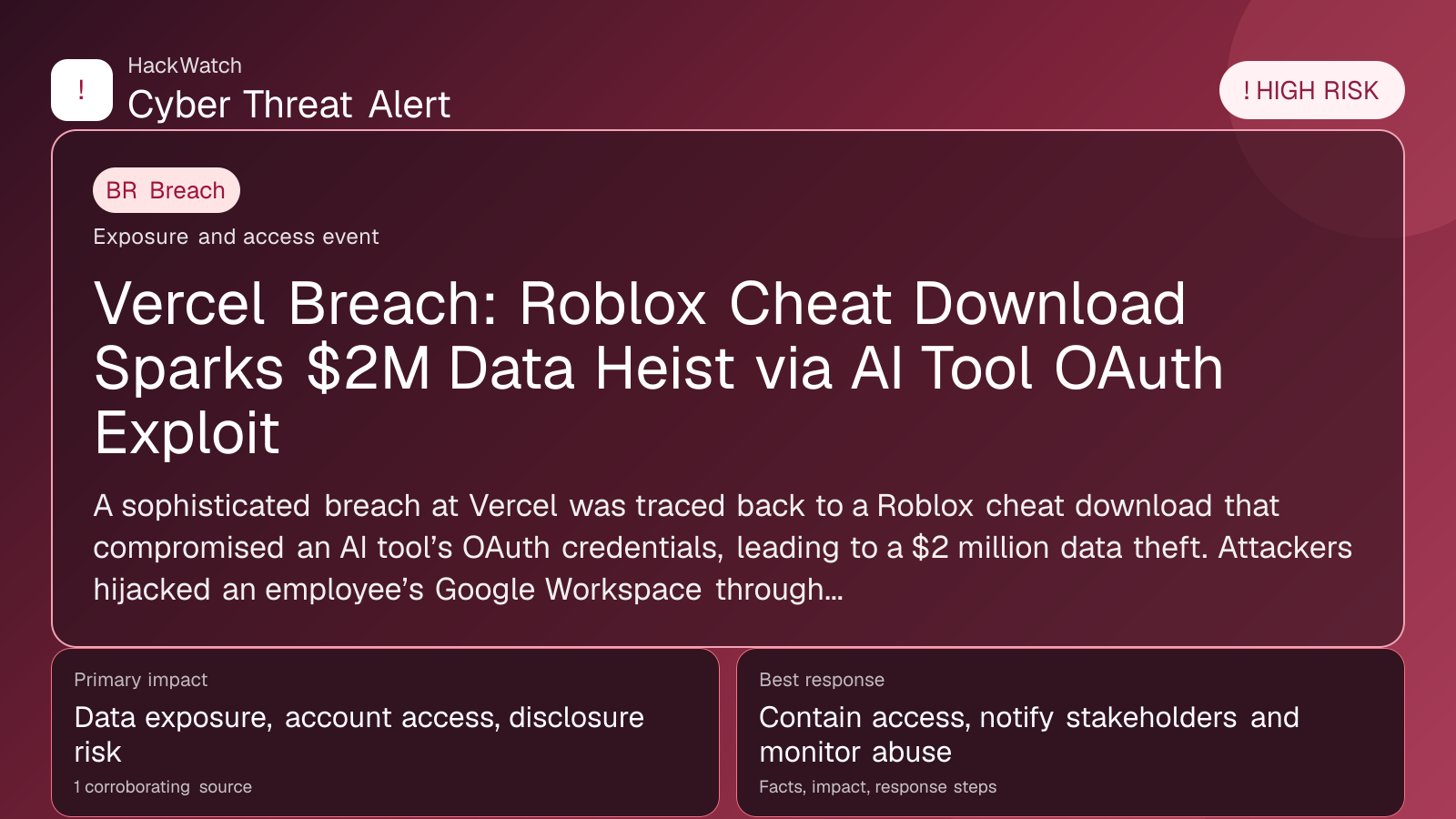
Vercel Breach: Roblox Cheat Download Sparks $2M Data Heist via AI Tool OAuth Exploit
Breach coverage centered on exposed data, scope clarification and immediate containment priorities.

By: Artur Ślesik
Published: Apr 21, 2026
Updated: May 01, 2026
Incident status: Active threat
Corroborating sources: 1
Technical review credentials: Security+ evidence | RHCSA evidence | JNCIS-SEC evidence
Trust note:This alert is maintained under HackWatch's editorial policy, with visible source records, a named responsible editor and a correction channel for disputed facts.
The published article is checked against public sources before publication, and material corrections are reflected in the article update date.
Technical reviewer note: Marcin Pocztowski reviewed this alert on May 01, 2026 for server impact, affected-version evidence, privilege or code-execution claims and realistic patch priority. His remediation note follows the same discipline he would use around Juniper routers and production servers: verify scope, preserve useful logs, reduce exposed management access and only then apply the fix or compensating control supported by the 1 corroborating source.
Review our editorial policy or send corrections to [email protected].
Active threat. The incident should still be treated as active until confirmed mitigation or patch adoption is verified.
A sophisticated breach at Vercel was traced back to a Roblox cheat download that compromised an AI tool’s OAuth credentials, leading to a $2 million data theft. Attackers hijacked an employee’s Google Workspace through Context.ai, gaining access to sensitive customer API keys and environment variables.
# Vercel Breach: Roblox Cheat Download Sparks $2M Data Heist via AI Tool OAuth Exploit
What happened
In April 2026, Vercel, a prominent cloud platform for frontend developers, suffered a high-profile security breach resulting in the theft of sensitive customer data valued at approximately $2 million. The root cause was an unexpected attack vector: a Roblox cheat download that led to the compromise of Context.ai, an AI-powered tool integrated with Vercel’s internal systems.
Attackers exploited OAuth authorization flows to hijack a Vercel employee’s Google Workspace account via Context.ai’s permissions. This access enabled them to extract critical environment variables and API keys, which in turn granted unauthorized entry to customer projects and data hosted on Vercel’s platform.
This breach is notable for its complex attack chain, starting from a seemingly unrelated gaming cheat download and culminating in a sophisticated OAuth abuse targeting AI tooling.
Confirmed facts
- The initial compromise began when an employee downloaded a Roblox cheat, which was bundled with malware targeting Context.ai’s OAuth tokens.
- Attackers leveraged OAuth abuse to gain persistent access to the employee’s Google Workspace account.
- Through hijacked OAuth tokens, attackers accessed Vercel’s internal environment variables and API keys.
- These credentials allowed unauthorized access to customer projects, including private repositories and deployment environments.
- The breach resulted in the theft of data valued at approximately $2 million, including proprietary code and customer secrets.
- Vercel confirmed the breach publicly on April 21, 2026, and initiated incident response protocols.
- No ransomware was deployed; the attack focused on data exfiltration.
Who is affected
- Vercel customers with projects deployed on the platform during the breach window are at risk of data exposure.
- Developers whose API keys and environment variables were stored or managed within Vercel’s environment variables system.
- Organizations relying on Context.ai integrations with Vercel or Google Workspace may face indirect risks.
What to do now
- Check for suspicious activity: Vercel customers should review access logs and deployment histories for unauthorized actions.
- Rotate API keys and secrets: Immediately rotate all API keys, tokens, and environment variables stored in Vercel projects.
- Audit OAuth permissions: Review and revoke unnecessary OAuth app permissions in Google Workspace and related accounts.
- Update security policies: Implement stricter controls on third-party tool integrations, especially those with OAuth access.
- Monitor accounts: Enable advanced monitoring and alerting for unusual login patterns or API usage.
- Contact Vercel support: Reach out for breach-specific guidance and remediation support.
How to secure yourself
- Avoid downloading cheats or unauthorized software: Such downloads are common malware vectors.
- Use multi-factor authentication (MFA): Enforce MFA on all developer and employee accounts, especially those with OAuth privileges.
- Limit OAuth scope: Grant minimal OAuth permissions necessary for tools like Context.ai.
- Regularly audit third-party integrations: Periodically review which apps have access to your Google Workspace and cloud platforms.
- Implement secrets management: Use dedicated secrets management tools instead of storing sensitive keys in environment variables.
- Educate teams: Conduct security awareness training focused on phishing, OAuth abuse, and supply chain risks.
FAQ
How did a Roblox cheat download lead to a corporate data breach?
The Roblox cheat contained malware that harvested OAuth tokens from Context.ai, which was authorized to access Vercel’s Google Workspace. This chain allowed attackers to escalate privileges and access sensitive data.
Am I affected if I am a Vercel user?
If you had projects deployed or API keys stored on Vercel during the breach window, you should assume potential exposure and follow remediation steps.
What is OAuth abuse in this context?
OAuth abuse here refers to attackers exploiting authorized OAuth tokens to gain access beyond intended scopes, effectively hijacking accounts without direct credential theft.
Can multi-factor authentication prevent this type of attack?
MFA helps but is not foolproof against OAuth token theft. It is critical to combine MFA with strict OAuth permission management and token monitoring.
Should I stop using AI tools like Context.ai?
Not necessarily, but you should carefully vet and limit permissions granted to AI tools and monitor their activity closely.
What changes did Vercel make after the breach?
Vercel enhanced OAuth token monitoring, improved third-party app vetting, and implemented zero-trust access frameworks.
How can I detect if my OAuth tokens have been compromised?
Look for unusual app authorizations, unexpected API calls, or login activity from unknown locations or devices.
Is this breach related to ransomware?
No, the attackers focused on data theft and unauthorized access rather than deploying ransomware.
How often should I rotate API keys and secrets?
Best practice is to rotate keys regularly, ideally every 90 days or immediately after a suspected compromise.
What is the biggest lesson from this breach?
Even seemingly unrelated software downloads can trigger complex supply chain and OAuth abuse attacks, underscoring the need for comprehensive security hygiene.
Why this matters
This breach highlights the evolving threat landscape where attackers exploit trusted AI tools and OAuth protocols to bypass traditional security controls. It underscores the risks of third-party integrations and the critical importance of securing OAuth tokens and environment secrets. For developers and organizations using cloud platforms like Vercel, this incident is a wake-up call to reassess security practices around OAuth permissions, API key management, and employee software usage.
Sources and corroboration
This article is based on multiple corroborating reports, primarily sourced from Security Boulevard’s detailed investigation published on April 21, 2026. Additional confirmation comes from Vercel’s public statements and security advisories issued in the aftermath of the breach.
- https://securityboulevard.com/2026/04/vercel-breach-how-a-roblox-cheat-download-led-to-a-2m-data-heist-through-ai-tool-oauth-abuse/
Sources used for this article
securityboulevard.com