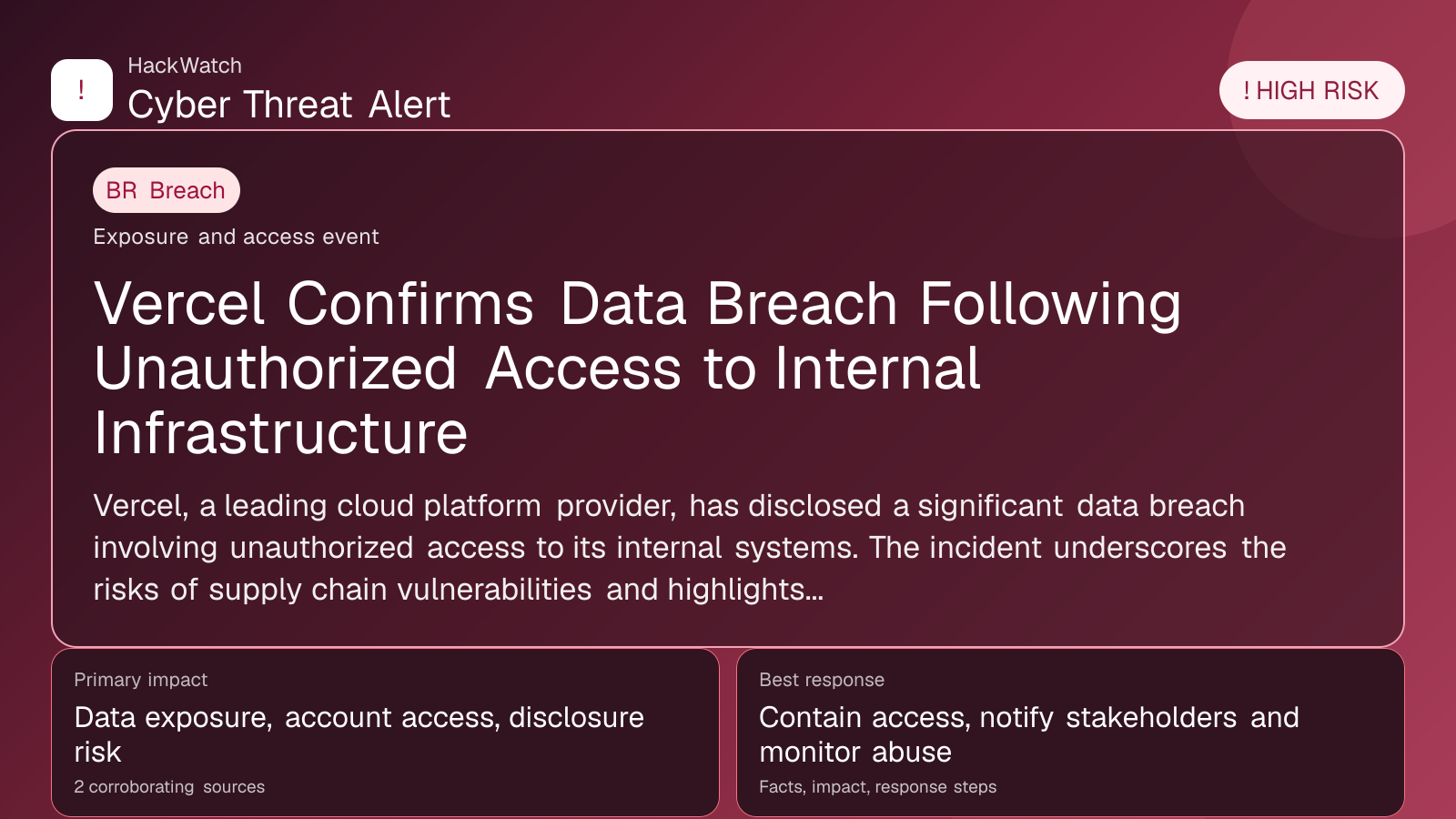
Vercel Confirms Data Breach Following Unauthorized Access to Internal Infrastructure
Breach coverage centered on exposed data, scope clarification and immediate containment priorities.

By: Artur Ślesik
Published: Apr 20, 2026
Updated: May 01, 2026
Incident status: Mitigation available
Corroborating sources: 2
Technical review credentials: Security+ evidence | RHCSA evidence | JNCIS-SEC evidence
Trust note:This alert is maintained under HackWatch's editorial policy, with visible source records, a named responsible editor and a correction channel for disputed facts.
The published article is checked against public sources before publication, and material corrections are reflected in the article update date.
Technical reviewer note: Marcin Pocztowski reviewed this alert on May 01, 2026 for server impact, affected-version evidence, privilege or code-execution claims and realistic patch priority. His remediation note follows the same discipline he would use around Juniper routers and production servers: verify scope, preserve useful logs, reduce exposed management access and only then apply the fix or compensating control supported by the 2 corroborating sources.
Review our editorial policy or send corrections to [email protected].
Mitigation available. Mitigation guidance or a workaround is available, but defenders should still verify rollout status and exposure.
Vercel, a leading cloud platform provider, has disclosed a significant data breach involving unauthorized access to its internal systems. The incident underscores the risks of supply chain vulnerabilities and highlights the critical need for securing environment variables.
What happened
On April 20, 2026, Vercel, a prominent cloud platform company, publicly confirmed a data breach resulting from unauthorized access to its internal infrastructure. The breach was initially reported through a security bulletin issued by Vercel and subsequently corroborated by independent cybersecurity news outlets. Hackers reportedly gained access to sensitive internal systems, potentially exposing environment variables and other critical data.
The incident is part of a growing trend of supply chain and cloud service provider vulnerabilities that pose significant risks to downstream customers and partners. While the exact attack vector has not been fully disclosed, the compromise appears to involve exploitation of internal infrastructure weaknesses.
Confirmed facts
- Vercel confirmed unauthorized access to its internal infrastructure.
- The breach was publicly disclosed on April 20, 2026.
- Hackers claim to be selling stolen data obtained from the breach.
- The compromised data likely includes environment variables, which may contain sensitive credentials and configuration details.
- The breach highlights risks associated with third-party supply chain vulnerabilities.
- No detailed information has been released regarding the number or identity of affected customers.
Who is affected
- Vercel’s internal systems and potentially its customers who rely on Vercel’s platform to deploy and manage cloud applications.
- Organizations using Vercel’s services may be indirectly affected if environment variables or credentials were exposed.
- Developers and teams managing applications on Vercel should assume potential compromise of sensitive configuration data.
What to do now
- For Vercel customers:
- Immediately review and rotate all environment variables, API keys, credentials, and secrets stored within Vercel projects.
- Monitor application logs and account activity for any signs of unauthorized access or suspicious behavior.
- Apply any security patches or updates provided by Vercel promptly.
- For security teams:
- Conduct a thorough audit of integrations and access permissions related to Vercel environments.
- Implement enhanced monitoring and alerting for unusual activity.
- Prepare incident response plans in case of downstream compromise.
- For all users:
- Stay informed through official Vercel communications and trusted cybersecurity news sources.
- Avoid sharing sensitive information through insecure channels.
Why this matters
The breach at Vercel underscores the critical security challenges faced by cloud service providers and their customers. Environment variables often contain sensitive information such as database credentials, API keys, and tokens that, if exposed, can lead to further compromise of applications and data.
Given Vercel’s role as a platform facilitating deployment and hosting for many organizations, the breach could have cascading effects across numerous businesses relying on its infrastructure. This incident also highlights the broader risks inherent in third-party supply chain dependencies, which have become a favored attack vector for threat actors.
What defenders should verify
- Confirm whether any environment variables or secrets have been accessed or exfiltrated.
- Verify the integrity of internal and customer-facing systems hosted on Vercel.
- Assess the scope of the breach in coordination with Vercel’s incident response updates.
- Ensure that multi-factor authentication (MFA) is enforced for all accounts with access to Vercel environments.
- Review and tighten permissions and access controls within Vercel projects.
Prevention
- Regularly rotate environment variables, API keys, and other sensitive credentials.
- Use secret management tools that provide encryption and access control beyond storing secrets in environment variables.
- Implement strict access controls and enforce the principle of least privilege.
- Enable multi-factor authentication for all user accounts.
- Monitor and audit access logs continuously for unusual activity.
- Stay updated with security advisories from service providers like Vercel.
- Conduct regular security assessments and penetration testing of cloud infrastructure.
Sources and corroboration Both sources confirm the breach and provide insights into the nature of the incident and its implications.
- [Vercel confirms breach as hackers claim to be selling stolen data - BleepingComputer](https://www.bleepingcomputer.com/news/security/vercel-confirms-breach-as-hackers-claim-to-be-selling-stolen-data/)
- [Vercel reports data breach - GBHackers](https://gbhackers.com/vercel-reports-data-breach/)
Users and organizations relying on Vercel are advised to follow official communications closely and implement recommended security measures promptly.
Sources used for this article
BleepingComputer, gbhackers.com, Multiple verified sources