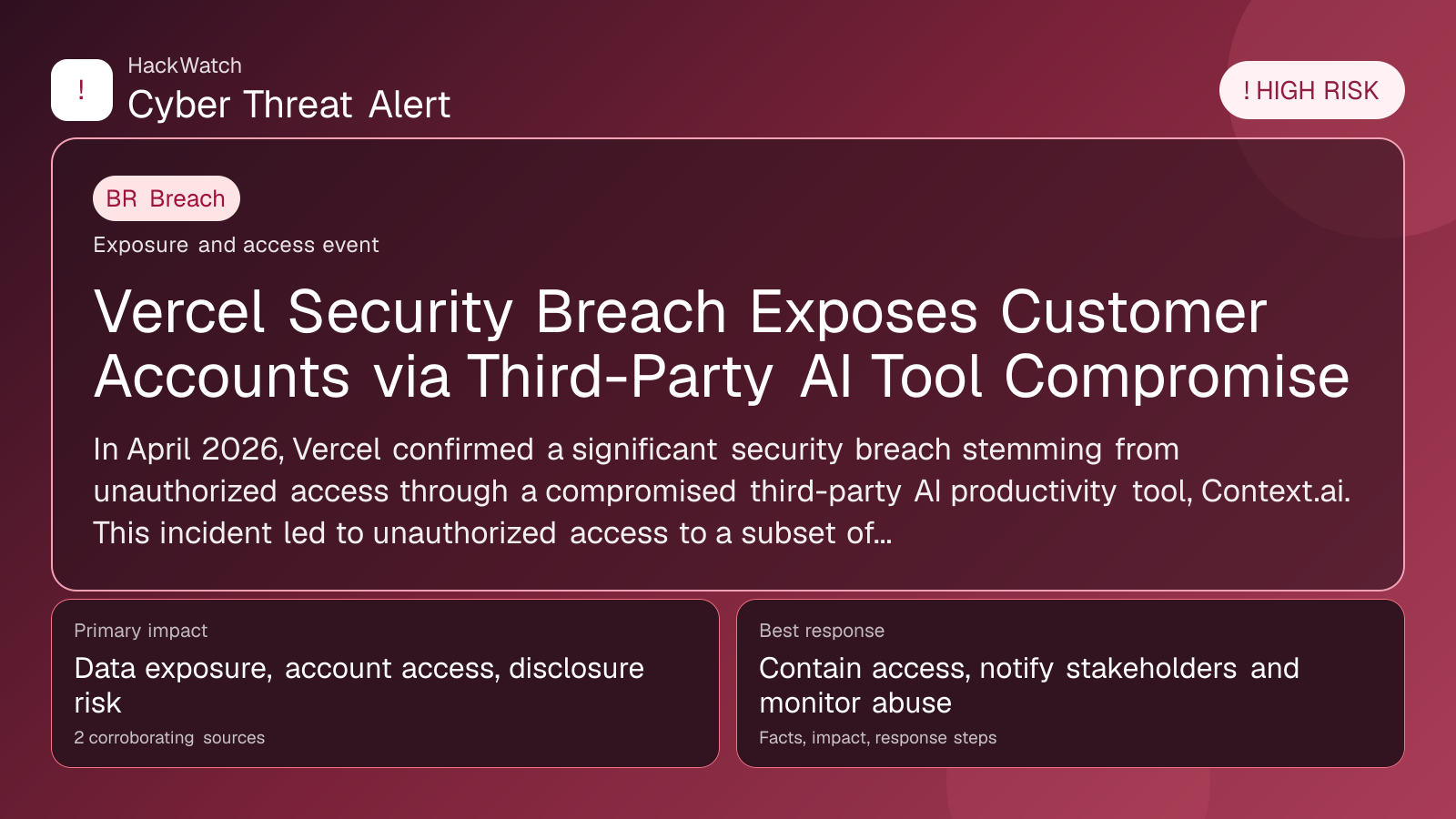
Vercel Security Breach Exposes Customer Accounts via Third-Party AI Tool Compromise
Breach coverage centered on exposed data, scope clarification and immediate containment priorities.

By: Artur Ślesik
Published: Apr 23, 2026
Updated: May 01, 2026
Incident status: Resolved or patched
Corroborating sources: 2
Technical review credentials: Security+ evidence | RHCSA evidence | JNCIS-SEC evidence
Trust note:This alert is maintained under HackWatch's editorial policy, with visible source records, a named responsible editor and a correction channel for disputed facts.
The published article is checked against public sources before publication, and material corrections are reflected in the article update date.
Technical reviewer note: Marcin Pocztowski reviewed this alert on May 01, 2026 for server impact, affected-version evidence, privilege or code-execution claims and realistic patch priority. His remediation note follows the same discipline he would use around Juniper routers and production servers: verify scope, preserve useful logs, reduce exposed management access and only then apply the fix or compensating control supported by the 2 corroborating sources.
Review our editorial policy or send corrections to [email protected].
Resolved or patched. Source coverage indicates that a fix or formal remediation has been published. Verify that updates are applied in your environment.
In April 2026, Vercel confirmed a significant security breach stemming from unauthorized access through a compromised third-party AI productivity tool, Context.ai. This incident led to unauthorized access to a subset of customer accounts.
# Vercel Security Breach Exposes Customer Accounts via Third-Party AI Tool Compromise
What happened
In April 2026, Vercel, a leading web infrastructure and deployment platform, disclosed a serious security breach involving unauthorized access to its internal systems. The attack was traced back to a compromise of Context.ai, a third-party AI productivity tool used by one of Vercel's employees. This initial breach enabled attackers to gain a foothold within Vercel's network, leading to unauthorized access to a subset of customer accounts.
The incident was first publicly acknowledged on April 19, 2026, through a Vercel security bulletin. Subsequent investigations revealed that the attacker exploited the third-party tool's compromised credentials or vulnerabilities to infiltrate Vercel’s internal environment. This breach highlights the growing risk posed by supply chain attacks, especially those involving AI tools integrated into corporate workflows.
Confirmed facts
- The breach originated from a compromise of Context.ai, an AI productivity tool used internally at Vercel.
- Attackers gained unauthorized access to Vercel’s internal systems through this third-party vector.
- A limited set of customer accounts were accessed by the attacker; however, Vercel has not confirmed any data exfiltration extent.
- Vercel promptly initiated an internal investigation and engaged cybersecurity experts to contain the breach.
- Password resets and multi-factor authentication (MFA) enforcement were rolled out for affected users.
- No evidence currently suggests that Vercel’s core infrastructure or production environments were compromised.
Who is affected
The breach impacts a subset of Vercel customers whose accounts were accessed during the incident. Customers using Context.ai or related integrations may face increased risk, especially if they share credentials or use weak authentication methods.
Developers and organizations relying on Vercel for web deployment should verify their account security status immediately. While Vercel has not disclosed the exact number of compromised accounts, users with elevated privileges or sensitive project access are at higher risk.
What to do now
- Check your Vercel account for unusual activity: Review deployment logs, access history, and any unfamiliar changes.
- Change your Vercel password immediately: Use a strong, unique password that you do not reuse elsewhere.
- Enable Multi-Factor Authentication (MFA): If not already enabled, activate MFA to add an extra layer of security.
- Audit third-party integrations: Review and revoke access for any unnecessary or suspicious third-party apps connected to your Vercel account.
- Monitor for phishing attempts: Attackers may use stolen information to craft targeted phishing emails.
- Stay updated: Follow official Vercel communications for ongoing updates and remediation steps.
How to secure yourself
- Use unique, complex passwords: Avoid password reuse across platforms.
- Implement MFA everywhere: Especially on developer platforms like Vercel.
- Limit third-party tool access: Only authorize trusted applications and regularly audit permissions.
- Keep software up-to-date: Ensure your development environment and tools are patched against known vulnerabilities.
- Educate your team: Train employees on recognizing phishing and social engineering tactics.
- Use dedicated secrets management: Avoid storing credentials in plaintext or shared documents.
FAQ
Was my Vercel account compromised in this breach?
If you have not received a direct notification from Vercel, your account may not be affected. However, it is prudent to review your account activity and update your credentials.
How did the attackers gain access to Vercel’s systems?
The attackers exploited a compromised third-party AI productivity tool, Context.ai, which was used by a Vercel employee, allowing them to infiltrate Vercel’s internal environment.
What data was exposed in the breach?
Vercel has not publicly confirmed the full extent of data accessed. The breach involved unauthorized access to customer accounts, but no detailed data exfiltration disclosures have been made.
What steps has Vercel taken to contain the breach?
Vercel initiated an internal investigation, enforced password resets, implemented MFA for affected accounts, and enhanced monitoring and security controls.
Should I stop using Context.ai or other AI productivity tools?
Not necessarily, but you should carefully evaluate the security posture of any third-party tools you use and limit their access to sensitive systems.
How can I protect my developer accounts from similar breaches?
Use strong, unique passwords, enable MFA, audit third-party app permissions regularly, and stay informed about emerging threats.
Does Vercel offer compensation or support for affected customers?
As of now, Vercel has not announced compensation but has committed to supporting affected customers through remediation and security improvements.
What changed in 2026 regarding supply chain attacks?
2026 saw a rise in attacks targeting third-party tools and services integrated into development workflows, prompting increased industry focus on zero-trust and enhanced third-party risk management.
Why this matters
This breach highlights the critical risks posed by third-party integrations in modern software development environments. As platforms like Vercel become central to web infrastructure, attackers increasingly target indirect vectors such as AI productivity tools to bypass traditional defenses.
For developers and organizations, this incident serves as a stark reminder to rigorously manage third-party access and enforce robust security measures. Failure to do so can result in unauthorized access, potential data loss, and disruption of critical services.
Sources and corroboration com/2026/04/vercel-finds-more-compromised-accounts.html) and [CybersecurityNews.com](https://cybersecuritynews.com/vercel-confirms-security-breach/), ensuring a comprehensive and accurate depiction of the Vercel breach incident.
---
Stay informed and proactive to safeguard your digital infrastructure in an evolving threat landscape.
Sources used for this article
The Hacker News, cybersecuritynews.com, Multiple verified sources