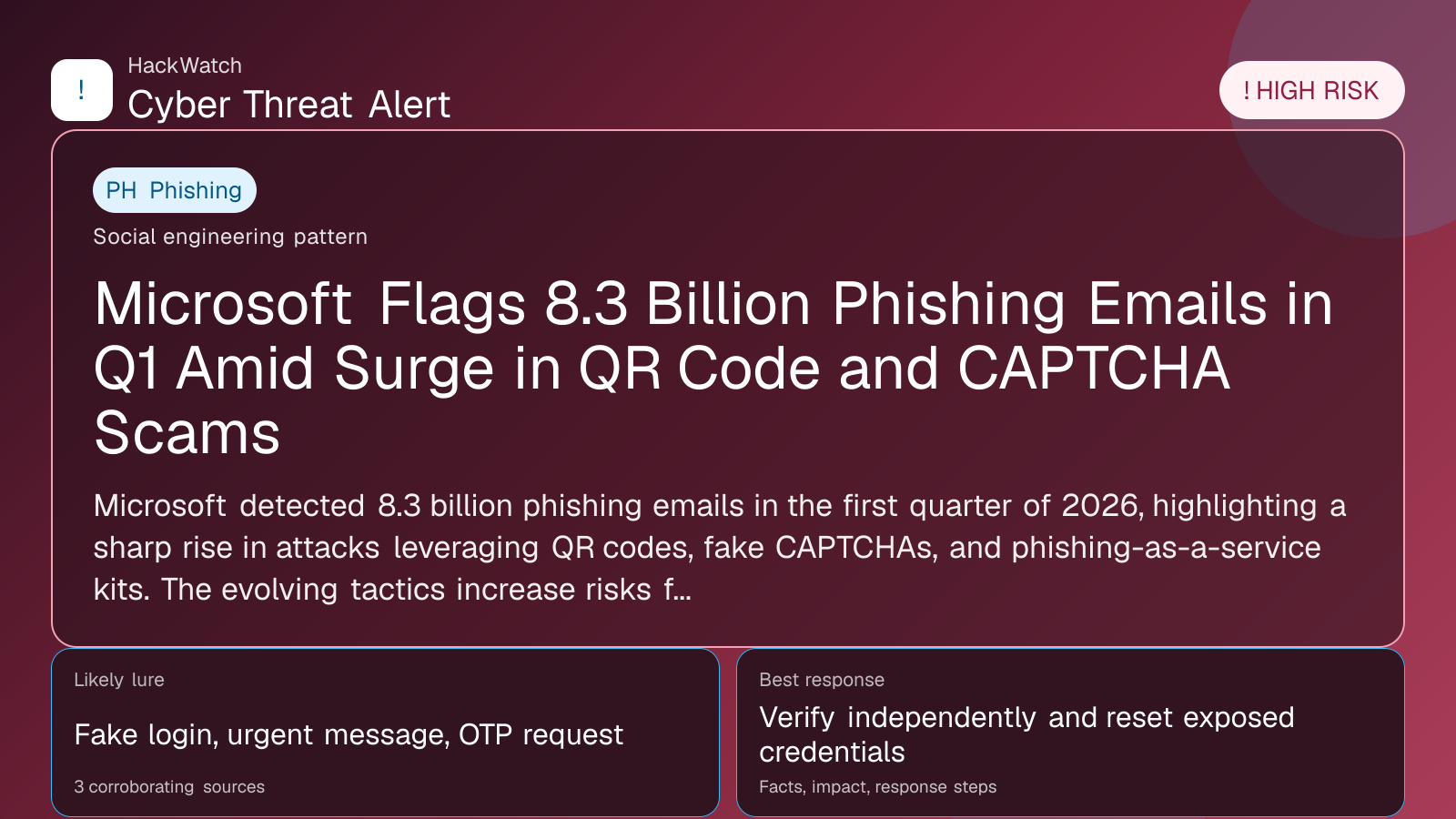
Microsoft Flags 8.3 Billion Phishing Emails in Q1 Amid Surge in QR Code and CAPTCHA Scams
Verification-lure coverage focused on fake messages, cloned pages and account defense steps.

By: Artur Ślesik
Published: May 01, 2026
Incident status: Active threat
Corroborating sources: 3
Technical review credentials: Security+ evidence | RHCSA evidence | JNCIS-SEC evidence
Trust note:This alert is maintained under HackWatch's editorial policy, with visible source records, a named responsible editor and a correction channel for disputed facts.
The published article is checked against public sources before publication, and material corrections are reflected in the article update date.
Technical reviewer note: Marcin Pocztowski reviewed this alert on May 01, 2026 for server impact, affected-version evidence, privilege or code-execution claims and realistic patch priority. His remediation note follows the same discipline he would use around Juniper routers and production servers: verify scope, preserve useful logs, reduce exposed management access and only then apply the fix or compensating control supported by the 3 corroborating sources.
Review our editorial policy or send corrections to [email protected].
Active threat. The incident should still be treated as active until confirmed mitigation or patch adoption is verified.
Microsoft detected 8.3 billion phishing emails in the first quarter of 2026, highlighting a sharp rise in attacks leveraging QR codes, fake CAPTCHAs, and phishing-as-a-service kits. The evolving tactics increase risks for users and organizations worldwide.
GLOBAL, May 1, 2026, 16:02 UTC
- Microsoft identified 8.3 billion phishing emails in Q1 2026.
- Attackers increasingly use QR codes and fake CAPTCHAs to bypass filters.
- Phishing-as-a-service (PhaaS) kits and file-based payloads are on the rise.
Microsoft flagged 8.3 billion phishing emails during the first quarter of 2026, as cybercriminals adopted new evasion techniques including QR codes and fake CAPTCHA challenges, according to a report by TechRepublic. This marks a significant escalation in phishing volume and sophistication compared to previous quarters.
Phishing remains a primary vector for credential theft, financial fraud, and malware delivery. The surge in QR code usage allows attackers to embed malicious links that evade traditional URL scanning tools. Similarly, fake CAPTCHAs trick users into interacting with fraudulent content, increasing the likelihood of successful compromise.
The rise of phishing-as-a-service (PhaaS) kits lowers the barrier for threat actors, enabling less skilled criminals to launch complex campaigns. These kits often bundle file-based payloads, which can install malware directly on victims’ devices.
Microsoft’s detection efforts highlight the dynamic nature of phishing threats. The company’s security teams have adapted filtering algorithms and threat intelligence feeds to counter these evolving tactics. However, the sheer volume of attacks underscores the persistent challenge for email providers and security teams.
Users and organizations should be vigilant about unexpected emails requesting interaction with QR codes or CAPTCHA prompts. Such requests are uncommon in legitimate communications and should prompt verification through direct channels.
Multi-factor authentication (MFA) remains a critical defense to mitigate account takeover risks, especially when credentials are exposed through phishing. Microsoft and other providers recommend enabling MFA wherever possible.
The increase in file-based payloads also calls for robust endpoint protection and updated antivirus solutions. Regular patching and user education on phishing indicators can reduce exposure.
Phishing campaigns exploiting QR codes are particularly concerning due to their ability to bypass URL filters and direct users to malicious sites on mobile devices. Organizations should consider deploying QR code scanners that verify link safety before users scan codes.
Microsoft’s findings align with broader industry reports showing phishing volumes rising globally. The integration of novel evasion techniques signals that threat actors continue to innovate rapidly.
Risk remains high as phishing attacks grow in scale and complexity. Security teams must balance automated detection with user awareness programs to reduce successful compromises.
Looking ahead to 2026, the phishing landscape is expected to evolve further with increased use of AI-generated content and social engineering tactics. Continuous monitoring and adaptive defenses will be essential.
What to Do Now
- Avoid scanning QR codes from unsolicited emails or messages.
- Do not complete CAPTCHA challenges received unexpectedly via email.
- Verify suspicious requests by contacting the sender through official channels.
- Enable multi-factor authentication on all critical accounts.
- Keep security software and systems updated.
How to Secure Yourself
- Use email filtering tools that detect phishing patterns.
- Train employees and users on the latest phishing tactics.
- Implement endpoint detection and response solutions.
- Regularly review access logs for unusual activity.
2026 Update
Phishing attacks will likely incorporate more AI-driven personalization and automated social engineering. Organizations should prepare for these shifts by investing in advanced threat intelligence and adaptive security frameworks.
For more details, see the full report at TechRepublic: https://www.techrepublic.com/article/news-microsoft-phishing-emails-qr-codes-captcha-phaas/
Sources used for this article
scmagazine.com, cybersecuritydive.com, techrepublic.com